
Understanding Partial Hospitalization Schizophrenia NJ
When Partial Hospitalization for Schizophrenia in NJ Feels Out of Reach

If you’re exploring partial hospitalization schizophrenia NJ options, here’s a quick answer: PHP is the most intensive outpatient level of care, but it’s not the only option. There are several effective, lower-cost alternatives that may fit your situation better.
Quick overview of care options for schizophrenia in NJ:
| Level of Care | Hours Per Week | Best For |
|---|---|---|
| Partial Hospitalization (PHP) | 25-30 hrs | Acute symptoms, step-down from inpatient |
| Intensive Outpatient (IOP) | 9-12 hrs | Stable but needing structure |
| Standard Outpatient | 1-2 hrs | Maintenance and monitoring |
| Telehealth Services | Flexible | Remote access, lower cost |
| Case Management | Varies | Resource navigation, coordination |
Managing schizophrenia is hard. Paying for treatment shouldn’t make it harder.
PHP programs in New Jersey typically run 5-6 hours a day, five days a week. That level of structure is genuinely life-changing for many people. But it also comes with a significant time and financial commitment that isn’t realistic for everyone.
The good news? Schizophrenia affects roughly 1% of the population, and the mental health system in New Jersey has evolved to offer multiple pathways to stability — not just one.
This article walks you through five real alternatives to PHP that can still deliver meaningful support, symptom management, and long-term recovery, often at a fraction of the cost.
Understanding Partial Hospitalization Schizophrenia NJ and Its Costs
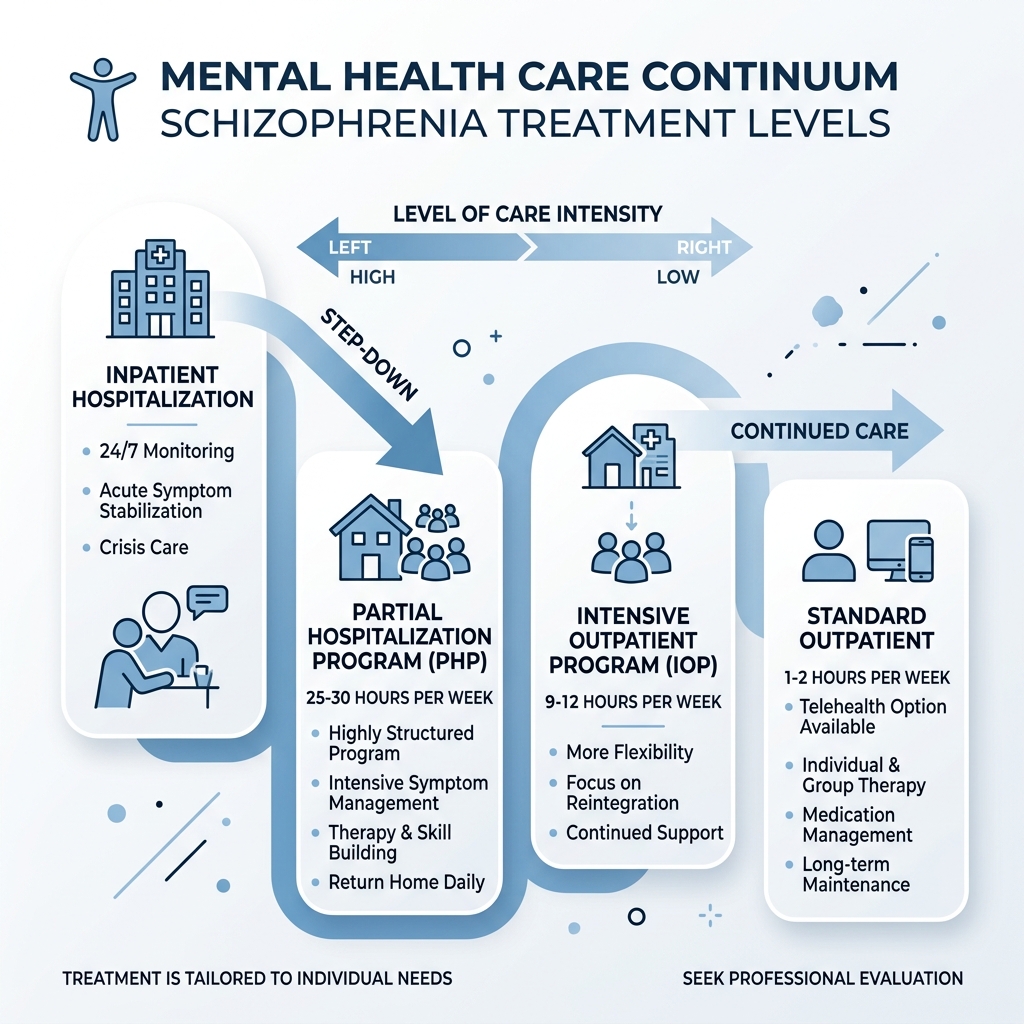
Before we dive into the alternatives, we need to understand exactly what a Partial Hospitalization Program (PHP) is. In New Jersey mental health, PHP is often the “Goldilocks” of treatment—more intensive than a weekly therapy session but less restrictive than a 24/7 hospital stay.
A partial hospitalization schizophrenia NJ program typically requires a commitment of 5 to 6 hours daily, five days a week. It is designed for stabilization. When symptoms like hallucinations or severe social withdrawal start escalating, it can feel like life is shrinking fast. Work becomes overwhelming, and sleep often falls apart. PHP steps in to provide a structured daytime environment where you receive professional guidance while still returning home to your own bed at night.
The primary goal is psychiatric oversight and functional improvement. You aren’t just sitting in a room; you are participating in a multidisciplinary treatment approach that includes individual therapy, group counseling, and medical monitoring. However, because of the high number of clinical hours and the involvement of psychiatrists and specialized nurses, the partial hospitalization program cost can be substantial if insurance coverage is limited.
For many, this level of care serves as a vital bridge. It helps people transition from inpatient units back into the community or acts as an “emergency brake” to prevent a full hospitalization. You can find more info about the partial hospitalization program to see if the intensity matches your current clinical needs.
Who is Eligible for Partial Hospitalization Schizophrenia NJ?
Eligibility for a PHP in New Jersey isn’t just about having a diagnosis; it’s about the intensity of your symptoms. Generally, these programs are designed for adults (age 18+) who are experiencing acute symptoms but are stable enough not to require 24-hour supervision for safety.
According to National Institute of Mental Health research on schizophrenia, symptoms usually fall into three clusters: positive (like hallucinations), negative (like loss of motivation), and cognitive (like trouble focusing). To be eligible for PHP, a clinician usually looks for:
- A primary diagnosis of Schizophrenia or Schizoaffective Disorder.
- A need for daily medication monitoring.
- Difficulty functioning in daily life (work, school, or self-care) due to symptoms.
- Sufficient stability to remain safe at home during evening and weekend hours.
Typical Daily Schedule in a NJ PHP
What does a day actually look like? Most NJ programs run from approximately 9:00 am to 3:30 pm, Monday through Friday. It is a full-time job focused entirely on your wellness.
A typical day might include:
- Morning Check-in: A group session to set goals for the day.
- Psychotherapy Groups: Two sessions daily focusing on processing stressors and identifying challenges.
- Medication Education: Learning about side effects and the importance of compliance.
- Skill-Building: Practicing social cues or stress management techniques.
- Individual Therapy: One-on-one time with a counselor to dig deeper into personal goals.
The partial hospitalization timeline usually lasts between 6 to 8 weeks, though this varies based on individual progress.
5 Cost-Effective Alternatives to PHP for Schizophrenia
While PHP is excellent, it isn’t the only way to get high-quality care. If the cost or the 30-hour-a-week commitment is a barrier, there are other mental health programs in New Jersey that offer flexibility and budget-friendly support without sacrificing clinical integrity.
1. Intensive Outpatient Programs (IOP)
If PHP is a “full-time” commitment, an Intensive Outpatient Program (IOP) is the “part-time” equivalent. This is often the most popular alternative to partial hospitalization schizophrenia NJ.
In an IOP, you typically attend therapy for 9–12 hours per week, spread across 3 to 5 days. Each session usually lasts about 3 hours. This allows you to maintain a part-time job, attend school, or manage family responsibilities while still receiving significant clinical support. It serves as a perfect “middle ground” for those who are stable but still need a structured environment to prevent relapse.
You can explore more info about partial hospitalization vs IOP to determine which level of intensity fits your current symptoms. For those specifically dealing with psychosis, there are IOPs for schizophrenia in NJ that tailor their groups to social skills training and CBT for psychosis.
2. Standard Outpatient Therapy with Medication Management
For many individuals living with schizophrenia, long-term success isn’t about “intensity”—it’s about consistency. Standard outpatient care involves weekly or bi-weekly sessions with a therapist and regular appointments with a psychiatrist.
This is significantly cheaper than PHP because you are paying for one hour of service rather than six. The key to making this work for schizophrenia is ensuring the therapy is specialized. Cognitive Behavioral Therapy for Psychosis (CBTp) is an evidence-based approach that helps individuals test the reality of their perceptions and manage distressing voices. When combined with rigorous medication management, this “low-intensity” approach can be highly effective for maintenance. Read more about schizophrenia treatment options that focus on these outpatient modalities.
3. Virtual/Telehealth Mental Health Services
The rise of telehealth has been a game-changer for cost-effective care in New Jersey. Virtual programs eliminate the need for transportation—a major hidden cost of PHP—and allow you to receive treatment from the comfort of your home.
Telehealth isn’t just for one-on-one talk therapy; many providers now offer virtual group sessions and intensive programs. This is particularly helpful for those in more rural parts of Sussex or Warren County who might otherwise struggle to commute to a physical facility daily. You can find out more about virtual mental health programs that offer the same evidence-based therapies as in-person clinics but with much greater scheduling flexibility.
4. Specialized Skill-Building Group Therapy
Sometimes, the most expensive part of treatment is the “hospital” setting itself. A cheaper alternative is to seek out specialized skill-building groups. These groups focus on “negative symptoms” of schizophrenia, such as social withdrawal or lack of motivation.
By participating in group therapy options, you benefit from peer support and lower costs per session. These groups often use “Social Skills Training” (SST) to help participants practice eye contact, conversational flow, and emotional expression in a safe, non-judgmental environment. It’s a practical way to rebuild a life that may have been disrupted by a psychotic episode.
5. Individualized Case Management & Resource Navigation
Schizophrenia treatment often fails not because of the therapy, but because of “life” stressors like housing instability or lack of insurance. Case management is a highly cost-effective addition to (or alternative for) intensive clinical care.
A case manager doesn’t just provide therapy; they help you navigate the complex New Jersey healthcare system. They can assist with Medicaid applications, connect you with “stigma-free” community initiatives, and coordinate care between your primary doctor and your psychiatrist. This comprehensive mental health care ensures that you aren’t just treating symptoms, but also building a stable foundation for recovery.
Comparing Levels of Care: PHP vs. IOP vs. Inpatient
Choosing the right level of care is about balancing safety with independence. While inpatient care offers 24/7 monitoring, it is also the most expensive and restrictive. PHP and IOP offer “real-world application,” meaning you can practice the skills you learn in therapy that very same evening at home.
| Feature | Inpatient | PHP | IOP |
|---|---|---|---|
| Hours per Week | 168 (24/7) | 25-30 | 9-12 |
| Average Duration | 3-10 days | 6-8 weeks | 8-12 weeks |
| Cost Level | Very High | High | Moderate |
| Supervision | Constant | Daytime | Scheduled |
If you or a loved one are currently in a crisis, inpatient schizophrenia treatments in NJ may be necessary for immediate safety. However, for long-term management, the outpatient options are far more sustainable.
Transitioning from Partial Hospitalization Schizophrenia NJ to IOP
Recovery isn’t a straight line; it’s a series of steps. Most people don’t go from a 30-hour-a-week PHP directly to nothing. A successful transition usually involves “stepping down” to an IOP.
This step-down approach is a critical part of relapse prevention. It allows you to slowly test your independence. If you’ve spent 6 weeks in a partial hospitalization schizophrenia NJ program, moving to a 12-hour-a-week IOP for the next two months helps solidify the coping skills you’ve learned. You can learn more about how long partial hospitalization lasts and how to plan your transition to ensure you don’t end up back in the hospital.
Targeting Positive, Negative, and Cognitive Symptoms
Regardless of the cost or the level of care, effective treatment must target all three symptom clusters of schizophrenia.
- Positive Symptoms: Managed primarily through medication and CBTp to reduce the distress of hallucinations.
- Negative Symptoms: Addressed through group therapy and social skills training to combat isolation.
- Cognitive Symptoms: Supported through executive functioning exercises and structured routines.
Using partial hospitalization for mental health as a starting point is often effective because it addresses all three simultaneously with a multidisciplinary team.
Navigating Insurance and Admissions in New Jersey
One of the biggest hurdles to accessing partial hospitalization schizophrenia NJ is the paperwork. However, New Jersey has relatively strong mental health parity laws. Most major insurance providers (PPO and POS plans) cover PHP and IOP, though they often require “medical necessity” documentation from a clinician.
When you call for an intake assessment, a clinical screening will determine which level of care is appropriate for you. If you don’t meet the criteria for PHP, or if it’s too expensive, the admissions team should help you find a more affordable IOP or outpatient alternative. Understanding the partial hospitalization program and how it fits into your insurance plan is the first step toward getting the help you need.
Frequently Asked Questions about Partial Hospitalization Schizophrenia NJ
How long does a typical schizophrenia PHP last in NJ?
Most programs are designed for short-term stabilization, typically lasting 6 to 8 weeks. The goal is to get you stable enough to transition to a lower level of care, like an IOP, where you can continue your recovery with more independence.
Does insurance cover the full cost of PHP in New Jersey?
While many PPO/POS plans cover a significant portion, “full” coverage depends on your specific plan’s deductible and out-of-pocket maximums. Most facilities will perform a free insurance verification before you admit to help you understand your potential costs.
Can I transition directly from inpatient care to a cheaper alternative?
Yes. In fact, many hospitals prefer a “step-down” protocol. If a patient is stable, they may move directly from inpatient to an IOP or even standard outpatient care with intensive case management, provided there is a solid safety plan in place.
Conclusion
At True Life Care Mental Health, we believe that every individual deserves a path to wellness that fits their life and their budget. Whether you need the intensive structure of partial hospitalization schizophrenia NJ or the flexible, cost-effective support of an Intensive Outpatient Program, we are here to help.
Our holistic approach combines expert psychiatric care with personalized treatment plans, empowering you to manage symptoms and reclaim your independence. Recovery from schizophrenia is possible, and it starts with finding the right level of support.
If you’re ready to take the next step, we encourage you to read an essential guide to schizophrenia treatment in NJ or reach out to our team today to discuss which program is the best fit for your journey.