
5 Effective Depression Treatment in Monmouth County NJ
Depression Is More Than Sadness — And Help Is Available Right Here in Monmouth County
 Depression Treatment in Monmouth County NJ is more accessible than many people realize — and finding the right support can genuinely change your life.
If you’re looking for a quick overview of your options, here’s where to start:
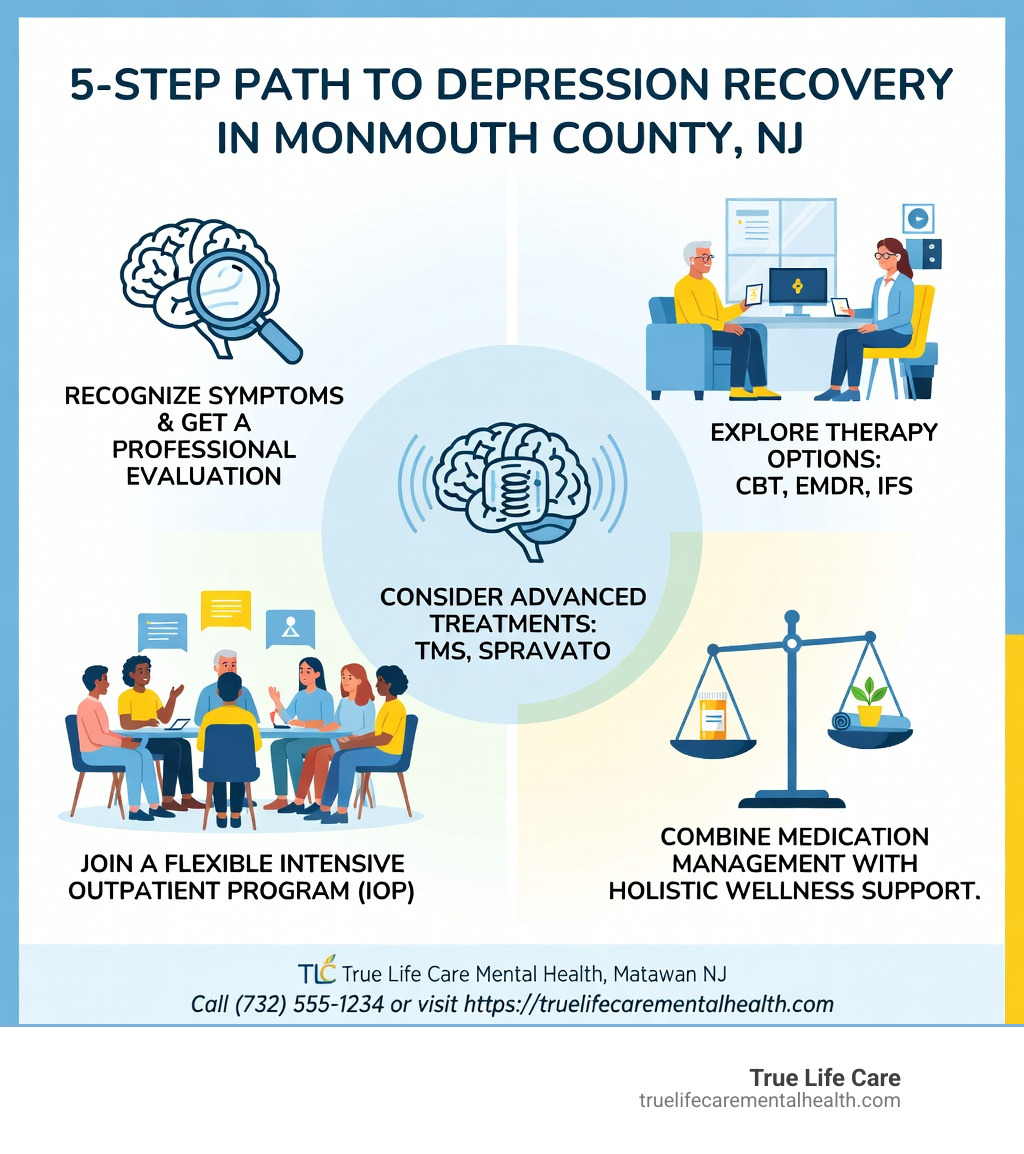
- Get a professional evaluation — A licensed clinician can confirm whether what you’re experiencing is clinical depression and recommend the right level of care.
- Try evidence-based therapy — CBT, EMDR, IFS, and psychodynamic therapy are all proven to help.
- Ask about advanced treatments — If antidepressants haven’t worked, TMS or Spravato may be right for you.
- Consider an Intensive Outpatient Program (IOP) — Flexible, structured care that fits around your life.
- Combine therapy with medication management — Often the most effective approach for lasting recovery.
True Life Care Mental Health in Matawan, NJ offers all of the above. If you’re ready to talk, reach out to their team today.
Depression is not just a rough patch. It is a persistent, often debilitating condition that affects how you think, sleep, eat, and function every single day. More than 1 in 5 adults in Monmouth County live with a diagnosable mental health condition — yet many suffer in silence, unsure where to turn.
The good news? Depression is treatable. With the right combination of therapy, support, and — when needed — medication or advanced interventions, recovery is absolutely possible.
Whether you’re just starting to wonder if something is wrong, or you’ve already tried treatments that haven’t worked, this guide walks you through five practical, effective steps for finding depression treatment in Monmouth County, NJ.
Simple guide to Depression Treatment in Monmouth County NJ:
- Mental health services in Monmouth County, New Jersey
- Understanding different types of depression
- Matawan NJ depression treatment options
1. Recognize the Signs and Seek a Professional Evaluation
The first step toward healing is acknowledging that what you are feeling is real and valid. Many of us in Monmouth County lead busy lives, and it is easy to dismiss persistent low moods as “just stress” or a “bad week.” However, clinical depression—often referred to as Major Depressive Disorder (MDD)—is a medical condition that requires professional attention.

Clinical Depression vs. Normal Sadness
Sadness is a natural human emotion that usually passes with time or a change in circumstances. Depression, on the other hand, is a heavy, persistent cloud. We often see clients who describe it as a “constant weight” or a “loss of color” in their world. Common symptoms include:
- Persistent Sadness or Hopelessness: Feeling “empty” or tearful nearly every day for at least two weeks.
- Anhedonia: A significant loss of interest in hobbies, social outings, or activities you once loved.
- Sleep Disturbances: Either struggling with insomnia or wanting to sleep all day.
- Appetite Changes: Significant weight loss or gain unrelated to dieting.
- Physical Fatigue: Feeling like your limbs are heavy or having no energy for basic tasks.
- Cognitive Issues: Difficulty concentrating, making decisions, or remembering details.
If you are experiencing these symptoms, you aren’t alone. Statistics show that roughly 628 people die by suicide every year in New Jersey—a heartbreaking reminder that when people are really down, they may occasionally wish they weren’t here. This is a serious sign that it is time to seek help.
What to Expect in Your First Session
At our Matawan, NJ facility, we aim to make your first visit as comfortable as possible. You’ll undergo a thorough evaluation where we discuss your history, current symptoms, and life circumstances. We use evidence-based screenings to understand the different types of depression you might be facing, whether it’s MDD, persistent depressive disorder, or something else. This evaluation is the blueprint for your personalized recovery plan.
2. Explore Evidence-Based Therapy Modalities
Once we understand your unique needs, we move into the “work” of healing. Therapy isn’t just about talking; it’s about gaining tools to rewire how your brain processes emotions and stress. We utilize several proven modalities to help our neighbors in Monmouth County find relief.
Proven Therapeutic Approaches
- Cognitive Behavioral Therapy (CBT): This is the gold standard for depression. It helps you identify negative thought patterns—like “I’m a failure” or “nothing will ever get better”—and replace them with more balanced, realistic perspectives.
- Eye Movement Desensitization and Reprocessing (EMDR): Often used for trauma, EMDR can be incredibly effective if your depression is rooted in past painful experiences. It helps the brain “reprocess” stuck memories so they no longer trigger intense emotional pain.
- Internal Family Systems (IFS): This approach looks at the different “parts” of your personality. It helps you understand the part of you that feels depressed and the part that might be trying to protect you, leading to deep internal harmony.
- Psychodynamic Therapy: This involves exploring unconscious patterns and early life experiences to understand how they influence your current mood and behavior.
By engaging in these sessions, you can learn how therapy helps you heal by building long-term coping strategies.
Finding Specialized Depression Treatment in Monmouth County NJ
We recognize that depression doesn’t look the same for everyone. Our programs are designed to be inclusive and specialized:
- Women’s Mental Health: Addressing unique life transitions, hormonal influences, and societal pressures that affect women.
- Young Adults: Navigating the specific challenges of depression in young adults, such as academic stress, social media pressure, and career beginnings.
- Co-occurring Disorders: Many people struggle with both depression and anxiety or substance use. We provide integrated care that treats the whole person, not just one symptom.
3. Consider Advanced Options for Treatment-Resistant Depression (TRD)
Standard treatments like talk therapy and basic antidepressants work for many, but they don’t work for everyone. In fact, about one-third of people with major depression do not respond to typical medications. If you’ve tried two or more antidepressants without success, you may be experiencing signs of treatment-resistant depression (TRD).
For those who feel like they’ve tried everything, innovative medical treatments offer a new horizon of hope.
| Feature | TMS (Transcranial Magnetic Stimulation) | Spravato (Esketamine) |
|---|---|---|
| Method | Non-invasive magnetic pulses | FDA-approved nasal spray |
| Target | Dorsolateral prefrontal cortex | Glutamate system |
| Anesthesia | None required | None (Medical monitoring required) |
| Recovery | No downtime; drive yourself home | Requires a ride home |
| Best For | Long-term brain “rewiring” | Rapid symptom relief (often within 24h) |
Accessing Innovative Depression Treatment in Monmouth County NJ
We offer guidance and referrals for these advanced therapies. TMS is a non-systemic treatment that uses MRI-strength magnetic pulses to stimulate brain areas involved in mood regulation. It’s FDA-cleared and involves no surgery or sedation.
Spravato (esketamine) is a “game-changer” for many. Unlike traditional antidepressants that target serotonin, Spravato works on the glutamate system. Many Spravato patient stories highlight how relief can be felt within just one day. Because it is a controlled substance, it must be administered under medical supervision in a certified clinic, where you are monitored for about two hours to ensure safety. You can learn more in our TRD guide.
4. Utilize Intensive Outpatient Programs (IOP) for Flexible Recovery
For some, a weekly therapy hour isn’t quite enough support, but a full hospital stay feels too restrictive. This is where an Intensive Outpatient Program (IOP) or a Partial Hospitalization Program (PHP) becomes the perfect middle ground.
At True Life Care Mental Health, our Matawan-based programs allow you to receive high-level clinical care while still sleeping in your own bed at night. This is vital for maintaining daily routines like going to work, attending school, or caring for your family.
The Benefits of Our Matawan NJ Recovery Center
Our IOP for mental health typically involves several hours of therapy, three to five days a week. It includes:
- Group Therapy: Connecting with others who truly understand what you’re going through.
- Individual Counseling: Deep dives into your personal recovery goals.
- Skill Building: Learning real-world techniques for managing triggers and stress.
- PHP Options: For those needing even more structure, our PHP for depression offers a full-day clinical schedule.
This community-integrated care model ensures that you aren’t healing in a vacuum—you’re learning to thrive in your actual life.
5. Comprehensive Depression Treatment in Monmouth County NJ
Recovery is rarely about one single “magic pill.” It’s about a comprehensive, holistic approach that addresses the mind, body, and spirit.
Medication Management and Serotonin
For many, medication is a necessary tool to balance brain chemistry. If you’re wondering how to get medication for depression, our expert psychiatric team can help. We provide a comprehensive review of antidepressants to help you understand how they work to elevate serotonin levels. We also discuss the pros and cons of antidepressants openly, ensuring you feel empowered in your choices.
Holistic Wellness and Accessibility
We believe that Depression Treatment in Monmouth County NJ should be accessible to everyone. To support this, we offer:
- Teletherapy: Secure online sessions for those who cannot commute to Matawan.
- Insurance Acceptance: We work with most major insurance providers to minimize your out-of-pocket costs.
- Flexible Scheduling: We know life is busy, and we strive to accommodate your needs.
Our goal is to remove every barrier between you and the help you deserve.
Frequently Asked Questions about Depression Treatment
How do I know if I need professional depression treatment?
If your symptoms—such as sadness, loss of interest, or fatigue—last for more than two weeks and interfere with your ability to work, maintain relationships, or care for yourself, it is time to seek help. If you are experiencing feelings of hopelessness or suicidal thoughts, please reach out immediately. You can call or text the 988 Lifeline support 24/7 for immediate assistance.
How long does depression treatment typically last?
There is no “one-size-fits-all” timeline. Some people feel significantly better within a few weeks of starting an IOP or new medication, while others may benefit from several months of therapy. Recovery time is influenced by the severity of symptoms, your support system, and how your body responds to treatment. Our focus is on sustainable, long-term maintenance and relapse prevention.
What crisis resources are available in Monmouth County?
In addition to the national 988 Suicide & Crisis Lifeline, Monmouth County has local crisis response teams equipped to provide in-community support. If you are in immediate danger, please call 911 or head to the nearest emergency room. Local crisis intervention services are available to provide immediate support for families and individuals throughout the county.
Conclusion
You don’t have to carry the weight of depression alone. At True Life Care Mental Health in Matawan, NJ, we are dedicated to providing the residents of Monmouth County with compassionate, evidence-based care. From our intensive outpatient programs to our expert medication management, we offer a holistic path toward wellness.
Whether you’re struggling with a first-time episode or navigating the complexities of treatment-resistant depression, our team is here to listen and support you. Take the first step today—your future self will thank you.
More info about top mental health treatment options in Monmouth County