
Why Finding the Right Major Depressive Disorder Treatment in New Jersey Matters
Major Depressive Disorder Treatment in New Jersey includes several evidence-based options designed to help you recover and regain control of your life. If you’re searching for help right now, here’s what you need to know:
Key Treatment Options Available in New Jersey:
- Outpatient Therapy – Weekly sessions with a therapist, typically CBT or medication management
- Intensive Outpatient Program (IOP) – 9-12 hours per week of structured therapy while living at home
- Partial Hospitalization Program (PHP) – 5 days per week of intensive treatment, returning home each evening
- Medication Management – SSRIs, SNRIs, and other antidepressants prescribed by psychiatrists
- Advanced Treatments – TMS, ECT, and ketamine therapy for treatment-resistant cases
- Crisis Support – Call 988 for immediate help 24/7
Depression is more than just “feeling sad” or having a bad day. It’s a serious medical condition that affects approximately 1.5 percent of U.S. adults each year. The good news? Research shows that 80-90% of patients respond well to treatment when they get the right help.
Major Depressive Disorder (MDD) requires symptoms to persist for at least two weeks and significantly impact your daily functioning. This includes persistent sadness, loss of interest in activities you once enjoyed, changes in sleep or appetite, fatigue, difficulty concentrating, and sometimes thoughts of suicide.
New Jersey offers a comprehensive continuum of care through state psychiatric hospitals, county-operated facilities, community mental health centers, and specialized private practices. With 154 depression treatment centers listed across the state, you have options whether you live in Northern, Central, or Southern New Jersey.
The key is finding the right level of care for your specific situation. Some people benefit from weekly outpatient therapy, while others need more intensive support through PHP or IOP programs. And if you’ve tried multiple treatments without success, you’re not alone—treatment-resistant depression affects many people, but specialized options are available.
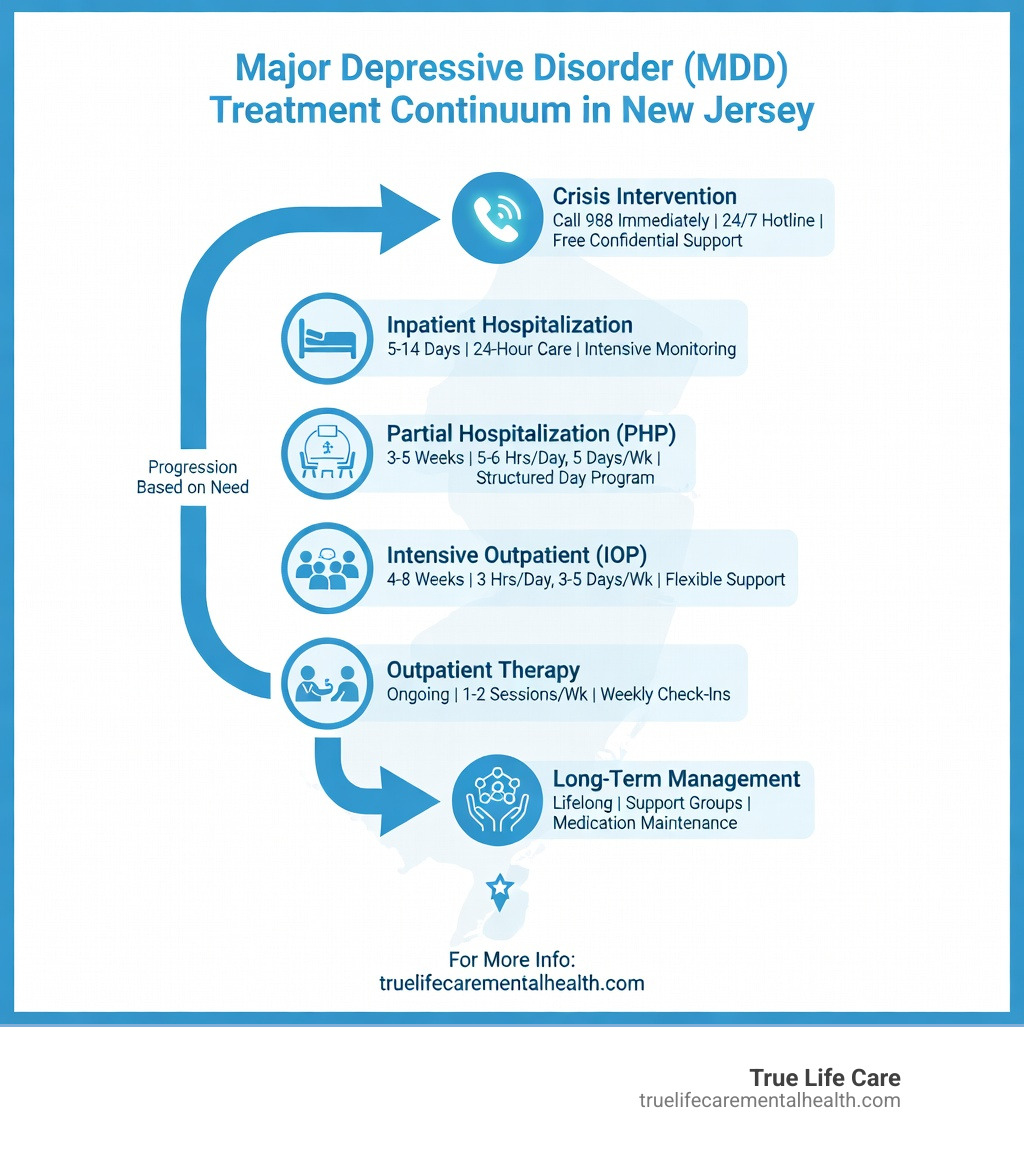
Learn more about Major Depressive Disorder Treatment in New Jersey:
Understanding Clinical Depression vs. Temporary Sadness
Before diving into treatment tips, we need to clear up a common misconception: depression isn’t just a “mood.” We all experience sadness—it’s a natural human response to loss, disappointment, or stress. However, Major Depressive Disorder (MDD) is a clinical diagnosis with specific criteria that set it apart from the “blues.”

To be diagnosed with MDD, symptoms must persist every day for at least two weeks. Unlike temporary sadness, which usually comes in waves and allows for moments of joy, clinical depression is a heavy, persistent blanket that smothers your ability to function.
Common symptoms we see in adults include:
- Persistent Sadness or “Emptiness”: A mood that doesn’t lift even when good things happen.
- Anhedonia: A fancy word for losing interest in things you used to love, like hobbies, socializing, or even eating.
- Physical Changes: Significant weight loss or gain, sleeping too much (hypersomnia), or not being able to sleep at all (insomnia).
- Cognitive Fog: Feeling like your brain is moving through molasses, making it hard to concentrate or make simple decisions.
- Feelings of Worthlessness: Intense, inappropriate guilt or a feeling that you are a burden to others.
It is also important to recognize high-functioning depression. This isn’t an official DSM-5 diagnosis, but it describes people who appear successful and accomplished on the outside while struggling with profound internal despair. They might never miss a day of work in Boonton or Montville, but they are exhausted by the effort of maintaining that facade.
Tip 1: Select the Right Level of Major Depressive Disorder Treatment in New Jersey
One of the most important steps we take with our clients is determining the appropriate “intensity” of care. In New Jersey, we are lucky to have a robust continuum of care. You don’t always have to choose between a one-hour therapy session and a full-scale hospital stay. There are highly effective “middle-ground” options.
Navigating PHP and IOP for Major Depressive Disorder Treatment in New Jersey
For many residents in places like Morris County or Bergen County, maintaining a daily routine is vital for recovery, but standard outpatient therapy isn’t enough. This is where Partial Hospitalization Programs (PHP) and Intensive Outpatient Programs (IOP) come in.
- PHP (The “Day Program”): This is a high-intensity option. You typically attend treatment five days a week for several hours a day. It’s designed for those who need significant structure but are stable enough to return home in the evening. How PHP helps you heal involves providing a safe, immersive environment where you can focus entirely on your mental health.
- IOP (The “Flexible Program”): This is a step down from PHP. It usually involves 9 to 12 hours of therapy per week, spread over three to four days. How IOP helps you heal is by allowing you to work or attend school in Boonton or Clifton while still receiving intensive group and individual therapy.
Level of Care Comparison Table
| Feature | Outpatient Therapy | Intensive Outpatient (IOP) | Partial Hospitalization (PHP) |
|---|---|---|---|
| Hours per week | 1–2 hours | 9–12 hours | 20+ hours |
| Frequency | Once weekly | 3–5 days/week | 5 days/week |
| Living Situation | At home | At home | At home |
| Best For | Mild symptoms | Moderate symptoms/Transitions | Severe symptoms/Stability |
| Work/School | Full compatibility | Partial compatibility | Limited compatibility |
Specialized Major Depressive Disorder Treatment in New Jersey for Dual Diagnosis
We often find that depression doesn’t travel alone. Many individuals in New Jersey struggle with co-occurring conditions like anxiety or substance use disorders. This is known as a dual diagnosis.
Treating only the depression while ignoring a substance use issue—or vice versa—is like trying to fix a leaky boat by only painting the deck. You have to address both. Dual diagnosis treatment centers in NJ provide integrated care where mental health professionals and addiction specialists work together. If you are seeking help for depression in Morris County NJ, ensure the facility offers this integrated approach for the best long-term outcomes.
Tip 2: Combine Cognitive Behavioral Therapy (CBT) with Medication Management
If there is a “gold standard” for Major Depressive Disorder Treatment in New Jersey, it is the combination of psychotherapy and medication. While some people prefer one over the other, research consistently shows that using both together leads to the highest success rates.
What is Cognitive Behavioral Therapy (CBT)? It is a goal-oriented talk therapy that focuses on the relationship between your thoughts, feelings, and behaviors. Instead of just talking about the past, CBT gives you concrete “homework” to challenge the negative thought patterns that fuel depression. For example, CBT therapy examples might include “behavioral activation”—scheduling small, manageable activities to break the cycle of lethargy—or “cognitive restructuring,” where you learn to catch and correct thoughts like “I’ll never get better.”
On the biological side, medication management plays a crucial role. Our brains rely on chemicals called neurotransmitters (like serotonin and dopamine) to regulate mood. When these are out of balance, antidepressants can help “reset” the system.
- SSRIs (Selective Serotonin Reuptake Inhibitors): These are the most common, including medications like Prozac or Zoloft.
- SNRIs (Serotonin-Norepinephrine Reuptake Inhibitors): Often used if SSRIs aren’t effective.
It’s important to have a comprehensive review of antidepressants with a psychiatrist. We encourage our clients to weigh the pros and cons of antidepressants—while they can be life-saving, they often take 4 to 8 weeks to reach full effect and may have side effects like weight gain.
Tip 3: Explore Advanced Options for Treatment-Resistant Depression
What happens if you’ve tried therapy and multiple medications, but the cloud still won’t lift? This is known as treatment-resistant depression (TRD). If you feel like you’ve tried everything, don’t lose hope—New Jersey is a hub for some of the most advanced psychiatric interventions in the country.
First, it’s important to recognize the signs of treatment-resistance. Generally, if you haven’t seen significant improvement after two different medication trials of adequate dose and duration, you may fall into this category. Our treatment-resistant depression guide outlines several paths forward:
- Transcranial Magnetic Stimulation (TMS): This is a non-invasive procedure that uses magnetic fields to stimulate nerve cells in the brain regions involved in mood control. It’s FDA-cleared and typically involves 19-minute sessions over several weeks. It’s a great option because it doesn’t require sedation and has very few side effects.
- Ketamine Infusion Therapy / Spravato: Ketamine has emerged as a treatment for severe depression. Unlike traditional antidepressants that take weeks to work, ketamine can sometimes provide relief within hours by promoting “neuronal plasticity”—essentially helping the brain repair damaged connections.
- Electroconvulsive Therapy (ECT): While often misunderstood due to old movies, modern ECT is a safe and highly effective medical procedure performed under general anesthesia. It remains one of the fastest ways to relieve severe, life-threatening depression.
If you are wondering, “Should I go to rehab for depression?” the answer is often yes if your symptoms have become resistant to standard care or if you are in a crisis. You can go to rehab for mental health, and knowing what to expect—a structured, supportive environment—can take the fear out of the process.
Tip 4: Use New Jersey’s Local Resources and Holistic Support
Recovery doesn’t just happen in a doctor’s office; it happens in the community. New Jersey has an extensive network of resources designed to support you and your family.
- Crisis Support: If you or a loved one are in immediate danger, call or text 988. This is the national Suicide & Crisis Lifeline, and it connects you with trained counselors 24/7.
- State Resources: The NJ Department of Human Services provides directories for screening centers and community mental health programs across all 21 counties. Each county, from Sussex to Mercer, has a Mental Health Board that helps oversee local services.
- Holistic Approaches: Professional treatment is the foundation, but holistic habits build the house. We highly recommend incorporating:
- Mindfulness and Meditation: To help manage the “thought loops” common in depression.
- Yoga and Exercise: Physical activity is a natural mood booster.
- Support Groups: Organizations like NAMI (National Alliance on Mental Illness) New Jersey offer peer support groups where you can connect with others who truly understand your struggle.
Family support is also vital. If you are a loved one, the best thing you can do is educate yourself and offer non-judgmental validation. Depression isn’t a choice, and “snapping out of it” isn’t a possibility. Your patience and encouragement to stay the course with professional treatment can make all the difference.
Frequently Asked Questions about Depression in NJ
What is the difference between clinical depression and general sadness?
Sadness is a temporary emotion usually tied to a specific event. Clinical depression (MDD) is a medical condition that affects your physical health, sleep, appetite, and ability to function. It persists even when life circumstances are good and typically lasts for at least two weeks.
How long must symptoms persist for an MDD diagnosis in New Jersey?
In accordance with the DSM-5 (the standard diagnostic manual), symptoms must be present nearly every day for at least two weeks. These symptoms must represent a change from your previous level of functioning.
What should I do if standard depression treatments aren’t working?
If therapy and basic medications haven’t helped, you should talk to your provider about “treatment-resistant” options. This might include switching to an Intensive Outpatient Program (IOP), exploring TMS or ketamine therapy, or looking into a Partial Hospitalization Program. There are 3 simple steps to find depression treatment options in Morris County NJ: consult your doctor, check your insurance for in-network providers, and reach out to specialized centers for an evaluation.
Conclusion
Living with depression can feel like being trapped in a room with no doors, but we want you to know that the doors are there—you just might need help finding them. Whether you are in Boonton, Fair Lawn, or anywhere else in our beautiful state, Major Depressive Disorder Treatment in New Jersey is accessible, evidence-based, and highly effective.
From the structured support of a Partial Hospitalization Program to the flexibility of an IOP and the precision of modern medication management, there is a path forward. At True Life Care, we believe in a holistic approach that treats you as a whole person, not just a diagnosis.
If you or a loved one is struggling, don’t wait for things to “get better on their own.” Reach out to a professional today. Recovery is not just a possibility—it is the expected outcome for the vast majority of people who seek help.
For more information on starting your journey, visit our guide on Major Depressive Disorder Treatment in New Jersey.