Understanding Virtual IOP in New Jersey
Virtual IOP in New Jersey gives you access to intensive, structured mental health and addiction treatment — without leaving your home.
Here’s a quick look at whether it might be right for you:
- You need more than weekly therapy but don’t require inpatient or residential care
- You have work, school, or family commitments that make in-person programs hard to attend
- You face transportation barriers or live far from treatment centers
- You want privacy and feel more comfortable opening up from home
- You’re stepping down from inpatient care and need continued structured support
Mental health challenges are rising sharply across New Jersey. 1 in 3 young people in the state have an anxiety disorder, and over 130,000 adolescents experienced a major depressive episode in the past year alone. For adults juggling jobs, kids, and daily responsibilities, getting help can feel impossible — even when it’s urgently needed.
That’s where Virtual IOP steps in.
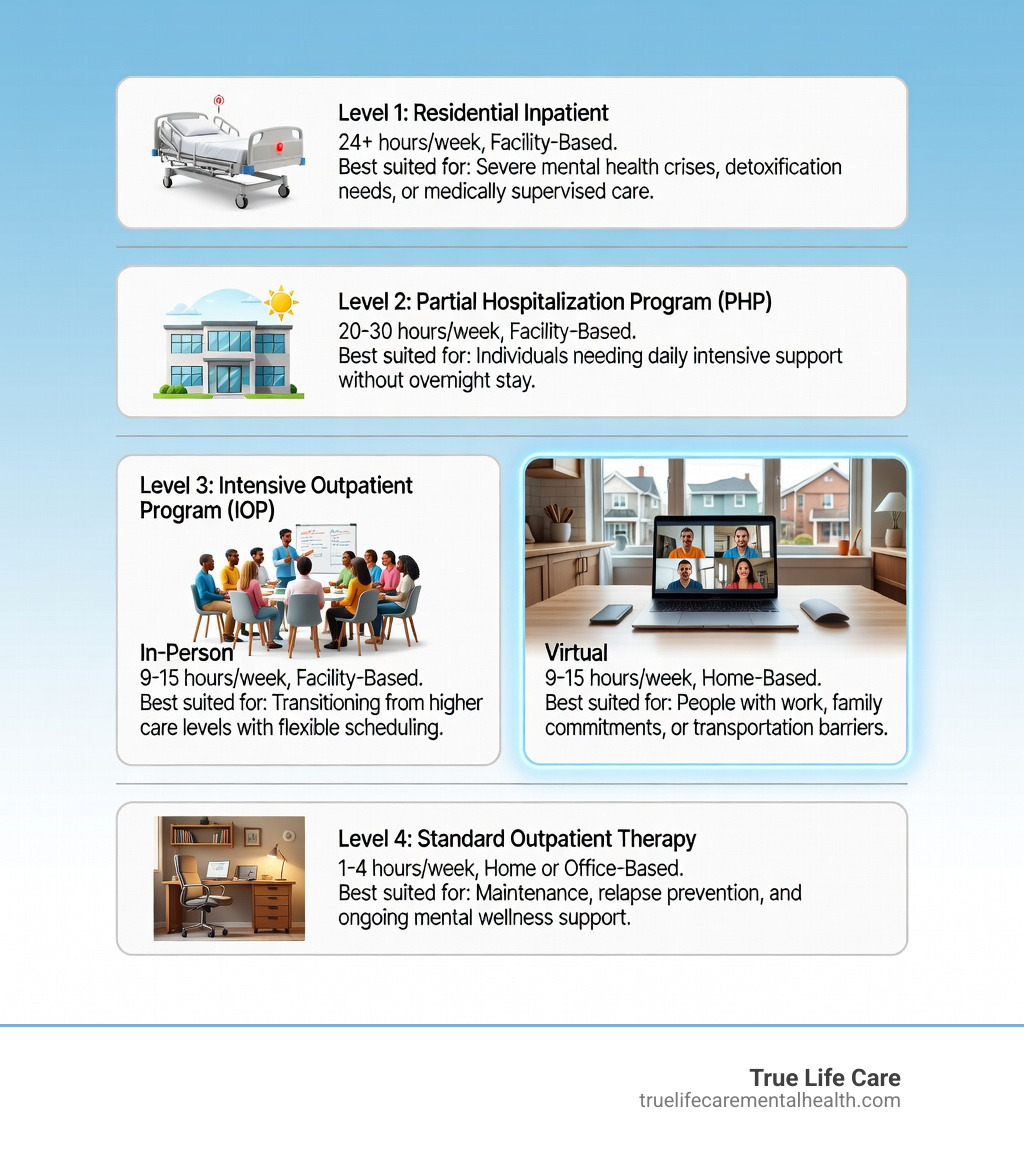
It’s a real, clinically rigorous level of care — not just video calls with a therapist. Programs typically run 9 to 15 hours per week, delivered through secure, HIPAA-compliant platforms by licensed New Jersey clinicians. The structure mirrors what you’d get in person, but fits around your life.
The results back it up too. Research shows nearly 80% of virtual IOP participants stayed actively engaged for at least 30 days, and 91% achieved 30 consecutive days of abstinence.
But it’s not the right fit for everyone. Below, we’ll walk through 5 clear signs that a virtual IOP in New Jersey is your best path forward.
Virtual IOP in New Jersey terminology:
An Intensive Outpatient Program (IOP) is a specific level of behavioral healthcare designed for those who need more support than a standard one-hour therapy session once a week, but who don’t require 24/7 supervision in a hospital. When we talk about Virtual IOP in New Jersey, we are referring to this same intensive care delivered via telehealth.
Many people wonder: “Is it the same quality?” The answer is a resounding yes. The clinical integrity of a virtual program matches that of in-person care. You are still working with the same licensed psychiatrists, therapists, and peer support specialists; the only difference is the “waiting room” is your living room couch.
To understand where this fits in your journey, it’s helpful to know what is an intensive outpatient program for mental health. It is a “middle ground” of care. It provides the structure necessary to manage a crisis or stabilize a condition while allowing you to sleep in your own bed at night.
| Feature | In-Person IOP | Virtual IOP |
|---|---|---|
| Weekly Hours | 9–15 Hours | 9–15 Hours |
| Setting | Physical Clinic/Facility | Secure Home Environment |
| Commute | Required (Traffic/Parking) | None (Instant Login) |
| Therapy Types | Individual, Group, Family | Individual, Group, Family |
| Privacy | Shared Public Spaces | Maximum Personal Discretion |
| Flexibility | Set Facility Hours | Often Includes Evening Options |
How a Virtual IOP in New Jersey Works
A typical Virtual IOP in New Jersey consists of 3 to 5 sessions per week, usually lasting about 3 hours each. During these sessions, you participate in a mix of group therapy, individual counseling, and psychiatric check-ins.
We use secure, HIPAA-compliant platforms that feature end-to-end encryption. This means your data is “scrambled” so that only you and your provider can access the session. Beyond just talking, these platforms allow for screen sharing of educational materials and interactive workshops.
The effectiveness of this model isn’t just a theory. A study published by the National Library of Medicine found that nearly 80% of participants in a telehealth IOP program stayed actively engaged for at least 30 days. Engagement is the #1 predictor of success in recovery, and virtual access removes the barriers that usually cause people to drop out.
Who Benefits Most from Remote Treatment
Virtual treatment is a game-changer for specific groups of New Jerseyans. If you are in early recovery and feel that the “real world” is full of triggers, having a structured support system accessible from your safe space at home can be life-saving.
It is also ideal for:
- Parents and Caregivers: Those who cannot leave children or elderly parents for half the day.
- Rural Residents: Individuals in parts of Sussex or Warren County who might otherwise have to drive over an hour to reach a quality facility.
- Professionals: People who need to maintain their career while receiving IOP treatment New Jersey overview levels of care.
5 Signs That Virtual Treatment is Your Best Option

Deciding to seek help is the first step; deciding how to receive it is the second. While some prefer the physical presence of a group room, many find that they actually make more progress when the logistical “noise” of treatment is removed. When you discover the benefits of intensive outpatient program mental health NJ treatment, you realize that the comfort of home can actually make you more vulnerable and honest in therapy.
Here are five specific signs that Virtual IOP in New Jersey is the right choice for you.
1. You Require Flexibility for Work or School
We live in a state. Whether you’re commuting to NYC or working locally in Bergen County, “pausing” your life for 30 days of residential treatment isn’t always an option. Career preservation is a major concern for many of our clients.
A virtual outpatient treatment program allows you to maintain your professional or academic routine. Because you save hours every week on commuting, you can often attend sessions in the late afternoon or evening and still have time for your responsibilities. This continuity helps prevent the “re-entry shock” that many people feel after leaving a full-time facility.
2. You Face Significant Transportation or Mobility Barriers
Let’s be honest: South Jersey traffic and the Parkway can turn a 20-minute drive into a two-hour ordeal. If you don’t have a reliable vehicle or if your mental health condition (like severe agoraphobia or social anxiety) makes leaving the house difficult, an in-person program becomes a barrier rather than a help.
Virtual IOP in New Jersey provides statewide availability. Whether you are in Clifton, Boonton, or Ringwood, you have access to the same high-level psychiatric care. For those with physical disabilities or mobility issues, virtual care ensures that your physical health never stands in the way of your mental well-being.
3. You Prioritize Maximum Privacy and Discretion
While we are working hard to reduce the stigma around mental health, many people still feel self-conscious about walking into a behavioral health facility in their local community. You might worry about bumping into a neighbor, a co-worker, or a fellow student.
A virtual IOP for mental health offers the ultimate level of discretion. You can receive world-class care without anyone ever knowing you are in treatment. By using secure web technology, you create a private sanctuary for healing within your own home. For many, this sense of safety allows them to open up much faster than they would in a public setting.
4. You Need Specialized Care for Co-Occurring Disorders
Many people struggling with substance use are also dealing with an underlying mental health condition like depression, anxiety, or PTSD. This is known as a “dual diagnosis.”
Treating only one side of the coin rarely leads to long-term success. Our intensive outpatient program for mental health is specifically designed to address co-occurring disorders simultaneously. We don’t just help you stop a behavior; we help you heal the wound that caused the behavior in the first place.
5. You Are Transitioning from Inpatient Care
If you have recently completed a stay at a residential facility or a Partial Hospitalization Program (PHP), the transition back to “normal life” can be jarring. This is a high-risk time for relapse.
Virtual IOP acts as a vital “step-down” support. It provides a safety net while you practice your new coping skills in your actual home environment. Understanding how long is intensive outpatient treatment helps you plan for this transition. Typically, staying connected to a peer support group and a therapist for several weeks after inpatient care significantly increases your chances of long-term stability.
Comprehensive Services in a Virtual IOP in New Jersey
A common misconception is that virtual care is “therapy-lite.” In reality, we offer a full suite of clinical services that mirror our in-person offerings. When you look at what outpatient mental health treatment entails, you’ll see it’s a robust, multi-disciplinary approach.
- Individual Counseling: One-on-one time with a primary therapist to work on specific personal goals and triggers.
- Group Therapy: The heart of the IOP. You connect with others facing similar challenges, reducing isolation and building a support network.
- Family Support: We believe family involvement is the #1 predictor of success. We offer sessions to help loved ones understand boundaries and communication strategies.
- Psychiatric Services: Regular meetings with a psychiatrist for evaluations and progress monitoring.
- Medication Management: If medication is part of your plan, our team tracks adherence and side effects via telehealth to ensure you are on the right path.
Evidence-Based Therapies Used Online
We don’t just “talk”; we use proven clinical methods to help rewire your brain and behavior. These include:
- Cognitive Behavioral Therapy (CBT): Identifying and changing the negative thought patterns that lead to self-destructive behaviors.
- Dialectical Behavior Therapy (DBT): Learning mindfulness, emotional regulation, and distress tolerance.
- Motivational Interviewing: Helping you find your own internal “why” for making a change.
- Trauma-Informed Care: Ensuring that your past experiences are handled with the sensitivity and expertise they require.
Specialized Virtual IOP in New Jersey Programs
We recognize that different populations have different needs. A “one size fits all” approach doesn’t work in mental health. That’s why we offer specialized tracks, including:
- Adolescent Care: Tailored for the unique social and academic pressures facing New Jersey teens.
- Eating Disorder Treatment: Including meal coaching and nutritional education from home.
- Gambling Addiction: Addressing the rise of online gambling with specific cognitive strategies to challenge “chasing losses.”
- LGBTQ+ Inclusive Care: Providing a safe, affirming space for individuals of all identities.
Navigating Insurance and the Intake Process
One of the biggest hurdles to getting help is worrying about the cost. The good news is that Virtual IOP in New Jersey is widely covered by major insurance providers. Because telehealth is now recognized as an effective and essential service, companies like Aetna, Cigna, and Horizon Blue Cross Blue Shield frequently cover these programs.
The process usually looks like this:
- Initial Screening: A quick 15-minute phone call to see if you’re a candidate for virtual care.
- Verification of Benefits: Our team works directly with your insurance to see what is covered, so there are no financial surprises.
- Biopsychosocial Assessment: A deep dive with a clinician to understand your history, needs, and goals.
- Personalized Treatment Plan: We create a roadmap tailored specifically to you.
If you are wondering how long is intensive outpatient treatment 2, the duration typically ranges from 8 to 12 weeks, though it is always based on your individual progress.
Frequently Asked Questions about Virtual IOP
Is virtual IOP as effective as in-person treatment?
Yes. Clinical outcomes show that virtual programs have equivalent—and sometimes better—engagement rates. For conditions like anxiety and depression, being in a comfortable environment can actually lead to more honest participation. Our data shows that 91% of participants achieve 30 consecutive days of abstinence during the program.
How is drug testing handled in a virtual program?
Accountability is key to recovery. We use randomized scheduling and remote protocols, which can include home testing kits and video-observed collections to maintain the “chain of custody” and ensure the integrity of the results.
What technology do I need to participate?
You don’t need a high-tech studio. A smartphone, tablet, or laptop with a working camera and microphone is all that’s required. You will also need a reliable high-speed internet connection and a private space where you won’t be interrupted. If you need help, our tech support team can even assist with troubleshooting or providing equipment like headphones.
Conclusion
At True Life Care Mental Health, we believe that your zip code or your busy schedule should never be a barrier to high-quality care. Our holistic approach combines expert psychiatric care with the flexibility you need to live your life. Whether you are in Bergen County or Warren County, our Virtual IOP in New Jersey is designed to empower you for long-term recovery and well-being.
Recovery doesn’t mean pausing your life; it means learning how to live it better.