
Depression Treatment in Ocean County, NJ: What You Need to Know Before You Start

Depression treatment in ocean county nj is more accessible than many people realize — and knowing your options before you start can make a real difference in your recovery.
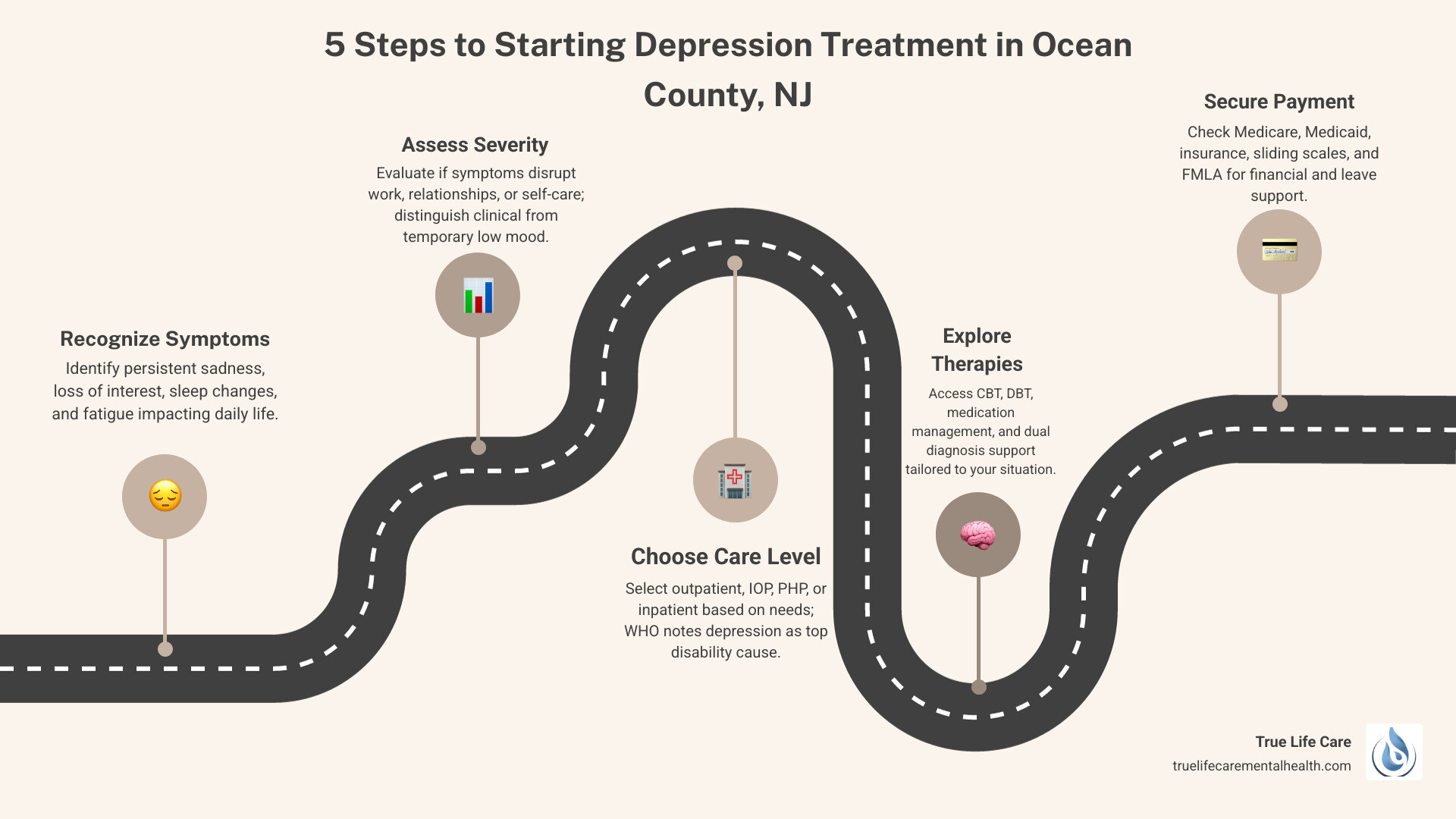
Quick answer: Here are the key things to know before starting depression treatment in Ocean County, NJ:
- Recognize your symptoms — Depression goes beyond sadness. It affects sleep, focus, energy, and your ability to function day to day.
- Choose the right level of care — Options range from standard outpatient therapy to Intensive Outpatient Programs (IOP), Partial Hospitalization Programs (PHP), and inpatient care.
- Explore evidence-based therapies — CBT, DBT, trauma-informed therapy, and medication management are all available locally.
- Find programs built for you — Specialized programs exist for veterans, seniors, the LGBTQ+ community, and those with co-occurring disorders like anxiety or substance use.
- Understand your payment options — Medicare, Medicaid, private insurance, sliding scale fees, and FMLA leave may all apply to your situation.
Depression is the leading cause of disability worldwide, affecting more than 300 million people according to the World Health Organization. In Ocean County, NJ, many residents are quietly struggling — balancing work, family, and daily life while dealing with persistent sadness, hopelessness, or emotional exhaustion that just won’t lift on its own.
The good news? Ocean County has a growing network of treatment providers, community programs, and clinical services designed to meet people where they are. Whether you’ve never sought help before or you’ve tried treatment that didn’t work, there are real options available — including advanced treatments for cases where standard therapy and medication fall short.
This guide walks you through the five most important things to understand before you begin your journey toward recovery.
1. Recognizing Symptoms and the Impact of Chronic Depression
Before diving into depression treatment in ocean county nj, it is essential to understand what you are actually fighting. Many of us grew up thinking depression was just “being sad,” but it is much more complex. According to the WHO, depression is the leading cause of disability worldwide, meaning it doesn’t just hurt your feelings—it impairs your ability to work, maintain relationships, and care for yourself.
In our experience, residents in Ocean County often wait too long to seek help because they believe their symptoms aren’t “bad enough.” However, if you are experiencing a persistent loss of interest in activities you once loved, changes in appetite, or a heavy sense of fatigue that sleep doesn’t fix, you are likely dealing with clinical depression.
Identifying Clinical vs. Persistent Depression
It is also important to distinguish between different types of the disorder.
- Major Depressive Disorder (Clinical Depression): This involves severe symptoms that interfere with your ability to work, sleep, study, and eat.
- Persistent Depressive Disorder (Dysthymia): As noted by NIMH research on chronic depression symptoms, this involves less severe but much longer-lasting symptoms—typically at least two years.
Even if you have been in “remission” (a period where symptoms are gone), signs of treatment-resistant depression can emerge. This is when standard medications or talk therapy don’t seem to move the needle. Recognizing these signs early allows us to pivot toward more intensive or specialized care.
2. Choosing the Right Level of depression treatment in ocean county nj

One size does not fit all when it comes to mental health. Ocean County offers a spectrum of care levels, and choosing the right one depends on the severity of your symptoms and how much support you need in your daily life.
- Outpatient Care: This is the most common starting point. You meet with a therapist or psychiatrist once or twice a week. It’s great for maintaining your routine while getting professional support.
- Intensive Outpatient Program (IOP): This is a step up. An IOP for depression helps you heal by providing several hours of therapy multiple days a week (typically three hours a day, three days a week). It’s perfect for those who need more than a weekly check-in but still want to live at home.
- Partial Hospitalization Program (PHP): This is the highest level of outpatient care. A PHP for depression help you heal by offering a full “workday” of treatment (usually 5-6 hours a day, five days a week). It provides the structure of a hospital setting without the overnight stay.
Accessing Advanced depression treatment in ocean county nj
For those dealing with medication-resistant cases, Ocean County has become a hub for advanced clinical options. If you’ve tried two or more antidepressants without success, you may be experiencing treatment-resistant depression (TRD).
Newer technologies like Transcranial Magnetic Stimulation (TMS) have shown incredible results. Statistics show that for medication-resistant patients, up to 83% report improvement and 62% reach full remission using advanced TMS therapy. If you feel stuck, it might be time to check out a guide to treatment-resistant depression to see if these advanced options are right for you.
3. Exploring Specialized and Evidence-Based Therapies
When you look for depression treatment in ocean county nj, you’ll hear a lot of acronyms. These aren’t just buzzwords; they represent evidence-based “blueprints” for recovery. At True Life Care Mental Health, we believe in using the right tool for the job.
- CBT (Cognitive Behavioral Therapy): The “gold standard.” It helps you identify and change negative thought patterns that fuel depression.
- DBT (Dialectical Behavior Therapy): Originally for borderline personality disorder, it’s now widely used for depression to help with emotional regulation and distress tolerance.
- Trauma-Informed Therapy: Since many cases of depression are rooted in past experiences, this approach ensures the treatment environment feels safe and avoids re-triggering the patient.
- MBCT (Mindfulness-Based Cognitive Therapy): This combines traditional CBT with mindfulness strategies like meditation to prevent relapse.
Benefits of Evidence-Based depression treatment in ocean county nj
The key to a successful recovery is often a “dual-track” approach. This means combining psychiatric care and medication management with intensive talk therapy.
We also see great success in addressing “co-occurring disorders.” It is very common for depression to bring friends along—like anxiety, PTSD, or substance use issues. Effective depression treatment in New Jersey must address all of these together. If you only treat the depression but ignore the underlying anxiety or trauma, the depression is much more likely to return.
4. Specialized Programs for Diverse Ocean County Communities
Ocean County is a diverse place, and your treatment should reflect who you are. A “cookie-cutter” approach rarely works because a 20-year-old college student faces different challenges than a 70-year-old retiree or a veteran returning from service.
- Veterans Services: Many local providers offer specialized peer support and trauma-informed care specifically for those who have served.
- Senior Programs: Depression in older adults is often misdiagnosed as “just getting old.” Specialized senior programs focus on isolation, grief, and health-related depression.
- LGBTQ+ Support: Finding a provider who understands the unique stressors of the LGBTQ+ community is vital for building trust and achieving long-term wellness.
- Peer-Led Groups: Organizations like the Mental Health Association in New Jersey (MHANJ) provide peer outreach support. These are people who have “been there” and can offer a unique level of empathy.
relapsing with depression is possible, but having a specialized support network in place makes it much easier to catch the warning signs early and get back on track.
5. Navigating Insurance, FMLA, and Treatment Costs
We know that for many, the biggest hurdle isn’t the therapy itself—it’s the bill. Navigating the financial side of depression treatment in ocean county nj can feel overwhelming, but there are more protections and options than you might think.
Many local clinics accept Medicare and Medicaid, and some offer “sliding scale fees,” which means they adjust the cost based on your income. Additionally, if you are worried about your job while seeking intensive treatment (like a PHP or IOP), you may be eligible for the Family and Medical Leave Act (FMLA).
As per the Department of Labor, FMLA provides up to 12 weeks of job-protected leave for serious health conditions, which includes clinically diagnosed depression.
| Option | Best For… | Key Detail |
|---|---|---|
| Private Insurance | Standard Outpatient, IOP, PHP | Most plans are required to cover mental health similarly to physical health. |
| Medicaid/Medicare | Low-income or Seniors | Many community-based agencies in Ocean County prioritize these. |
| Sliding Scale | Uninsured or Underinsured | Fees are based on what you can actually afford to pay. |
| FMLA | Full-time Employees | Protects your job for up to 12 weeks while you attend treatment. |
Frequently Asked Questions about Depression Treatment
What is the difference between IOP and PHP for depression?
The main difference is the “dosage” of treatment. A Partial Hospitalization Program (PHP) is like a full-time job—you’re there for most of the day, five days a week. It’s meant for people who need high-level stabilization. An Intensive Outpatient Program (IOP) is more flexible, usually meeting for three hours a day, three times a week, allowing you to maintain some work or school responsibilities.
Can I receive depression treatment while working?
Absolutely. Many residents in Ocean County utilize outpatient therapy or IOPs specifically because they can be scheduled around work hours. If you need a higher level of care like PHP, that is where FMLA protections come in to ensure you have a job to return to once you’ve completed your program.
Conclusion
At True Life Care Mental Health, we understand that starting depression treatment in ocean county nj is a brave first step. Our holistic approach ensures that we aren’t just treating a diagnosis—we are treating a person. By combining personalized evidence-based therapies with flexible programs like PHP and IOP, we empower our clients to achieve long-term recovery.
If you are ready to take that step, we are here to help you navigate the process, from insurance verification to creating a custom recovery plan. Whether you are exploring coverage options, planning time away from work, or looking for advanced psychiatric care, your journey to a better life can start with a single conversation. You do not have to do this alone.