
When You Need More Than Weekly Therapy: The Case for a Behavioral Health Retreat

A behavioral health retreat is a structured, residential program that combines clinical mental health treatment with holistic healing — all in a supportive, non-hospital environment. It’s a step above traditional outpatient therapy, and a world apart from a standard psychiatric ward.
Here’s a quick look at what these retreats offer:
| Feature | What It Means for You |
|---|---|
| Who it’s for | Adults with depression, anxiety, PTSD, addiction, or co-occurring disorders |
| Setting | Residential campuses, nature-based environments, private suites |
| Program length | 5 days to 30+ days depending on the facility |
| Therapies offered | CBT, DBT, EMDR, group therapy, yoga, mindfulness, neurofeedback |
| Cost range | Varies widely; some programs accept insurance or offer reimbursement |
| Key benefit | Intensive, immersive care that can accelerate healing faster than weekly sessions |
If you’ve tried regular therapy and felt like you weren’t making real progress, you’re not alone. Millions of people struggle with mental health and substance use disorders — yet only a fraction ever receive the level of care they actually need.
Behavioral health retreats fill that gap.
They offer something traditional outpatient care simply can’t: full immersion. No work distractions. No daily stressors pulling you back. Just focused, expert-guided healing in an environment designed for recovery.
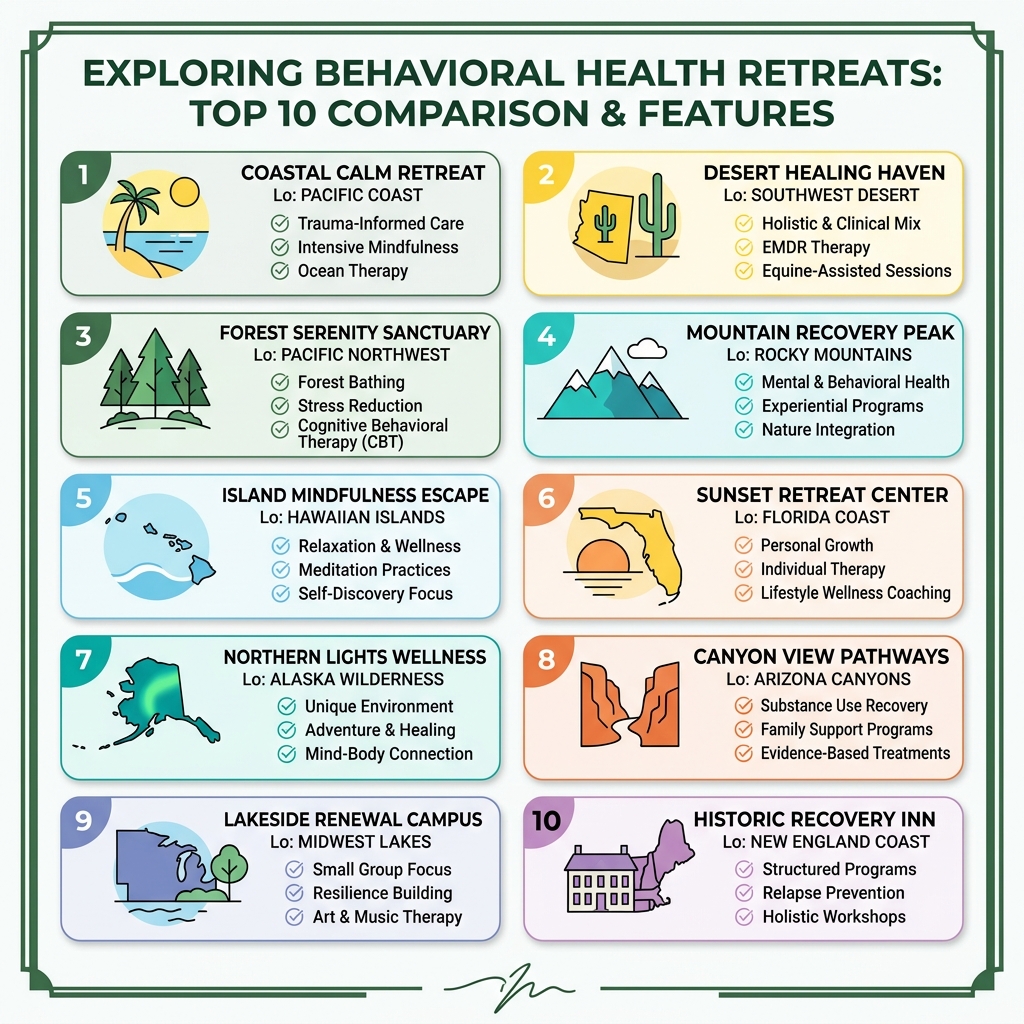
This guide reviews the top 10 behavioral health retreats — what makes each one stand out, who they’re best suited for, and what you can realistically expect in terms of cost and care.
Behavioral Health Retreat vocab to learn:
- Mental Health Treatment in Middlesex county NJ
- mental health retreat covered by insurance
- trauma recovery retreat
Defining the Behavioral Health Retreat Model
When we talk about a Behavioral Health Retreat, we are describing a model of care that prioritizes clinical excellence within a restorative setting. Unlike a standard hospital, these facilities focus on “stabilization through serenity.” According to SAMHSA statistics, while over 20 million Americans struggle with substance use, only about 10% receive specialized treatment. Retreats aim to close this gap by offering an inviting, less stigmatized path to wellness.
The model is built on personalized rehabilitation. Instead of a one-size-fits-all approach, we look at the individual’s history, biology, and environment. This often involves residential care where patients stay on-site, allowing for 24/7 support and a break from the triggers of everyday life.

What to Expect at a Behavioral Health Retreat
Entering a retreat is a commitment to a highly structured daily schedule. While the environment is comfortable, the “work” is intensive. A typical day might include:
- Morning Mindfulness: Starting the day with meditation or yoga to ground the nervous system.
- Individual Therapy: One-on-one sessions with doctoral-level clinicians to dive deep into personal challenges.
- Group Sessions: Peer-led and therapist-guided discussions that foster connection and reduce isolation.
- Digital Detox: Many programs encourage or require “unplugging” from phones and laptops to facilitate true reflection.
For those dealing with deep-seated wounds, finding freedom through trauma recovery retreats often involves specialized workshops that go beyond what a 50-minute weekly session can achieve.
The Benefits of a Behavioral Health Retreat Environment
The environment itself acts as a “silent therapist.” Many of the top-tier retreats we see are situated on expansive campuses—some as large as 87 acres—featuring walking trails, private suites, and common areas designed to feel like a home rather than a clinic.
Nature immersion is a core component. Research suggests that being in natural settings can significantly lower cortisol levels and improve mood. Luxury amenities, such as private rooms and high-quality nutrition, aren’t just about comfort; they are about providing the dignity and safety necessary for a person to be totally honest and vulnerable in their healing journey.
Choosing the Right Behavioral Health Retreat for Your Recovery
Selecting a facility is a major life decision. We recommend looking for specific markers of quality, starting with accreditation. The Joint Commission standards are considered the “gold standard” in behavioral health. If a facility carries this seal, you know they meet rigorous safety and clinical benchmarks.
Beyond accreditation, look at the staff-to-patient ratio. A high-quality Behavioral Health Retreat will often employ dozens of professionals—from psychiatrists and specialized clinicians to nutritionists—to ensure every guest receives an individualized plan.
Top 10 Retreats for Mental Health and Wellness (Key Characteristics)
To help you navigate the landscape, we’ve categorized the top 10 types of retreats based on their unique strengths and service models:
- Comprehensive Residential Programs: These are the heavy hitters of the industry. They offer extended stays, typically 20 to 30 days, combining medical stabilization with deep psychological work. They are ideal for those who need a complete reset in a secure, supportive environment.
- Nature-Integrated Healing: These retreats are often located near mountains or coastal areas. They use the environment as a therapeutic tool, incorporating “adventure therapy” or simple quietude to help patients reconnect with themselves.
- Established Excellence & Heritage: Some institutions have been around for nearly two centuries. This longevity often means they have refined their evidence-based practices over generations, offering a blend of historic wisdom and modern science.
- Intensive Short-Term Immersions: Not everyone can step away for a month. These 5-to-7-day “intensives” provide a year’s worth of therapy in a single week. They are perfect for professionals or parents who need a high-impact, short-duration intervention.
- Specialized Trauma-Focused Workshops: These programs focus specifically on the “why” behind self-defeating behaviors. They often use somatic experiencing or psychodrama to help participants process trauma that is “stuck” in the body.
- Holistic & Humanistic Approaches: These programs shy away from heavy medication-first models, focusing instead on humanistic psychotherapy, music therapy, and sound baths. They treat the person, not just the diagnosis.
- Multi-Location Accessibility: Large networks with facilities across the East Coast (from Connecticut to Florida) allow for a “continuum of care.” You might start in residential treatment in one state and transition to outpatient services closer to home.
- Luxury & Professional Care (New Jersey): For residents in Bergen, Morris, or Passaic counties, there are high-end options that cater specifically to professionals. These provide discreet, premium care with amenities that make the stay feel like a “vacation with a purpose.” Explore top retreats in NJ here.
- University-Affiliated & Evidence-Based Programs: Retreats connected to major medical schools or research hospitals offer the highest level of academic rigor. They are often at the forefront of new treatments for treatment-resistant depression or OCD.
- Globally Diverse & Accessible Options: From spiritual retreats in Bali to clinical programs in Europe, these options cater to those who find healing in cultural shifts and international perspectives.
Therapeutic Modalities and Holistic Healing
The “secret sauce” of a successful Behavioral Health Retreat is the integration of diverse therapies. We don’t just rely on one method; we use a “toolbox” approach.
- Clinical Mainstays: Cognitive Behavioral Therapy (CBT) and Dialectical Behavior Therapy (DBT) remain essential for managing symptoms and building coping skills.
- Trauma Work: EMDR (Eye Movement Desensitization and Reprocessing) is a game-changer for PTSD, helping the brain reprocess traumatic memories so they no longer trigger a fight-or-flight response.
- The Power of Duration: NIDA research indicates that for treatment to be truly effective, individuals should participate for at least 90 days across various levels of care. Retreats provide the intensive “launchpad” for this long-term journey.
- Cutting-Edge Tools: Neurofeedback and Deep TMS (Transcranial Magnetic Stimulation) are increasingly common at elite retreats, helping to “calm” or “rewire” the brain’s electrical activity before deep talk therapy begins.
The results are measurable. Holistic approaches, including yoga and mindfulness, have shown up to a 40% improvement in anxiety and depression symptoms. For women specifically, mindfulness-based retreats have been linked to a 35% reduction in perceived stress.
Cost, Insurance, and Admissions Planning
Let’s talk numbers. A Behavioral Health Retreat is a significant investment in your future. Costs vary based on the level of luxury and the intensity of clinical care.
| Program Type | Estimated Duration | Typical Cost Range | Insurance Involvement |
|---|---|---|---|
| Luxury Residential | 20–30 Days | $40,000 – $70,000+ | Often Self-Pay / OON Reimbursement |
| Intensive Workshop | 5–7 Days | $3,000 – $10,000 | Eligible for some reimbursement |
| PHP / IOP | 4–8 Weeks | $10,000 – $25,000 | Frequently covered by major plans |
Many high-end residential programs are “self-pay,” meaning they require payment upfront. However, many facilities provide a “Superbill” that you can submit to your insurance company for out-of-network reimbursement.
For those looking for mental health retreats covered by insurance, Partial Hospitalization Programs (PHP) or Intensive Outpatient Programs (IOP) are often the most accessible route. These programs offer the same high-level clinical care but may allow you to live at home or in a nearby “sober living” environment, making them much more likely to be covered by providers like Aetna, BCBS, or Cigna.
The Admissions Process:
- Initial Inquiry: A confidential call to discuss your needs.
- Clinical Screening: Ensuring the retreat is a safe and appropriate match for your condition.
- Insurance Verification: Our team (or the facility’s team) checks your benefits to see what’s covered.
- Travel Logistics: Coordinating arrival at the campus.
Frequently Asked Questions about Behavioral Health Retreats
How do retreats differ from traditional psychiatric hospitals?
The biggest difference is the “feel.” A hospital is for acute crisis—think locked doors, scrubs, and fluorescent lights. A Behavioral Health Retreat is for rehabilitation. The campuses are usually unlocked, the environment is warm and “vacation-like,” and the focus is on holistic wellness rather than just symptom management. You are a “guest” or “resident,” not just a “patient.”
What conditions are typically treated at these facilities?
Retreats are equipped to handle a wide range of behavioral health issues, including:
- Severe Depression and Anxiety
- Complex PTSD and Childhood Trauma
- Bipolar Disorder
- OCD and Personality Disorders
- Co-occurring Substance Use Disorders (Dual Diagnosis)
- Burnout and Career-Related Stress for Professionals
Is insurance accepted for behavioral health retreats?
It depends on the facility. While many luxury residential programs are private pay, many offer “intensive outpatient” or “partial hospitalization” tracks that are in-network with major insurance providers. Always ask for a verification of benefits before you commit.
Conclusion
A Behavioral Health Retreat is more than just a break from reality; it is a bridge to a new one. By combining evidence-based clinical care with the restorative power of a serene environment, these programs offer a level of transformation that weekly therapy often cannot match.
At True Life Care Mental Health, we believe in this holistic, personalized approach. Whether you are in Bergen County, Morris County, or anywhere in the New Jersey and New York area, the path to long-term recovery involves treating the whole person—mind, body, and spirit. Family involvement and robust aftercare planning are the final pieces of the puzzle, ensuring that the progress you make at a retreat stays with you long after you return home.
If you’re ready to take that next step, explore our guide to mental health retreats in NJ and find the escape that leads you back to yourself.