
The Complete List of BPD IOP Programs in NJ
What You Need to Know About Borderline Personality Disorder IOP NJ

Borderline Personality Disorder IOP NJ refers to Intensive Outpatient Programs in New Jersey designed specifically to treat BPD — and finding the right one can be life-changing.
Here’s a quick overview of what’s available:
| What You’re Looking For | Quick Answer |
|---|---|
| What is a BPD IOP? | Structured therapy 3-5 days/week, 3+ hours/day — no overnight stay required |
| Primary therapy used | Dialectical Behavior Therapy (DBT) — the gold standard for BPD |
| How long does it last? | Typically 8-12 weeks, sometimes longer based on individual needs |
| Does insurance cover it? | Yes — most major plans cover IOP under mental health parity laws |
| Who is it for? | Adults with BPD, including those with co-occurring addiction, trauma, or depression |
| Is recovery possible? | Yes — about 85% of people with BPD achieve remission within 10 years of treatment |
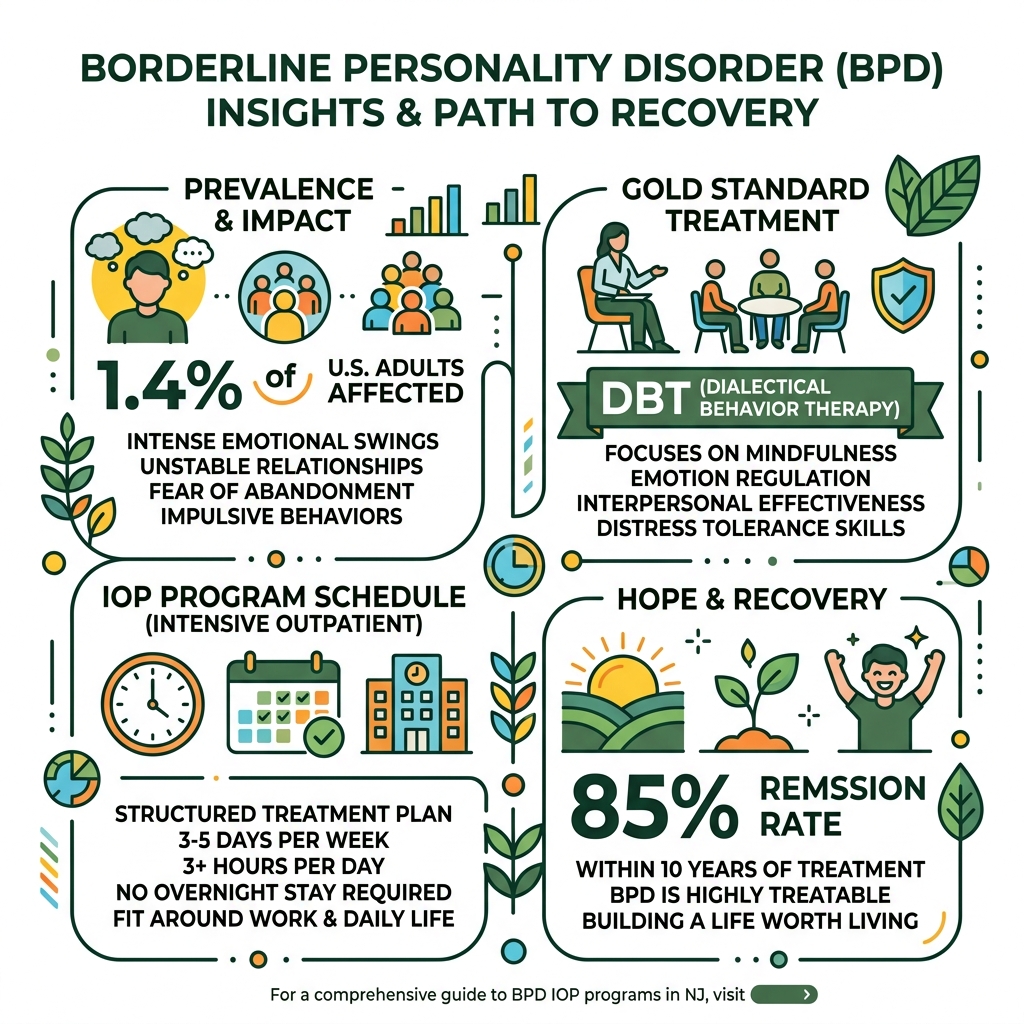
BPD is one of the most commonly diagnosed personality disorders in clinical settings. Yet it remains widely misunderstood — even by those living with it. It affects roughly 1.4% of U.S. adults, causing intense emotional swings, unstable relationships, fear of abandonment, and impulsive behaviors that can make everyday life feel overwhelming.
The good news? BPD is highly treatable. And in New Jersey, there are structured IOP programs built specifically for this condition — programs that fit around your work, family, and daily life.
This guide walks you through every major BPD IOP program in NJ, what to expect, which therapies work, and how to get started.
Understanding Borderline Personality Disorder and Co-occurring Conditions
At its core, borderline personality disorder is a condition of the nervous system. According to the National Institute of Mental Health, it involves long-term patterns of instability rather than short-lived episodes. Imagine your emotions are like a pendulum; for someone with BPD, that pendulum swings with incredible force and speed.
Research into BPD diagnosis and clinical presentation highlights several hallmark symptoms:
- Fear of Abandonment: An intense, sometimes frantic effort to avoid real or imagined separation.
- Unstable Relationships: A pattern of “love-hate” cycles, where a person is idealized one moment and devalued the next.
- Impulsive Behaviors: Risky spending, unsafe driving, or binge eating.
- Chronic Emptiness: A persistent feeling that something is missing or that life lacks meaning.
- Emotional Dysregulation: Mood shifts that can last from a few hours to a few days, often triggered by interpersonal stress.
According to the National Alliance on Mental Illness (NAMI), approximately 75% of those diagnosed are women, though experts believe men are frequently misdiagnosed with PTSD or depression. Perhaps most critically, over 75% of people with BPD engage in self-injurious behaviors. This is why finding a specialized Borderline Personality Disorder IOP NJ is so vital—it provides the safety net needed to manage these risks while building a life worth living.
The Link Between BPD and Substance Use Disorders
It is incredibly common for BPD to “bring friends” to the party, and usually, those friends are substance use disorders. Research suggests that over 75% of individuals with BPD will struggle with addiction at some point. This is often a form of “self-medication”—using alcohol or drugs to quiet the “emotional fire” or fill the void of chronic emptiness.
When BPD and addiction exist together, it is called a dual diagnosis. Standard rehab often fails these individuals because it doesn’t address the underlying personality structure. That is why our intensive outpatient program for mental health focuses on trauma-informed care. By treating the impulse control issues and the emotional pain simultaneously, we help break the cycle of relapse.
Why Choose a Borderline Personality Disorder IOP NJ?
Choosing the right level of care can feel like trying to fold a fitted sheet—confusing and slightly frustrating. However, an Intensive Outpatient Program (IOP) offers a “sweet spot” for many. It provides more structure than seeing a therapist once a week but offers more freedom than a residential “rehab” stay.

In a Borderline Personality Disorder IOP NJ, you typically participate in treatment for 9 to 19 hours per week. This allows you to live at home in Bergen, Mercer, or Middlesex County, keep your job, and stay connected to your family while receiving high-level clinical support. According to NIMH statistics, BPD is about long-term patterns, and an IOP allows you to practice new coping skills in the “real world” every single evening.
Our overview of IOP treatment in New Jersey highlights that this flexibility is key to long-term success. You aren’t healing in a vacuum; you’re healing while navigating your actual life.
The Structure of a Borderline Personality Disorder IOP NJ
What does a day actually look like? Most NJ programs run 3 to 5 days a week for about 3 hours per session. A typical schedule might include:
- Check-in & Mindfulness: Grounding yourself for the work ahead.
- DBT Skills Group: Learning the “how-to” of managing emotions.
- Individual Counseling: Diving deeper into your specific triggers and history.
- Medication Management: Meeting with a psychiatrist if needed to manage co-occurring anxiety or depression.
Every participant starts with a comprehensive psychiatric evaluation to ensure the program is tailored to their unique needs. Whether you are in Clifton, Fair Lawn, or Montville, this structured routine helps regulate a dysregulated nervous system.
Benefits of a Borderline Personality Disorder IOP NJ for Dual Diagnosis
For those of us in New Jersey struggling with both BPD and addiction, the IOP model is a powerhouse. It provides:
- Simultaneous Treatment: No more “fixing the drinking first.” We treat both at once.
- Relapse Prevention: Learning to sit with “big feelings” without reaching for a substance.
- Holistic Wellness: Integrating physical health, nutrition, and mental health programs in New Jersey to support the whole person.
Evidence-Based Therapies in NJ Intensive Outpatient Programs
If BPD treatment had a “greatest hits” album, Dialectical Behavior Therapy (DBT) would be the title track. Developed by Dr. Marsha Linehan, DBT is widely considered the gold standard for BPD treatment.
In a Borderline Personality Disorder IOP NJ, we use DBT therapy to teach four specific skill sets:
- Mindfulness: Being present in the moment without judgment.
- Distress Tolerance: Getting through a crisis without making it worse (no more “blowing up” your life).
- Emotion Regulation: Learning to turn down the volume on intense feelings.
- Interpersonal Effectiveness: Asking for what you need and saying “no” while keeping your relationships healthy.
The APA clinical practice guidelines emphasize that these skills are essential for reducing self-harm and hospitalization.
Core Modules of DBT in an IOP Setting
In an IOP, DBT isn’t just a lecture; it’s a workshop. You will engage in behavioral chain analysis, where you look at a recent “slip” or emotional outburst and trace it back to the very first trigger. This helps you identify exactly where you could have used a skill to change the outcome.
Skills coaching is another vital component. Many NJ programs offer ways to get “in-the-moment” support when you’re facing a real-life trigger outside of therapy hours.
Specialized Approaches for Complex Trauma
Many people with BPD have a history of significant trauma. When traditional talk therapy isn’t enough, we turn to specialized approaches like Eye Movement Desensitization and Reprocessing (EMDR).
Integrating DBT for PTSD allows us to process traumatic memories without becoming so overwhelmed that we “shut down.” According to the SAMHSA Evidence-Based Practices Resource Center, these integrated approaches are the most effective way to achieve identity stability—finally knowing who you are and feeling okay in your own skin.
Navigating the Levels of Care for BPD in New Jersey
Finding the right “level” is important. Think of it like a ladder:
- Residential/Inpatient: 24/7 care for acute crises.
- Partial Hospitalization (PHP): 5-6 hours a day, 5 days a week. High structure, but you go home at night.
- Intensive Outpatient (IOP): 3 hours a day, 3-5 days a week.
- Standard Outpatient: 1 hour a week with a therapist.
| Feature | PHP | IOP | Outpatient |
|---|---|---|---|
| Hours/Week | 25-30 | 9-19 | 1-2 |
| Medical Supervision | High | Moderate | Low |
| Ideal For | Transitioning from hospital | Maintaining work/school | Long-term maintenance |
Many of our clients use IOP as “step-down care.” After completing a more intensive program, they move to an IOP to maintain their momentum. You can learn more about choosing between PHP and IOP here.
Family Involvement and Aftercare Planning
BPD doesn’t just affect the individual; it affects the whole family. We often see families in places like Morris Plains or Lake Hopatcong who are exhausted by the “emotional roller coaster.”
Effective Borderline Personality Disorder IOP NJ programs include family education. We teach your loved ones how to validate your feelings without enabling harmful behaviors. Understanding the difference between DBT and CBT can help families understand why “just thinking positive” isn’t enough for someone with BPD.
Aftercare planning is the final, crucial step. Before you finish the IOP, we help you connect with local therapists in Sussex or Warren County to ensure your remission lasts for years, not just weeks.
Frequently Asked Questions about BPD IOP NJ
Does health insurance cover BPD IOP treatment in New Jersey?
Yes! Thanks to mental health parity laws, most major insurance plans cover IOP just as they would any other medical procedure. Whether you have private insurance or a local NJ plan, verifying your benefits is the first step. Most facilities will do this for you for free.
How long does a typical BPD IOP program last?
While everyone’s journey is different, most programs last between 8 and 12 weeks. Some people stay longer if they are working through complex trauma or a dual diagnosis. The goal isn’t to stay in treatment forever—it’s to get the skills you need to graduate back into your life.
What is the success rate for BPD treatment?
The statistics are incredibly hopeful. Research shows that 85% of people with BPD achieve remission within 10 years of starting evidence-based treatment like DBT. Even better, once someone achieves remission, they are very unlikely to “relapse” back into full BPD criteria. Early intervention in a structured setting like an IOP significantly speeds up this process.
Conclusion
Living with Borderline Personality Disorder can feel like you’re trying to navigate a storm without a compass. But you don’t have to do it alone. At True Life Care Mental Health, we provide the expert psychiatric care and personalized treatment plans you need to find your way back to solid ground.
From Bergen County to South Jersey, our holistic approach empowers you to manage your emotions, heal your relationships, and build a future you’re excited to live. Start your journey to wellness today and discover that recovery isn’t just a possibility—it’s a reality.