
“Digital tools and technology in mental health care help with screening, mood tracking, and between-session skill practice. They expand access and support clinicians, but they do not replace licensed therapists or structured treatment programs for conditions like depression, anxiety, or PTSD”.
Digital tools and clinical technology are reshaping how mental health care gets delivered across the United States. From screening and early detection to between-session support, these advances are making quality care more reachable for people who might otherwise wait months to see a provider. But they work best when paired with real human expertise — not as a replacement for it.
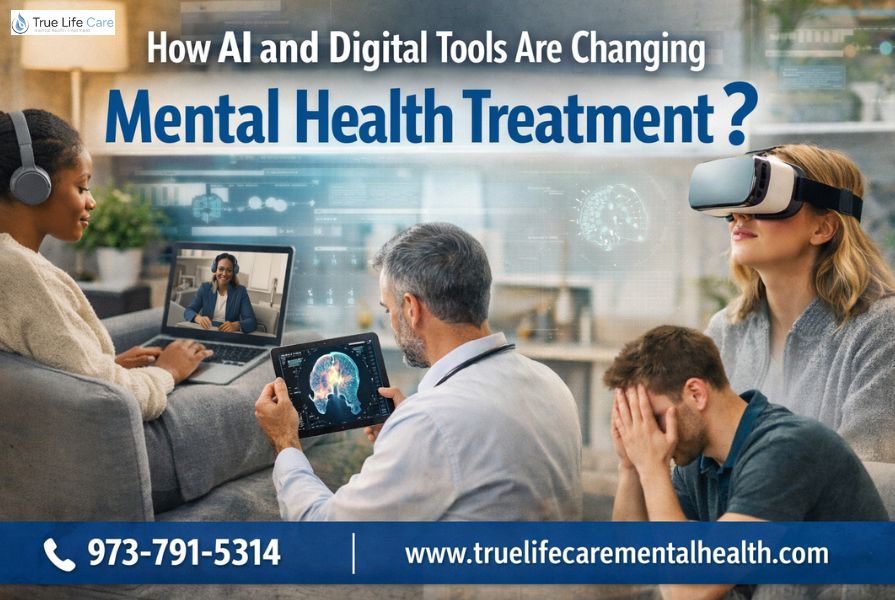
The Mental Health Care Gap That Technology Is Helping Address
The numbers around mental health in America have been hard to ignore for years. According to the National Institute of Mental Health, nearly one in five U.S. adults lives with a mental health condition in any given year. Yet a large portion of them never connect with a professional.
The reasons are familiar: long wait times, provider shortages, cost barriers, and stigma. For many people in New Jersey and across the country, finding a therapist who is accepting new patients — and whose schedule actually lines up with yours — can take weeks, sometimes longer.
That gap is exactly where digital tools have started to play a meaningful role. They do not replace a trained clinician. What they do is help bridge the distance between someone who is struggling and the point where structured, professional care begins.
Key Takeaways
- Digital tools and technology-assisted approaches are expanding access to mental health care, not replacing clinical treatment.
- The most effective use of technology in mental health involves structured integration with licensed clinicians and evidence-based care frameworks.
- Apps and monitoring tools can strengthen between-session engagement for conditions like anxiety, depression, PTSD, and bipolar disorder.
- Telehealth has meaningfully improved access for many populations, though in-person structured programs remain essential for certain levels of care.
- Patients should evaluate digital mental health tools carefully — looking for clinical evidence, human oversight, and clear data privacy standards.
- Conditions requiring intensive care, including dual diagnosis, trauma, and severe mood disorders, still call for comprehensive in-person treatment programs.
- The human relationship in therapy carries therapeutic value that technology supports but cannot substitute.
What “AI in Mental Health” Actually Means
The phrase gets used loosely, so it is worth being specific.
When researchers, clinicians, and healthcare organizations talk about technology-assisted mental health support, they are generally referring to a few distinct categories:
- Symptom screening and monitoring tools — digital questionnaires, mood trackers, and check-in apps that help someone understand their own patterns over time
- Data-informed clinical decision support — systems that help providers review treatment history, track progress, and flag when a patient’s symptoms may be worsening
- Teletherapy and digital care platforms — video and messaging-based therapy that expands access to licensed clinicians
- Psychoeducation tools — apps and online programs built around evidence-based frameworks like Cognitive Behavioral Therapy (CBT), helping people practice skills between sessions
- Crisis support systems — automated pathways that connect people in distress to real counselors faster
None of these tools diagnose mental illness on their own. None of them prescribe medication. And in any responsible clinical setting, none of them operate without human oversight.
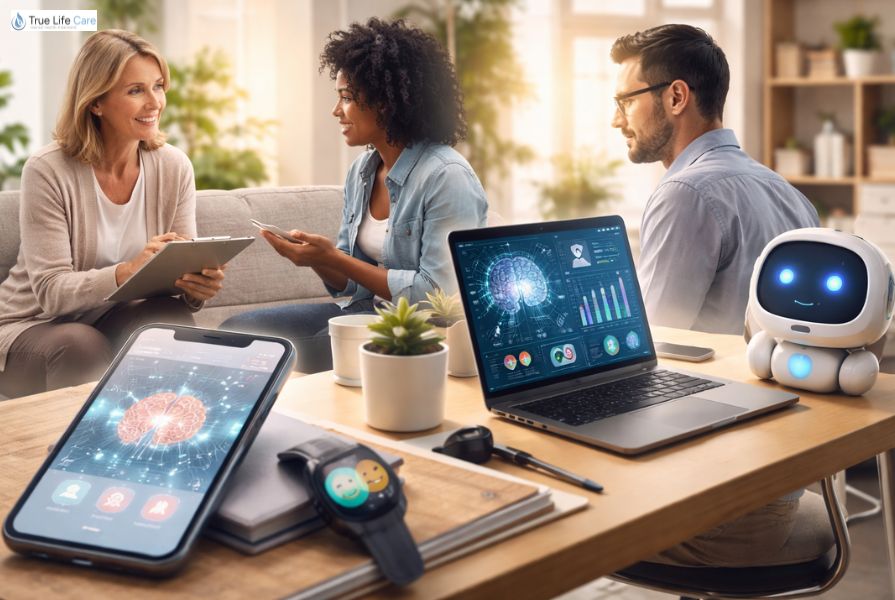
How Clinicians Are Using These Tools in Practice
At legitimate mental health treatment centers, digital tools are woven into care — not layered on top of it as an afterthought.
Intake and Assessment
A patient coming in for a partial hospitalization program or an intensive outpatient program will often complete standardized digital assessments before their first session. These screenings — such as the PHQ-9 for depression or the GAD-7 for anxiety — help clinicians build a clearer picture from day one rather than piecing information together over multiple sessions.
The assessments do not replace clinical judgment. They sharpen it. A clinician reviewing pre-intake screening data walks into that first session already oriented, which means more time can be spent on the person rather than on paperwork.
Between-Session Support
One of the most discussed applications of mental health technology is what happens between appointments. Traditional outpatient therapy might mean one session per week. That leaves six days in which symptoms can shift, coping strategies can break down, or a person can simply feel stuck.
Skill-based apps built on Cognitive Behavioral Therapy principles give patients something structured to engage with between sessions — thought logs, breathing exercises, behavioral activation prompts. When a patient arrives at their next session having tracked their mood daily, the clinician has much richer material to work with.
Progress Tracking
For conditions like depression, bipolar disorder, and anxiety, patterns matter enormously. Sleep changes, appetite shifts, energy fluctuations — these can be subtle signals that treatment needs adjustment. Digital mood tracking, when reviewed by a clinician, can make those patterns visible in a way that memory alone cannot.
The Role of Telehealth in Expanding Access
Telehealth expanded dramatically during the pandemic years, and access to mental health care specifically saw the most sustained growth. According to data from the Health and Human Services Office, teletherapy helped reach rural populations, working adults, parents of young children, and anyone for whom physically attending a clinic had been a persistent barrier.
For a person managing PTSD and working a demanding schedule, being able to connect with a therapist from home might be the difference between engaging in treatment at all and delaying it for another year.
Telehealth is not without its limits. Some individuals need in-person structure, group interaction, and a clinical environment to make real progress. That is especially true for those stepping into a partial hospitalization or dual diagnosis program for the first time. The physical setting, the staff, the peers in treatment — these elements carry therapeutic value that a screen cannot fully replicate.
Most well-designed programs today use a hybrid approach: digital tools for monitoring and between-session engagement, with in-person or live video contact for the actual therapeutic work.
A Closer Look: Technology Across Different Conditions
| Condition | How Technology Supports Treatment |
| Depression | Mood tracking apps, CBT skill tools, PHQ-9 digital monitoring |
| Anxiety | Breathing exercises, GAD-7 screening, exposure tracking apps |
| PTSD & Trauma | Psychoeducation platforms, trauma-focused journaling tools |
| Bipolar Disorder | Mood and sleep cycle tracking, medication reminder apps |
| Dual Diagnosis | Integrated monitoring systems that flag substance use and mental health simultaneously |
These tools are complementary to structured treatment — not substitutes for it. Someone dealing with a dual diagnosis of a mental health condition and substance use still needs comprehensive clinical assessment, medication evaluation, and a skilled treatment team.
What Good Technology Integration Looks Like
Not every app or digital platform is built on clinical evidence. This distinction matters a great deal.
Reputable tools in this space are developed with input from licensed mental health professionals and validated through research. They align with evidence-based practices recognized by the American Psychological Association, the Substance Abuse and Mental Health Services Administration (SAMHSA), and the National Institute of Mental Health.
When evaluating any digital mental health tool, it is worth asking:
- Was it built with clinical input? Tools developed in collaboration with licensed providers are more likely to be both safe and effective.
- Is there peer-reviewed evidence behind it? Apps tied to established therapeutic frameworks like CBT or Dialectical Behavior Therapy (DBT) carry more clinical credibility than general wellness apps.
- Does it include a clear pathway to human care? A responsible tool always connects users to professional support rather than positioning itself as a standalone solution.
- How does it handle personal data? Mental health data is sensitive. HIPAA-compliant platforms and transparent privacy policies are non-negotiable.
The Human Element Cannot Be Replaced
There is an important conversation happening in clinical circles right now about what technology can and cannot do in mental health treatment.
It can expand reach. It can support monitoring. It can reinforce skills between sessions. What it cannot do is hold space for someone in genuine crisis, pick up on the non-verbal cues that an experienced therapist notices, or make the nuanced clinical judgments that come from years of training and supervised practice.
Trauma-focused therapy, for instance, involves a degree of attunement between therapist and patient that no digital platform has replicated. The same is true for DBT therapy, which involves real-time group dynamics and a coaching relationship that technology can supplement but not replace.
The most honest framing: digital tools are clinical infrastructure. The treatment itself still depends on trained people.
What Patients and Families Should Know
If you or someone you love is navigating a mental health condition, here is what matters when it comes to technology and care:
- Technology should make care more accessible, not less personal. If a program leans entirely on apps with minimal human contact, that is a concern.
- Digital screening tools can be a good first step. Taking an online assessment can help you understand your symptoms before a first clinical appointment. It is not a diagnosis.
- Telehealth is a legitimate, evidence-supported format for many types of mental health treatment — but not for every situation. Some levels of care require in-person attendance.
- Your data matters. Any platform you use for mental health monitoring should clearly explain how your personal information is stored and protected.
- Structured programs still offer what no app can. The clinical environment, the group experience, the consistent human relationship with a therapist — these are not features that can be digitized away.
Looking Ahead: What Is Developing in This Field
Researchers and clinicians continue to explore how technology can better support mental health care without compromising it. A few areas drawing serious attention:
Predictive analytics — Using aggregated clinical data (with appropriate privacy protections) to identify patterns that may predict deterioration before a crisis occurs. This is being studied in hospital systems and outpatient settings alike.
Wearable integration — Devices that track physiological markers like heart rate variability, sleep quality, and activity levels are being explored as supplementary data sources for mental health monitoring. Early research shows some promise, though this area is still developing.
Natural language processing in clinical documentation — Clinicians spend significant time on documentation. Tools that help streamline this work — with full clinician review — could free up more time for actual patient care.
Culturally responsive digital content — There is growing recognition that many mental health tools were developed with limited cultural context. Newer efforts aim to build platforms that are genuinely accessible to diverse communities across language, culture, and lived experience.
These developments are worth watching. The field of digital mental health is moving quickly, and the quality of evidence behind different approaches varies significantly.
Frequently Asked Questions
1. Can an app replace therapy for anxiety or depression?
No app replaces therapy. Digital tools built around CBT or mindfulness can support skill practice between sessions, but structured treatment with a licensed clinician remains the standard of care for anxiety and depression. They work best as a complement to professional treatment, not a substitute.
2. What is the difference between telehealth therapy and in-person therapy?
Both are delivered by licensed clinicians. Telehealth happens via secure video or messaging platforms, while in-person therapy takes place at a physical treatment center. Research suggests outcomes are comparable for many conditions, though some levels of care — like partial hospitalization — require in-person attendance for full effectiveness.
3. How do mental health apps use my personal information?
Reputable mental health apps follow HIPAA guidelines and disclose how data is collected, stored, and shared. Before using any platform, review its privacy policy. Clinical platforms used within licensed treatment programs are held to stricter standards than general consumer wellness apps.
4. Is teleherapy covered by insurance?
Many insurance plans now cover telehealth mental health services, particularly following changes made permanent after 2020. Coverage specifics vary by plan and provider. Contacting your insurance carrier or a treatment center’s admissions team can clarify your benefits.
5. What does “AI-powered” mental health support actually mean?
In practice, it often refers to tools that automate screening, flag risk patterns in data, or personalize psychoeducation based on user input. These functions require clinical oversight. No technology autonomously diagnoses or treats mental health conditions.
6. Can digital tools help with PTSD treatment?
Some research supports the use of digital platforms to reinforce psychoeducation and coping skills for PTSD between sessions. However,trauma-focused therapy itself requires a skilled clinician. Technology here is a support structure, not a treatment.
7. How do I know if a mental health app is clinically sound?
Look for tools developed with licensed mental health professionals, tied to evidence-based frameworks like CBT or DBT, with published research behind them. SAMHSA maintains resources that can help evaluate digital mental health options.
Ready to Take the Next Step?
If you or someone you care about is dealing with anxiety, depression, PTSD, bipolar disorder, or a dual diagnosis condition, the most important step is talking to someone who can actually assess where things stand.
At True Life Care Mental Health in New Jersey, our team offers structured, evidence-based programs across multiple levels of care — from intensive outpatient to partial hospitalization — built around real clinical relationships. Technology supports our work. But care is still fundamentally human here.
Call us at (973) 791-5314 or verify your insurance online to get started today.
References & Resources
- National Institute of Mental Health (NIMH) — Statistics on mental illness prevalence in the U.S.: nimh.nih.gov
- Substance Abuse and Mental Health Services Administration (SAMHSA) — Treatment guidelines, crisis resources, and digital mental health tool evaluation: samhsa.gov
- American Psychological Association (APA) — Evidence-based practice standards and telehealth guidance: apa.org
- Health and Human Services Office (HHS) — Telehealth expansion and mental health access policy documentation: hhs.gov
- National Alliance on Mental Illness (NAMI) — Consumer resources on mental health treatment options: nami.org
- 988 Suicide and Crisis Lifeline — Immediate support for mental health crises: 988lifeline.org
- HIPAA Privacy Rule — U.S. Department of Health and Human Services guidance on health data protection: hhs.gov/hipaa
- Journal of Medical Internet Research (JMIR) — Peer-reviewed research on digital mental health interventions: jmir.org