
Some days, you wake up and just feel… heavy.
You aren’t in an immediate crisis, and you don’t feel completely broken. It’s not dramatic enough to call an emergency, but it’s enough to affect your life every single day.
On the outside, you’re still functioning, going to work, talking to friends, and showing up for responsibilities. But internally, something feels off.
When weekly therapy sessions aren’t moving the needle enough, but full hospitalization isn’t necessary, an Intensive Outpatient Program (IOP) for depression in New Jersey bridges that gap. It provides structured, consistent support while allowing you to maintain your daily life.
Therapy vs. IOP for Depression: How to Know What You Need
If you’re questioning whether your current support is enough, you might notice:
- Therapy helps temporarily, but the relief fades
- You keep falling into the same negative thought patterns
- You understand your depression—but can’t change how you feel
An IOP for depression in NJ is designed for this exact stage.
It gives you more support without taking away your independence.
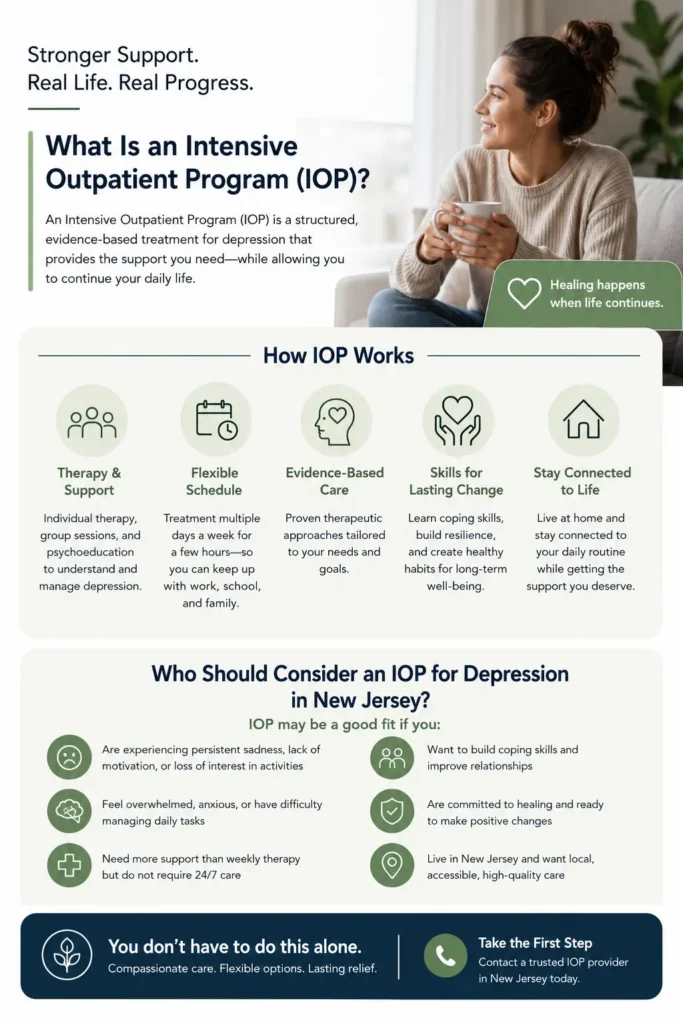
What Is an Intensive Outpatient Program (IOP)?
An Intensive Outpatient Program (IOP) is a structured mental health treatment program that allows you to receive intensive care while continuing to live at home.
In a typical New Jersey intensive outpatient program, your care plan includes:
- 3 to 5 therapy sessions per week
- A combination of individual counseling and group therapy
- Evidence-based treatment for depression
You can learn more about the structure and approach here:
Intensive Outpatient Program in New Jersey
Real Outcomes: When Weekly Therapy Isn’t Enough
A working professional in New Jersey shared:
“I wasn’t in crisis, but I just didn’t feel like myself anymore.”
They were:
- Going to work
- Staying socially active
- But mentally exhausted every day
After transitioning into an IOP for depression in New Jersey:
- Their routine stabilized
- Sleep improved
- Thoughts became more manageable
Not overnight, but steadily.

Who Should Consider an IOP for Depression in New Jersey?
This level of care is effective if you are experiencing:
- Persistent low mood most days
- Loss of interest in activities
- Constant overthinking and burnout
- Mental exhaustion that affects daily life
- A need for structured support without hospitalization
If symptoms feel more intense or overwhelming, a higher level of care may be appropriate. You can explore that option here: Partial Care Program in New Jersey
What to Expect During IOP Treatment
In simple terms, IOP helps you:
- Understand your thought patterns
- Learn how to manage daily triggers
- Rebuild structure in your life
- Stop handling everything alone
It’s not just about talking, it’s about applying real tools.
Will I Have to Speak in Group Therapy?
This is one of the most common concerns.
The answer is no.
- You can go at your own pace
- No one forces you to speak
- Listening itself can be helpful
Many people find group sessions to be one of the most valuable parts of their recovery.
IOP Schedule in New Jersey: Managing Treatment with Life
A typical IOP schedule in NJ includes:
- 3 to 5 days per week
- 2 to 4 hours per day
This allows you to continue:
- Working
- Staying with family
- Maintaining your routine
If you’re looking for less structured support, you can explore: Outpatient Mental Health Program in New Jersey
Does IOP for Depression Actually Work?
Yes, when you stay consistent.
IOP works because:
- You maintain momentum between sessions
- You apply what you learn immediately
- You stay supported throughout the process
Do I Need Medication?
Not necessarily.
Some people improve with therapy alone.
Others benefit from a combination of therapy and medication.
Your treatment plan is personalized.
How Long Does an IOP Program Last?
Most IOP programs in New Jersey last:
- 4 to 12 weeks
The duration depends on your progress and individual needs.
Is IOP Covered by Insurance in New Jersey?
In many cases, yes.
Most insurance providers cover intensive outpatient programs for depression as they are considered medically necessary.
Clinical Expertise and Patient Experiences
This program is delivered by:
- Licensed therapists
- Clinical psychologists
- Medical professionals when needed
All care is evidence-based and personalized.
What Patients and Families Say
“I came here during one of the worst phases of my life… the house didn’t feel like an institution. I finally felt properly diagnosed for the first time.”
“Group therapy felt intimidating at first, but once I opened up, I didn’t regret it. The people were inspiring and kind.”
“I had a truly life-changing experience. The clinicians are exceptional and the results were far beyond what I expected.”
“This place focuses on real growth—helping you rebuild confidence, hope, and balance.”
“Within weeks, we could see hope and stability coming back. This is a place where healing actually happens.”
Take the First Step Toward Feeling Better
You don’t have to wait until things get worse.
If something feels consistently off, that’s already a reason to get help.
An Intensive Outpatient Program (IOP) for depression in New Jersey gives you the structure, support, and guidance needed to move forward.
Start here:
Explore the Intensive Outpatient Program
Final Thought
You don’t need to figure everything out alone. Sometimes, the difference is only the right level of support. And for many people in New Jersey, that’s exactly what IOP provides.
Frequently Asked Questions About IOP for Depression in New Jersey
Is an IOP for depression really worth it?
If your current therapy isn’t helping enough, IOP provides more structure and support, which often leads to faster and more consistent improvement.
Can I stop the program if I feel better?
Yes. Your treatment plan is flexible and based on your progress. Clinicians guide you on when it’s best to step down.
Will I be judged in group therapy?
No. Everyone in the program is going through something similar. Most people feel understood rather than judged.
Can I continue working during IOP?
Yes. Most programs in New Jersey are designed with flexible schedules so you can manage work and treatment.
What happens after IOP ends?
Most people transition to a less intensive program or regular therapy to maintain progress.
How can I start my treatment for IOP in New Jersey?
Starting is simpler than most people expect:
- Reach out to the treatment center
- Speak briefly about what you’re experiencing
- Get a professional recommendation for the right level of care
You can begin here: https://truelifecarementalhealth.com/intensive-outpatient-program/
There’s no pressure to commit immediately; the goal is just to understand what kind of support you need.