
Why Finding the Right Mental Health Treatment Program Monmouth County NJ Matters
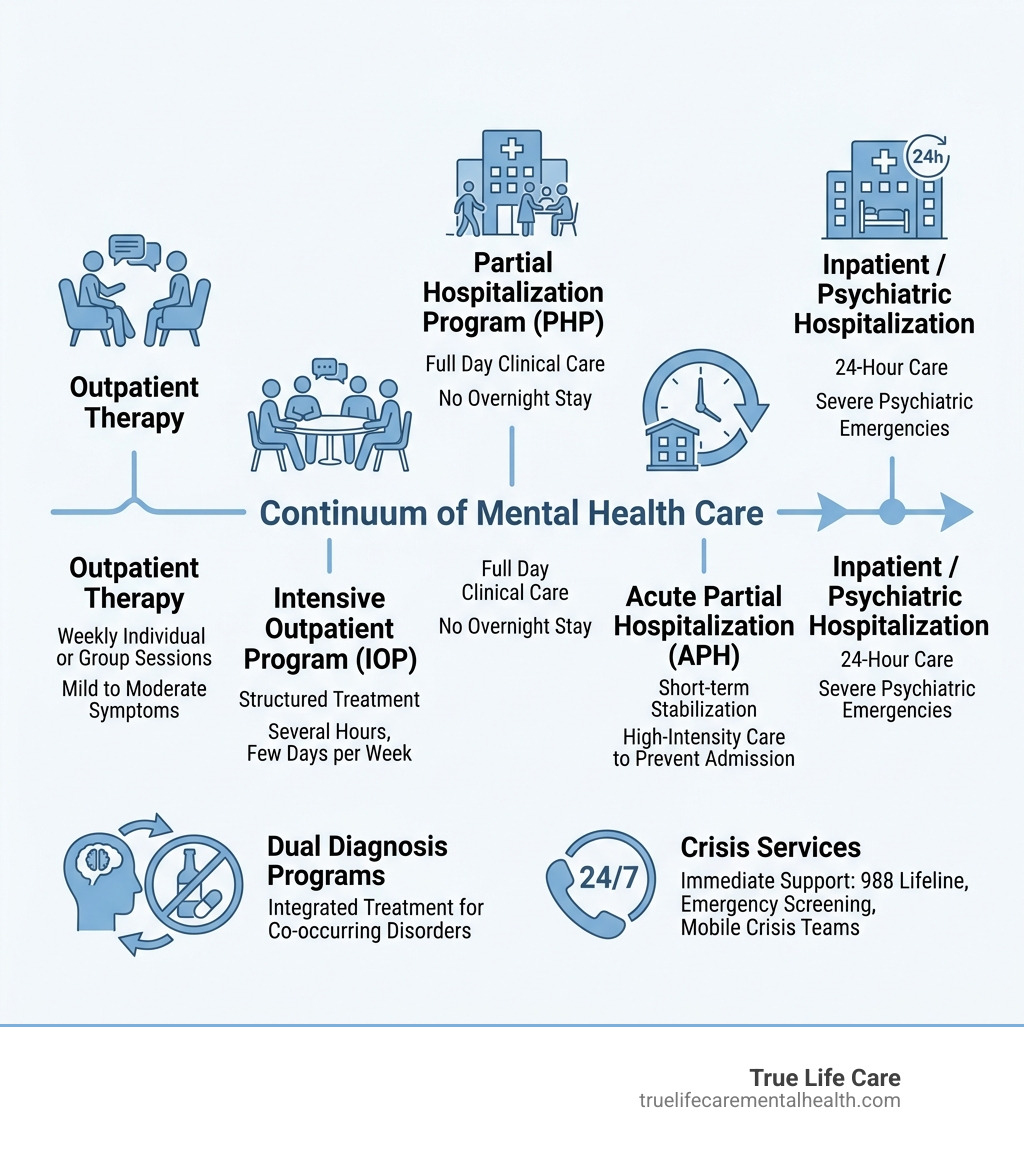
If you are looking for a mental health treatment program Monmouth County NJ, here is a quick overview of your main options:
- Outpatient Therapy – Weekly individual or group sessions for mild to moderate symptoms
- Intensive Outpatient Program (IOP) – Structured treatment several hours per day, a few days per week
- Partial Hospitalization Program (PHP) – Full days of clinical care without overnight stays
- Acute Partial Hospitalization (APH) – Short-term, high-intensity stabilization to prevent inpatient admission
- Inpatient / Psychiatric Hospitalization – 24-hour care for severe psychiatric emergencies
- Dual Diagnosis Programs – Integrated treatment for co-occurring mental health and substance use disorders
- Crisis Services – 24/7 support via the 988 Lifeline, Psychiatric Emergency Screening, and Mobile Crisis teams
True Life Care serves Monmouth County residents from its Matawan, NJ location and is an out-of-network provider that accepts PPO insurance plans.
Mental health challenges touch nearly every family. Across Monmouth County, adults are managing everything from depression and anxiety to schizophrenia and co-occurring addiction — often without knowing where to turn first. The landscape of mental health in New Jersey is vast, stretching from the coastal communities of Asbury Park and Long Branch to the suburban corridors of Marlboro and Holmdel. Each of these communities faces unique stressors, yet they all share a common need for accessible, high-quality clinical intervention.
The need is real. The Monmouth County Division of Behavioral Health, which merged mental health and substance use services in 2020, coordinates a wide network of providers across the county. Organizations like CPC Integrated Health serve over 12,000 clients annually, and still, many residents struggle to find the right level of care at the right time. This high demand often leads to long waitlists at state-funded facilities, making the availability of private, out-of-network options like True Life Care essential for those who need immediate and intensive support.
Getting help should not feel like solving a puzzle.
That is why this guide exists. Whether you are in crisis right now, stepping down from a hospital stay, or simply realizing that weekly therapy is no longer enough — there is a program designed for exactly where you are. We aim to demystify the clinical jargon and provide a roadmap for recovery that is both compassionate and evidence-based. In Monmouth County, we are fortunate to have a robust continuum of care, but navigating it requires an understanding of how different programs interact and which one aligns with your specific diagnostic needs.
Below, you will find a clear breakdown of every major type of mental health treatment available in Monmouth County, who each program is best suited for, and how to take the next step toward lasting wellness.
Mental Health Treatment Program Monmouth County NJ terms you need:
- ADHD Treatment in New Jersey
- Mental Health Facilities that accept Horizon
- Mental Health Treatment in Ocean County New Jersey
Comprehensive Mental Health Treatment Program Monmouth County NJ Options
When you or a loved one begins the search for a Mental Health Treatment Program Monmouth County NJ, the sheer volume of information can be overwhelming. In April 2026, the landscape of care in New Jersey has evolved to be more integrated and person-centered than ever before. Modern facilities now utilize multidisciplinary staff—including psychiatrists, advanced practice nurses, licensed clinical social workers, and primary care physicians—to ensure that every aspect of a person’s well-being is addressed. This holistic approach recognizes that mental health does not exist in a vacuum; it is inextricably linked to physical health, social stability, and environmental factors.

One of the most important developments in local care is the use of specialized clinical tracks. Rather than a “one size fits all” approach, the best programs offer specific pathways for different age groups and diagnoses. For instance, a young adult struggling with their first episode of psychosis requires a vastly different therapeutic environment than an older adult managing treatment-resistant depression or a professional balancing a career with an anxiety disorder. These tracks allow for peer-to-peer connection among individuals facing similar life stages and challenges, which is a critical component of the healing process.
Individualized care plans are the gold standard. We believe that treatment should be as unique as the person receiving it. This involves a comprehensive biopsychosocial assessment at the start of the journey to identify not just the symptoms, but the environmental, biological, and social factors contributing to the struggle. This assessment looks at everything from sleep patterns and nutritional habits to family history and workplace stress. For a deeper dive into how these services are organized locally, you can explore the Monmouth County Mental Health Guide.
Understanding the Levels of Care: PHP, IOP, and APH in a Mental Health Treatment Program Monmouth County NJ
Navigating the “alphabet soup” of mental health acronyms is a common hurdle for families. Understanding these levels of care is essential for matching the intensity of treatment to the severity of the symptoms. Each level serves as a specific tool in the clinician’s toolkit, designed to provide the maximum amount of support while allowing for the maximum amount of independence possible.
- Partial Hospitalization Program (PHP): This is often referred to as “day treatment.” It provides a high level of clinical structure, typically meeting five days a week for several hours a day (usually 9:00 AM to 3:00 PM). It is designed for those who need more than traditional outpatient therapy but do not require 24-hour supervision. PHP is an excellent option for individuals who are struggling to maintain daily routines or those who require frequent medication adjustments under the close supervision of a psychiatrist.
- Intensive Outpatient Program (IOP): An IOP offers more flexibility, often meeting three days a week for three hours per session. This level of care is ideal for individuals transitioning from a higher level of care or those whose symptoms are impacting their daily functioning but still allow them to live at home and perhaps maintain part-time work or school commitments. You can find more details on IOP Programs In Monmouth County NJ to see if this fits your schedule.
- Acute Partial Hospital (APH): This is a specialized, short-term program focused on rapid stabilization. The primary goal of APH is to prevent the need for full inpatient psychiatric hospitalization or to provide a safe “bridge” for those recently discharged from a hospital. APH programs are high-intensity and focus heavily on crisis management and immediate symptom reduction.
By utilizing these levels of care as a “step-down” process, we help patients gradually reintegrate into their daily lives while maintaining a strong safety net of support. This continuum of care is proven to reduce the risk of relapse and re-hospitalization, as it prevents the “cliff effect” where a patient goes from 24-hour care to no care at all.
Specialized Support for Schizophrenia and Severe Mental Illness within a Mental Health Treatment Program Monmouth County NJ
For individuals living with schizophrenia, schizoaffective disorder, or severe bipolar disorder, specialized psychiatric care is non-negotiable. These conditions require a sophisticated blend of medication management and psychosocial support to achieve long-term stability. In Monmouth County, the approach to severe mental illness (SMI) has shifted toward a recovery-oriented model, which emphasizes the person’s strengths and potential for a fulfilling life rather than just the management of symptoms.
In Monmouth County, comprehensive programs focus on symptom reduction through evidence-based medicine and psychoeducation. It is not just about “taking a pill”; it is about helping the individual and their family understand the nature of the illness, recognize early warning signs of a flare-up, and develop strategies for independent living. This often includes Social Skills Training (SST) and Cognitive Adaptation Training (CAT), which help individuals navigate the practicalities of daily life.
Expert Psychiatric Care In Monmouth County NJ involves regular meetings with psychiatrists or psychiatric nurse practitioners who specialize in complex cases. These clinicians stay abreast of the latest pharmacological advancements, including long-acting injectables (LAIs) which can be life-changing for those who struggle with medication adherence. To ensure the best start to this process, many providers follow strict protocols, often referred to as the 10 Commandments of Psychiatric Evaluations in Monmouth County NJ, to ensure no stone is left unturned during the initial diagnostic phase.
Emergency Services and Crisis Intervention in Monmouth County
A mental health crisis can happen at any time—on a Tuesday afternoon or at 3:00 AM on a Sunday. Knowing exactly who to call can be life-saving. Monmouth County has a robust network of emergency services designed to de-escalate crises and provide immediate stabilization. The county’s approach is built on the principle of “least restrictive care,” meaning the goal is to help the individual stay in the community whenever it is safe to do so.
The Psychiatric Emergency Screening Services (PESS) are the front lines of crisis care. These centers, located within major medical facilities like Monmouth Medical Center in Long Branch and Jersey Shore University Medical Center in Neptune, provide 24/7 evaluations. These units are staffed by certified mental health screeners, psychiatrists, and nurses who are trained to assess risk and determine the most appropriate level of care. If you or a loved one is in immediate danger, these are the primary locations for help.
For those who need support but may not require a trip to the emergency room, the 988 Suicide & Crisis Lifeline offers free, confidential support via call, text, or chat. In Monmouth County, this is often integrated with Mobile Crisis Outreach Response Teams (MCORT). These teams consist of crisis workers and peer specialists—individuals with lived experience in recovery—who can meet an individual in the community to provide on-site de-escalation. This mobile approach is vital for reducing the trauma often associated with psychiatric emergencies and avoiding the need for law enforcement involvement.
Additionally, the Disaster Response Crisis Counselor Team (DRCC) is a specialized group deployed during natural or man-made disasters to provide psychological first aid to residents. This was particularly evident during the aftermath of Superstorm Sandy and throughout the COVID-19 pandemic, where DRCC members provided essential support to a grieving and stressed community. Whether it is a personal crisis or a community-wide event, Monmouth County residents have access to immediate, compassionate care. The county also utilizes the “Early Intervention Support Services” (EISS) model, which provides rapid-access outpatient care for those who are in distress but do not meet the criteria for involuntary commitment.
Evidence-Based Modalities: Group Therapy and Healing Approaches
Modern mental health treatment has moved far beyond simple “talk therapy.” Today, a Mental Health Treatment Program Monmouth County NJ will likely incorporate a variety of evidence-based modalities designed to rewire the brain and provide practical coping tools. These therapies are grounded in clinical research and are proven to be effective for a wide range of psychiatric conditions.
- Cognitive Behavioral Therapy (CBT): This is the gold standard for many conditions. It focuses on identifying and changing negative thought patterns and behaviors. By recognizing “cognitive distortions”—such as catastrophizing or all-or-nothing thinking—patients can learn to respond to challenges in a more balanced and productive way.
- Dialectical Behavior Therapy (DBT): Originally developed for borderline personality disorder, DBT is now used for any condition involving intense emotional dysregulation. It teaches four key skill sets: mindfulness, distress tolerance, emotional regulation, and interpersonal effectiveness. It is particularly excellent for individuals who struggle with self-harm or chronic suicidal ideation.
- EMDR (Eye Movement Desensitization and Reprocessing): A powerful tool for treating PTSD and trauma. EMDR helps the brain reprocess traumatic memories so they no longer trigger a fight-or-flight response. It is often producing results in weeks that traditional therapy might take years to achieve, making it a cornerstone of trauma-informed care in Monmouth County.
- Spravato (Esketamine): An innovative, FDA-approved nasal spray treatment for treatment-resistant depression. Offered at specialized centers in Monmouth County, Spravato is administered under medical supervision and has provided hope for individuals who have not found relief through traditional antidepressants.
For those struggling with persistent worry, reading an Anxiety Treatment In Monmouth County NJ Review can help in understanding which modalities are currently most effective. Similarly, if you are seeking a way out of the darkness of low mood, check out these 5 Effective Tips For Depression Treatment In Monmouth County NJ.
We also recognize the importance of holistic healing. Programs like the “Wellness Within” yoga series combine restorative physical movement with therapeutic group discussions. This approach addresses the somatic (body-based) symptoms of mental illness, such as the muscle tension associated with anxiety or the lethargy associated with depression. By integrating the mind, body, and spirit, we foster a more comprehensive and lasting recovery process.
The Power of Group Therapy in Depression Treatment
Group therapy is a cornerstone of effective depression treatment. While depression often lies to you, telling you that you are alone in your struggle and that no one could possibly understand your pain, group therapy provides immediate, tangible evidence to the contrary. It breaks the cycle of isolation that is both a symptom and a cause of depressive disorders.
In a group setting, facilitated by expert clinicians, peers share their experiences and offer mutual support. This shared journey helps to reduce the crushing isolation that often accompanies mental illness. Participants develop “interpersonal effectiveness”—the ability to communicate their needs, set boundaries, and build healthy relationships—which is vital for long-term emotional resilience. Healing in a communal setting allows individuals to practice new coping skills in a safe, “real-world” environment before applying them to their lives outside of treatment. The “universality” found in groups—the realization that others share similar thoughts and feelings—is one of the most powerful therapeutic factors in modern psychology.
Specialized Programs for Dual Diagnosis and Specific Demographics
Many people struggling with mental health also face challenges with substance use. This is known as a dual diagnosis or co-occurring disorder. In the past, these issues were often treated separately, which frequently led to poor outcomes. Today, integrated programs in Monmouth County address both issues simultaneously. This means that the same clinical team works on both the psychiatric symptoms and the addiction, ensuring that the root causes of substance use—often self-medication for untreated trauma or depression—are addressed.
| Program Type | Target Demographic | Key Focus Areas |
|---|---|---|
| Youth & Family | Children & Adolescents | School stability, family dynamics, PerformCare integration, bullying issues |
| Young Adult | Ages 18-25 | Life skills, vocational support, identity formation, “failure to launch” support |
| Adult | Ages 26-64 | Career balance, parenting, trauma-informed recovery, stress management |
| Senior Citizen | Ages 65+ | Grief/loss, cognitive health, medication interactions, social isolation |
| Dual Diagnosis | All Adults | Integrated SUD and psychiatric care, relapse prevention, 12-step integration |
Beyond age-specific care, Monmouth County offers specialized resources for the LGBTQIA+ community, ensuring that treatment is provided in an affirming and culturally competent environment. There are also specific tracks for gambling disorder treatment, which is a growing concern in the region. Furthermore, the Housing Supports Program is a critical resource that helps individuals with serious mental illness secure and maintain stable housing, recognizing that recovery is nearly impossible without a safe place to sleep.
These stigma-free initiatives ensure that every resident, regardless of their background, gender identity, or specific challenge, feels seen and supported. The goal is to remove every possible barrier to care, whether that barrier is social, physical, or psychological. By providing specialized tracks, Monmouth County providers can tailor their interventions to the specific cultural and developmental needs of each patient, leading to higher engagement and better long-term outcomes.
Navigating Insurance and Accessing Care in Matawan, NJ
We understand that the logistics of starting treatment can be a major barrier. At True Life Care, we aim to make the intake process as seamless as possible for Monmouth County residents. We believe that when someone reaches out for help, they should be met with immediate support rather than a bureaucratic maze.
Our facility is located in Matawan, NJ, making it highly accessible for those living in the northern and central parts of the county, including Aberdeen, Old Bridge, and Marlboro. True Life Care is an out-of-network provider and primarily accepts PPO insurance plans. This out-of-network status allows us to maintain a high standard of personalized care, offering lower staff-to-patient ratios and more individualized attention than many state-funded or in-network programs. By operating outside of the restrictive contracts of some insurance networks, we can focus entirely on the clinical needs of the patient rather than the administrative requirements of the insurer.
When you contact us, we begin with a thorough biopsychosocial assessment. This is not just a checklist; it is a deep dive into your history, your strengths, and your goals for the future. We also work closely with the Monmouth County Division of Behavioral Health and other referral networks to ensure that if our program isn’t the perfect fit for your specific clinical or insurance needs, we help you find the one that is. Our goal is to reduce the wait times that have historically plagued the mental health system; in fact, many local providers have successfully reduced wait times by over 50% through improved Access Center coordination and the expansion of private treatment options.
Choosing an out-of-network provider often means more flexibility in treatment modalities and a more private, boutique-style environment. For many of our clients, this environment is essential for feeling safe enough to engage in the deep work of recovery. We provide assistance in navigating your out-of-network benefits to ensure you understand exactly how your PPO plan works within our system.
Frequently Asked Questions about Mental Health Treatment in Monmouth County
How do I access emergency psychiatric services in Monmouth County?
If you are experiencing a life-threatening emergency, call 911 or go to the nearest emergency room. For a psychiatric crisis that is not immediately life-threatening, you can contact the Psychiatric Emergency Screening Services (PESS) at Monmouth Medical Center (732-923-6999) or Jersey Shore University Medical Center (732-776-4555). You can also call or text 988 to reach the Suicide & Crisis Lifeline 24/7. These services are available to all residents regardless of their insurance status.
What is the difference between PHP and IOP programs?
The primary difference is the intensity and time commitment. A Partial Hospitalization Program (PHP) is a full-day commitment (usually 5-6 hours a day, 5 days a week) and is designed for stabilization and intensive clinical work. It is often used as an alternative to inpatient care. An Intensive Outpatient Program (IOP) is typically 3 hours a day, 3 days a week, allowing participants to maintain work or school schedules while still receiving intensive clinical support. IOP is often a “step-down” from PHP.
Are there specialized services for children and adolescents?
Yes. New Jersey’s PerformCare (1-877-652-7624) is the central point of entry for all children’s behavioral health services in the state. Monmouth County also offers Children’s Mobile Crisis Response, which can be deployed to a home or school to help de-escalate a situation involving a minor. Many local hospitals also offer youth-specific IOP and PHP tracks that address issues like school refusal, social media-related anxiety, and family conflict.
Does True Life Care accept my insurance?
True Life Care is an out-of-network provider. We primarily work with PPO insurance plans, which typically offer out-of-network benefits. We recommend contacting our admissions team for a free benefits verification. This process allows us to explain how your specific plan may cover the costs of our PHP or IOP programs. We do not participate in any state-funded or HMO-only networks.
What should I expect during my first assessment?
Your first assessment is a comprehensive evaluation conducted by a licensed clinician. You will discuss your mental health history, current symptoms, any history of substance use, and your personal goals for treatment. This assessment usually takes about 60 to 90 minutes and is used to create your individualized treatment plan. It is a collaborative process where your voice and your preferences are prioritized.
Can I continue to work while in treatment?
Yes, depending on the level of care. Our Intensive Outpatient Program (IOP) is specifically designed to be flexible, with morning or evening sessions that allow many participants to continue working or attending school. However, if you are in the Partial Hospitalization Program (PHP), the time commitment usually requires a temporary leave of absence from work, which can often be covered under the Family and Medical Leave Act (FMLA).
Conclusion
Recovery is not just about the absence of symptoms; it is about the presence of a meaningful, self-directed life. In Monmouth County, the resources are vast and diverse—ranging from vocational rehabilitation and peer-led support groups to the advanced psychiatric care offered at our Matawan location. The journey toward mental wellness is rarely a straight line, but with the right support system, it is a journey that leads to lasting transformation.
The Monmouth County Division of Behavioral Health continues to lead the way in New Jersey by integrating services and reducing stigma, ensuring that mental health is treated with the same urgency and respect as physical health. Whether you are seeking help for depression, schizophrenia, or a complex dual diagnosis, you are not alone in this journey. The community of providers in this county is dedicated to ensuring that no resident falls through the cracks.
At True Life Care, we are dedicated to the long-term well-being of our neighbors. As an out-of-network provider focusing on high-quality, individualized care, we pride ourselves on creating a sanctuary for healing. We invite you to reach out and Start your journey with Mental Health Treatments in New Jersey today. Your path to healing, independence, and a brighter future starts with a single, courageous conversation. Our team is ready to listen and help you navigate the next steps toward the life you deserve.
External Resources for New Jersey Residents: