
When Your Mind Won’t Stop: Finding OCD Treatment in New Jersey

OCD treatment New Jersey residents can access spans several proven, evidence-based options. Here is a quick overview of what’s available:
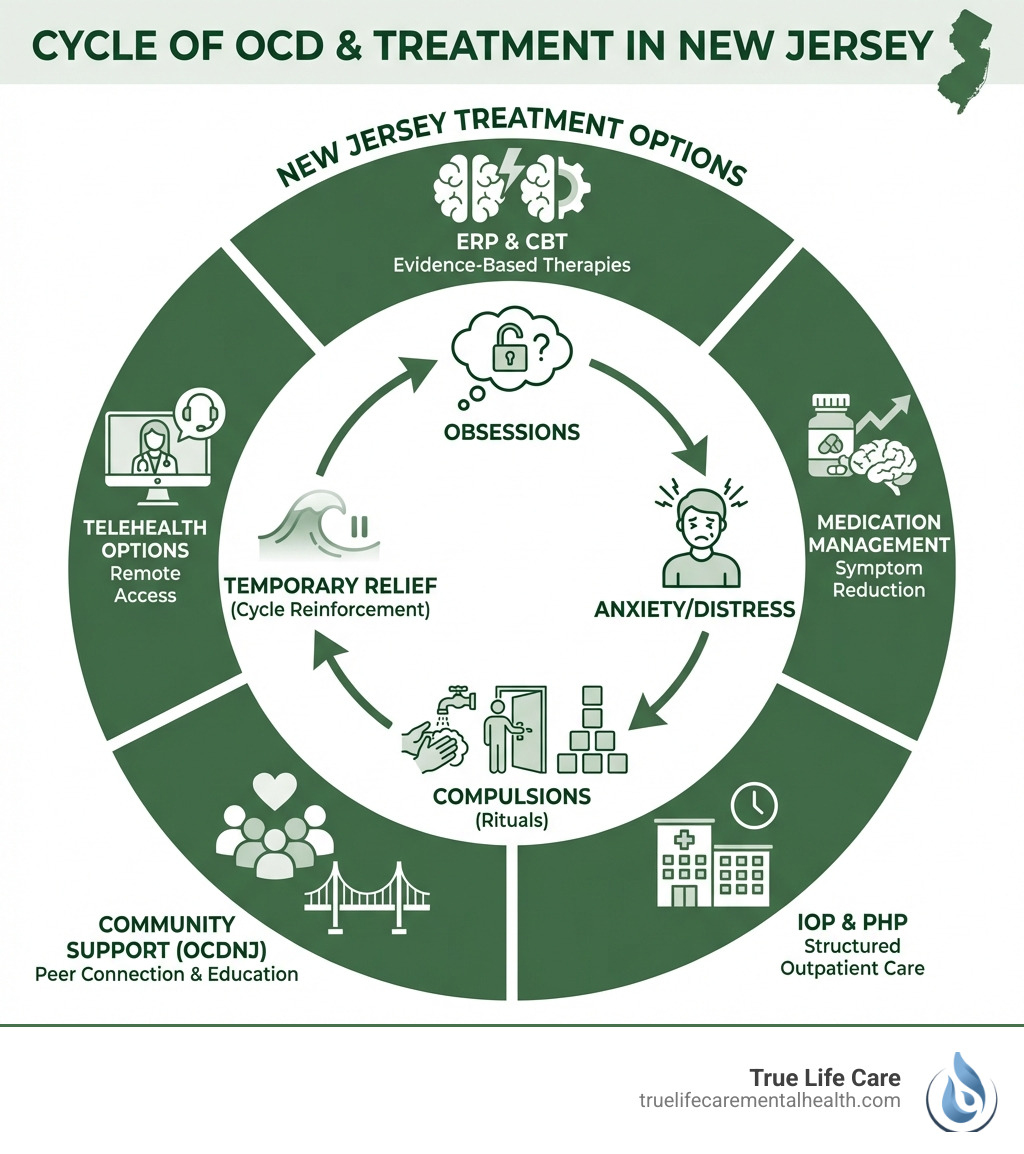
- Exposure and Response Prevention (ERP) – the gold standard therapy for OCD
- Cognitive Behavioral Therapy (CBT) – helps reframe negative thought patterns
- Medication management – SSRIs can reduce symptoms by 60-70%
- Intensive Outpatient Programs (IOP) – structured care without full hospitalization
- Partial Hospitalization Programs (PHP) – higher-level support for more severe cases
- Telehealth options – remote access to licensed OCD specialists
- Community support – nonprofits like OCD New Jersey (OCDNJ) offer education and peer connection
OCD is far more common than most people realize. It affects 1 in 40 adults and 1 in 200 children in the United States — that’s roughly 6.5 million Americans living with relentless, unwanted thoughts and the exhausting rituals that follow.
If you live in New Jersey and recognize this pattern in yourself or someone you love, you are not alone. And more importantly, effective help exists close to home.
OCD is not about being a neat freak or a worrier. It is a chronic condition where the brain gets stuck in a loop — generating distressing thoughts and then demanding behaviors to make the discomfort stop. That loop can consume hours every day and quietly dismantle relationships, careers, and quality of life.
The good news? OCD is highly treatable. With the right specialist and the right approach, most people see meaningful, lasting relief.
OCD treatment new jersey resources:
- Mental health programs in New Jersey
- More info about DBT for OCD
- How to support a loved one with OCD
Understanding OCD: Symptoms and the Cycle of Obsessions
To find the right OCD treatment New Jersey has to offer, we first have to understand what we are fighting. Obsessive-Compulsive Disorder is often described as a “hiccup” in the brain. Imagine a record player where the needle gets stuck on a single, scratchy line of music. No matter how much you want to hear the rest of the song, that one line keeps playing over and over.
In OCD, that “scratchy line” is an obsession—an intrusive, unwanted thought, image, or urge. To stop the noise, the brain demands a compulsion—a repetitive behavior or mental act. While the compulsion provides a few seconds of relief, it actually reinforces the “stuck” needle, making the next obsession even louder.

The Statistics of the Struggle
Research shows that 2.3% of U.S. adults will live with OCD at some point in their lives. Interestingly, the prevalence is slightly higher in females (1.8%) compared to males (0.5%) in certain adult demographics. Globally, OCD is ranked as the tenth leading cause of disability. It isn’t just a “quirk”; it’s a neuropsychiatric illness that costs billions in lost productivity and medical expenses.
Common themes we see in our New Jersey communities include:
- Contamination: An intense fear of germs, chemicals, or “dirty” surfaces.
- Symmetry and Ordering: The need for items to be aligned “just right” or for tasks to be completed in a specific, perfect sequence.
- Checking: Repeatedly verifying that the stove is off, the door is locked, or that you didn’t accidentally harm someone while driving.
- Intrusive Thoughts: Distressing images or urges that feel completely out of character, often involving harm or taboo subjects.
Differentiating Intrusive vs. Impulsive Thoughts
One of the biggest hurdles in seeking OCD treatment New Jersey is the shame associated with intrusive thoughts. We often hear patients ask, “If I thought about something bad, does that mean I want to do it?”
The answer is a resounding no. In fact, it’s usually the opposite.
- Intrusive Thoughts (OCD): These are “ego-dystonic,” meaning they go against your actual values. They are unwanted, horrifying, and cause immense anxiety. You do rituals specifically to ensure these thoughts never come true.
- Impulsive Thoughts: These are spontaneous urges to act, often without much regard for the consequences.
In a clinical setting, we look for a one-hour diagnostic threshold. If these thoughts and behaviors take up more than an hour of your day and cause significant functional impairment—meaning you’re late for work in Clifton, struggling with school in Montville, or avoiding social gatherings in Bergen County—it’s time to look at specialized care.
Evidence-Based OCD Treatment New Jersey: The Gold Standard Approaches
When you’re looking for a way out of the loop, you don’t just need “talk therapy.” You need evidence-based protocols designed to rewire the brain’s response to anxiety. At True Life Care Mental Health, we believe in a holistic approach that combines psychological tools with psychiatric expertise.
The two heavy hitters in OCD treatment New Jersey are Cognitive Behavioral Therapy (CBT) and its specialized offshoot, Exposure and Response Prevention (ERP). While CBT helps us identify and challenge the distorted “rules” the OCD brain creates, ERP is the muscle that actually breaks the cycle.
We also find that for many, Dialectical Behavior Therapy (DBT) plays a vital role. DBT provides the emotional regulation skills needed to sit with the intense discomfort that arises when you stop performing your compulsions. It’s about building a “life worth living” even while the mind is being noisy.
Exposure and Response Prevention (ERP) as a Primary OCD Treatment New Jersey
If ERP sounds intimidating, you aren’t alone. It is often called the “gold standard” for a reason.
The “Exposure” part involves gradually and safely facing the thoughts or situations that trigger your anxiety. The “Response Prevention” part is the secret sauce: it means choosing not to do the ritual or compulsion that usually follows.
Through a process called habituation, your brain eventually learns that the “danger” isn’t real. The anxiety naturally peaks and then drops—all on its own, without you needing to wash your hands twenty times or check the lock for the fifth time. Over time, your tolerance for uncertainty grows, and the OCD loses its power.
Medication Management and Pharmacotherapy
While therapy is the primary tool, medication can be a powerful ally. Think of it as lowering the “volume” of the OCD so you can actually focus on your therapy exercises.
In New Jersey, board-certified psychiatrists often prescribe:
- SSRIs (Selective Serotonin Reuptake Inhibitors): These are the first line of defense. Research indicates that serotonin reuptake inhibitors can reduce negative thoughts and behaviors by 60–70%.
- Beta Blockers: Sometimes used to manage the physical symptoms of anxiety (like a racing heart) during high-stress moments.
- Medication Therapy Management: This involves regular check-ins to monitor progress and adjust dosages, ensuring the treatment is working for your specific brain chemistry.
Specialized Levels of Care: PHP and IOP Programs in NJ
Sometimes, a one-hour therapy session once a week isn’t enough to break a severe OCD cycle. That’s where structured programs come in. Whether you are in Morris County or Passaic County, accessing a higher level of care can provide the “jumpstart” needed for recovery.
| Feature | Partial Hospitalization (PHP) | Intensive Outpatient (IOP) |
|---|---|---|
| Time Commitment | Usually 5-6 hours a day, 5 days a week | Usually 3 hours a day, 3-5 days a week |
| Level of Support | Highest level of outpatient care | High support with more flexibility |
| Focus | Stabilization and intensive skill-building | Integrating skills into daily life |
| Best For | Severe symptoms that prevent daily functioning | Moderate to severe symptoms needing structure |
These programs offer a blend of individual sessions, group counseling, and family involvement. We know that OCD doesn’t just affect the individual; it affects the whole house. Learning how to support a loved one with OCD without accidentally “enabling” the rituals is a key part of our family therapy sessions.
Accessing Specialized OCD Treatment New Jersey for Children and Adults
OCD doesn’t discriminate by age. It can show up in a second-grader in Fair Lawn or a retiree in Sussex County.
- Pediatric and Adolescent OCD: Symptoms often begin in the teen years, but they can appear in children as young as 8. For kids, treatment often involves “SPACE” training (Supportive Parenting for Anxious Childhood Emotions) to help parents change how they respond to their child’s OCD.
- PANDAS: In some rare cases, a sudden onset of OCD in children can be linked to a streptococcal infection (Pediatric Autoimmune Neuropsychiatric Disorders Associated with Streptococcal Infections). This requires a specialized medical and psychiatric approach.
- Adult Care: For adults, the focus is often on reclaiming roles in the workplace and maintaining healthy relationships that may have been strained by the “rules” of OCD.
Insurance, Telehealth, and Community Resources in the Garden State
One of the biggest concerns for families is, “How do we pay for this?” and “How do we fit this into our schedule?”
The good news is that OCD treatment New Jersey is more accessible than ever. Many providers accept major insurance plans, including Horizon Blue Cross Blue Shield, Aetna, Cigna, UnitedHealthcare, and Medicare.
The Rise of Telehealth
For those living in more rural areas like Warren County or Hunterdon County, HIPAA-compliant telepsychiatry has been a game-changer. You can now work with a world-class OCD specialist from the comfort of your living room. This is especially helpful for people whose OCD makes it difficult to leave the house (such as those with severe contamination fears or agoraphobia).
The Role of Nonprofits and Support Groups
You don’t have to navigate this journey alone. OCD New Jersey (OCDNJ) is a fantastic nonprofit organization sanctioned by the International OCD Foundation. They offer:
- Community Education: Helping the public understand that OCD is a medical condition, not a choice.
- Support Groups: Connecting sufferers and their families with others who “get it.”
- Annual Conferences: Bringing in experts to share the latest research and treatment breakthroughs.
Frequently Asked Questions about OCD Treatment
How is OCD diagnosed by professionals in New Jersey?
A professional diagnosis usually involves a comprehensive evaluation based on the DSM-5 criteria. A specialist will talk with you about the nature of your thoughts, the time spent on rituals (the 1-hour rule), and how much distress the symptoms cause. They will also rule out other conditions like generalized anxiety, depression, or tic disorders, which often co-occur with OCD.
Does insurance cover OCD therapy in the Garden State?
Yes, most private insurance and Medicare plans cover OCD treatment, including therapy and medication management. Some specialized programs like PHP or IOP may require “prior authorization,” which our administrative teams can help you navigate. Always check with your provider to see if they are “in-network” to keep your out-of-pocket costs low.
What are the most common types of OCD treated in NJ?
While OCD can latch onto any topic, the most common themes we treat in New Jersey are contamination fears, checking rituals (locks, ovens, safety of loved ones), symmetry/ordering, and “Harm OCD” (fear of accidentally or purposefully hurting someone). We also see many cases of “Scrupulosity,” which involves religious or moral obsessions.
Conclusion: Reclaiming Your Life
The quest for “mental quiet” isn’t about erasing every anxious thought—it’s about changing your relationship with them. It’s about getting to a place where a thought can pop into your head, and you can say, “Oh, that’s just my OCD again,” and then go right back to enjoying your dinner, your walk in Ringwood, or your workday in Boonton.
At True Life Care Mental Health, we specialize in these personalized journeys. We know that behind every diagnosis is a person with a story, a family, and a future that deserves to be free from the loop.
If you’re ready to take the first step toward a quieter mind and a fuller life, we are here to help. Whether you need the structure of an IOP or the guidance of expert psychiatric care, your recovery is possible.
Ready to explore your options? Learn more about our mental health programs in New Jersey and start your journey toward long-term well-being today.