
The Stress-Free Guide to Mental Health Retreats Covered by Insurance
Mental Health Retreats and Insurance: What You Need to Know Before You Start

Mental health retreat covered by insurance is possible — but it depends on the type of program you choose.
Here’s a quick breakdown:
| Program Type | Typically Covered by Insurance? |
|---|---|
| Residential Treatment Center (RTC) | Yes, often covered |
| Partial Hospitalization Program (PHP) | Yes, often covered |
| Intensive Outpatient Program (IOP) | Yes, often covered |
| Wellness/Spa Retreat | No, usually not covered |
| Meditation or Yoga Retreat | No, usually not covered |
The key distinction: Insurance covers programs that are medically necessary and delivered by licensed clinical professionals. It does not typically cover retreats that blend therapy with vacation-style wellness experiences.
Right now, roughly 57.8 million adults in the United States are living with some form of mental illness. That’s a staggering number — and for many people in New Jersey and across the country, the biggest barrier to getting help isn’t the will to seek treatment. It’s the cost.
The good news? If you’re looking at a structured, clinically supervised residential program, your insurance may cover far more than you think — in some cases, up to 100% of the cost under most private plans.
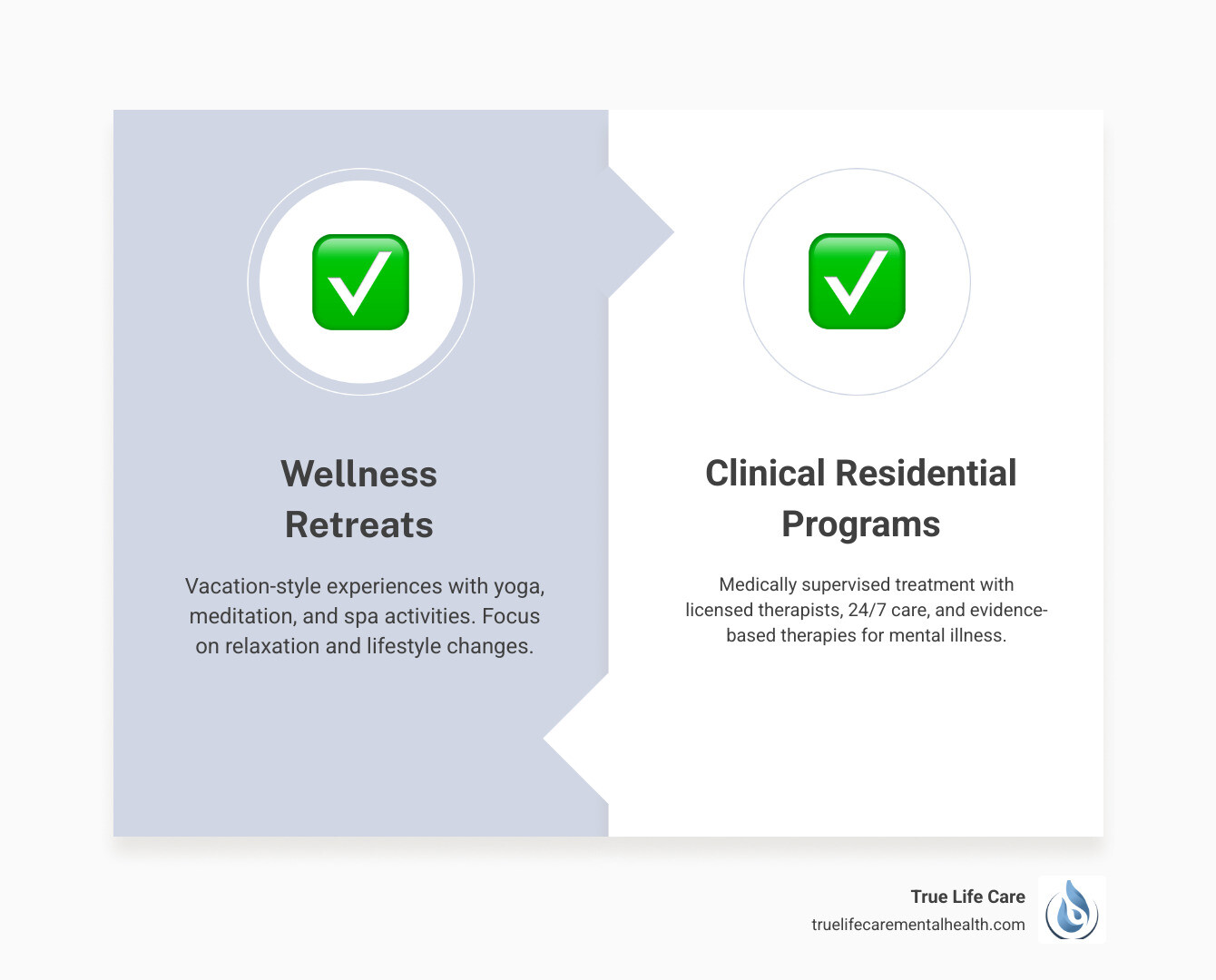
The confusion comes from one common mix-up: wellness retreats and clinical residential programs are not the same thing. One is a lifestyle experience. The other is medical treatment. Insurance companies know the difference — and so should you before you start making calls.
This guide will walk you through exactly how coverage works, what qualifies, and how to navigate the process without the stress.
Explore more about mental health retreat covered by insurance:
What is a Mental Health Retreat Covered by Insurance?
When we talk about a mental health retreat covered by insurance, we are usually referring to what clinicians call “residential treatment” or “inpatient care.” While the word “retreat” conjures up images of mountaintop cabins and sunrise yoga (which are lovely), insurance companies view “retreats” as elective wellness experiences. To get your costs covered, the program must meet a clinical definition of medical necessity.
According to the National Institute of Health (NIH), 57.8 million adults live with some form of mental illness. For many, a standard 50-minute therapy session once a week isn’t enough to break through the fog of severe depression, anxiety, or PTSD. This is where a clinical retreat—or residential program—comes in. It provides an immersive, therapeutic environment where you live on-site, away from the triggers of daily life in places like Clifton or Morris Plains, NJ.
These programs offer 24/7 support and are staffed by licensed psychiatrists, psychologists, and therapists. Unlike a vacation, every hour of your day is structured around evidence-based care. You aren’t just there to relax; you’re there to do the deep work of healing. For those needing a higher level of care, more info about inpatient mental health treatment can help clarify why these intensive programs are often the best path for long-term recovery.
Factors That Determine Your Mental Health Retreat Covered by Insurance Eligibility
Not every facility that calls itself a retreat will be accepted by your insurance provider. To ensure your mental health retreat covered by insurance is actually paid for, the facility must meet strict standards.
- Accreditation: The center should be accredited by recognized bodies like The Joint Commission (TJC) or the Commission on Accreditation of Rehabilitation Facilities (CARF). These “gold seals” tell insurance companies that the facility follows the highest safety and clinical standards.
- Clinical Supervision: A covered retreat must have a medical director and a staff of licensed professionals. If the “facilitators” only have wellness certifications rather than clinical degrees, insurance will likely pass on the bill.
- Medical Necessity: This is the most important factor. A physician or licensed therapist must document that your condition requires this level of intensive care. For example, if you are struggling with severe burnout that has led to clinical depression, a doctor can explain why a residential stay is necessary for your safety and stabilization.
- Diagnostic Criteria: Insurance typically covers treatments for recognized conditions like Major Depressive Disorder, Generalized Anxiety Disorder, PTSD, and Bipolar Disorder. Utilizing mental health resources and community support can help you find the right professionals to provide these necessary referrals.
Common Insurance Providers and Plan Limitations
In our experience helping residents from Bergen County to Middlesex County, we’ve seen that most major private insurance providers do offer coverage for residential mental health care. Common providers include Magellan, Aetna, and Optum.
However, each plan has its own set of “rules.” For instance, if you are looking for mental health facilities accepting Horizon, you’ll find that while they cover residential care, they may require “pre-authorization.” This means your doctor has to get the “okay” from the insurance company before you check in.
Other limitations to watch out for include:
- Session Caps: Some plans limit the number of days they will pay for in a residential setting per year.
- Out-of-Pocket Maximums: You may have to pay a certain amount (your deductible) before insurance kicks in at 100%.
- In-Network vs. Out-of-Network: Staying “in-network” significantly reduces your costs. If you choose an out-of-network retreat, you might be responsible for a much larger portion of the bill.
Understanding Insurance Coverage for Clinical vs. Wellness Programs

It helps to think of the difference between a “wellness retreat” and a “clinical residential program” as the difference between a spa day and a hospital stay. A spa day makes you feel better, but a hospital stay saves your life. Insurance is in the business of the latter.
Thanks to the Mental Health Parity and Addiction Equity Act (MHPAEA), insurance companies are legally required to provide mental health benefits that are equal to their physical health benefits. This means if they cover a stay for a physical surgery, they must provide comparable coverage for a mental health crisis.
| Feature | Wellness Retreat | Clinical Residential Program |
|---|---|---|
| Primary Goal | Relaxation & Rejuvenation | Stabilization & Clinical Healing |
| Staff | Yoga instructors, chefs, guides | Psychiatrists, RNs, licensed therapists |
| Insurance Coverage | Rarely (usually out-of-pocket) | Often (if medically necessary) |
| Activities | Hiking, spa, meditation | CBT, DBT, group therapy, psychiatry |
| Medical Records | Not required | Required for admission |
We often get asked, “Is cognitive behavioral therapy covered by insurance?” The answer is almost always yes, as it is an evidence-based practice. On the flip side, people wonder, “Is hypnotherapy covered by insurance?” This is more of a gray area—it often depends on whether it’s being used as a primary treatment or a supplemental “wellness” tool.
Steps to Secure a Mental Health Retreat Covered by Insurance
Navigating the insurance maze can feel like a full-time job, but we’re here to simplify it. If you’re ready to find a mental health retreat covered by insurance, follow these steps:
- Review Your Policy: Look for terms like “Behavioral Health Residential Treatment” or “Inpatient Mental Health.”
- Verify Your Benefits: This is the most crucial step. You can verify your insurance coverage directly with us to see exactly what your plan covers without any guesswork.
- Gather Documentation: Have your current therapist or doctor write a letter of medical necessity. This letter should explain your diagnosis and why a lower level of care (like weekly therapy) hasn’t worked.
- Explore Single-Case Agreements: If there are no in-network retreats near your home in New Jersey or New York, your insurance might agree to a “single-case agreement.” This allows them to pay for an out-of-network facility at in-network rates because they lack a local alternative.
- Consider the Continuum of Care: Sometimes, insurance will only cover a residential stay for a week or two. In these cases, it’s helpful to know does insurance cover outpatient treatment? Most do, allowing you to transition from a retreat to a Partial Hospitalization Program (PHP) or Intensive Outpatient Program (IOP) while still being covered.
Costs, Alternatives, and Maximizing Your Benefits
If you were to pay entirely out of pocket, a mental health retreat could be quite an investment. Mid-range retreats typically cost between $225 and $275 per day, while luxury programs can reach $400 to $650 per day. For a standard 7-day stay, you could be looking at $1,800 to $4,500.
However, when you find a mental health retreat covered by insurance, those numbers drop significantly. Many of our clients in the New Jersey area find that their insurance covers 80% to 100% of the cost after their deductible is met.
For those dealing with complex issues, such as finding trauma recovery retreats, the clinical structure is even more vital. Specialized care for trauma or dual diagnosis (when you have both a mental health and a substance use disorder) requires more intensive staffing. You might wonder, “does NJ insurance cover 100% of dual diagnosis?” While “100%” depends on your specific plan (like a PPO vs. an HMO), New Jersey has some of the strongest parity laws in the country to ensure these services are accessible.
Affordable Alternatives to High-Cost Retreats
If a full residential “retreat” isn’t an option—either due to insurance limitations or life commitments in NYC or Jersey City—there are excellent, affordable alternatives that offer similar intensive healing:
- Partial Hospitalization Programs (PHP): Think of this as a “day retreat.” You spend 5-6 hours a day at a clinical center receiving therapy and psychiatric care, but you go home at night. It is almost always covered by insurance.
- Intensive Outpatient Programs (IOP): These are even more flexible, usually involving 3 hours of therapy a few days a week. This is a great way to maintain your progress after a residential stay.
- Telehealth Options: Many retreats now offer “virtual retreats” or intensive online programs. While you don’t get the nature immersion, you do get the clinical expertise from the comfort of your home.
- Community Support: Organizations like NAMI (National Alliance on Mental Illness) offer free support groups and workshops throughout New Jersey that can supplement your professional treatment.
Frequently Asked Questions about Mental Health Retreats
What should I do if my insurance denies coverage for a retreat?
First, don’t panic. Denials are common, but they aren’t always the final word. You have the right to an appeals process.
- Request a Peer-to-Peer Review: Your doctor can speak directly with the insurance company’s medical director to explain why the stay is necessary.
- Submit Clinical Notes: Sometimes a denial happens simply because the insurance company doesn’t have enough information. Providing detailed notes from your therapists can bridge the gap.
- Alternative Level of Care: If they deny a “residential” stay, they might still approve a “Partial Hospitalization” stay, which still offers intensive daily therapy.
Are holistic or family-centered retreats covered?
Yes, many insurance-covered programs now include holistic elements. While insurance won’t pay for a “yoga retreat,” they will pay for a clinical program that includes yoga, meditation, and art therapy as part of a multi-disciplinary treatment plan.
Family-centered care is also becoming more common. Many programs in the Hunterdon and Passaic County areas offer family therapy sessions and behavioral health counseling for loved ones, as healing rarely happens in a vacuum. If the family therapy is part of the patient’s clinical treatment plan, it is typically covered.
How has insurance coverage for mental health evolved recently?
2024 has seen significant updates in how mental health is handled. There is a much stronger push for parity enforcement, meaning the government is watching insurance companies more closely to ensure they aren’t making it harder to get mental health care than physical care.
We’ve also seen:
- Expanded Telehealth: Even for intensive programs, hybrid models are becoming more acceptable.
- Residential Care Access: More insurers are recognizing that “preventative” residential care (treating burnout before it becomes a total breakdown) saves them money in the long run.
- Integrated Health Models: There is a shift toward treating the whole person—mind and body—rather than just a set of symptoms.
Conclusion
Finding a mental health retreat covered by insurance doesn’t have to be a source of more stress. At True Life Care, we believe that everyone deserves access to high-quality, evidence-based healing. Whether you are in Boonton, Clifton, or New York City, there are paths to recovery that won’t break the bank.
By focusing on clinical residential programs rather than elective wellness spas, you can leverage your insurance benefits to get the 24/7 support and psychiatric care you need. From PHP and IOP structures to holistic integration, the modern landscape of mental health care is designed to meet you where you are.
If you’re ready to take that first step toward a refreshed and renewed version of yourself, we encourage you to explore the top mental health retreats in NJ and see what’s possible. Your mental health is an investment, and with the right insurance strategy, it’s one you can afford to make. Reach out to us today—we’re here to help you navigate the paperwork so you can focus on the healing.