
Objective
This blog breaks down how OCD and anxiety disorders overlap, where they differ, and why that difference matters when it comes to getting the right treatment.
Table of Contents
- Why This Comparison Matters
- What an Anxiety Disorder Really Looks Like
- What OCD Really Looks Like
- Where OCD and Anxiety Overlap
- Key Differences You Should Know
- Intrusive Thoughts: A Closer Look
- How Anxiety Therapy Differs Between the Two
- What Is ERP Therapy?
- When to Reach Out for Help
- Conclusion
- FAQs
Key Takeaways
- OCD and anxiety disorders share symptoms, but need different treatments.
- Anxiety symptoms like fear, avoidance, and sleep trouble appear in both.
- Intrusive thoughts can happen to many people, but in OCD they become repetitive, distressing, and linked to compulsions or mental rituals.
- ERP therapy is one of the most recommended and evidence-based treatments for OCD.
- Exposure and response prevention works by breaking the obsession-compulsion loop.
- The right diagnosis is the most important first step.
1. Why This Comparison Matters?
These two conditions are often confused, and understandably so. Both involve persistent fear. Both disrupt daily life. Both make people feel stuck.
Until 2013, OCD was even classified as an anxiety disorder. The DSM-5 separated them into different categories. But clinicians and patients still mix them up constantly.
That mix-up has real consequences. Treating OCD without addressing compulsions can leave the main cycle untouched. In some cases, repeated reassurance can make the pattern stronger. Getting the right diagnosis directly shapes how treatment is approached.
This distinction matters because the right diagnosis shapes the right care plan.
2. What an Anxiety Disorder Really Looks Like
Everyone feels anxious sometimes. That is normal. An anxiety disorder is different. The fear is intense, hard to control, and disruptive. It can affect school, work, sleep, relationships, and daily life.
There are several types. These include generalized anxiety disorder, social anxiety disorder, panic disorder, and specific phobias.
Each has its own trigger, but the underlying pattern is the same: fear that is out of proportion to the actual situation.
Common anxiety symptoms across these types include:
- Constant worry that is hard to turn off
- Racing heart, chest tightness, or shortness of breath
- Muscle tension and restlessness
- Difficulty sleeping or concentrating
- Avoiding situations that trigger fear
The person usually feels their worry is justified, even when it is clearly excessive to those around them.
3. What OCD Really Looks Like
OCD, Obsessive-Compulsive Disorder, has two central features: obsessions and compulsions.
Obsessions are unwanted, repetitive thoughts or urges that feel deeply disturbing. They arrive without warning, feel out of character, and cause real distress.
Compulsions are the behaviors a person does to reduce that distress, checking locks, washing hands, repeating phrases mentally, seeking reassurance. The compulsion brings temporary relief. But here is the problem.
That relief teaches the brain something harmful: rituals make discomfort go away. So the urge to repeat them grows stronger each time. Without treatment, the cycle tightens.
4. Where OCD and Anxiety Disorders Overlap
The overlap is significant and that is why misdiagnosis is so common.
Both conditions share:
- Fear and avoidance, both groups pull back from distressing situations
- Physical anxiety symptoms, tension, racing thoughts, sleep problems
- Sensitivity to uncertainty, both groups struggle with unresolved situations
- Impact on work, relationships, and daily functioning
Because the surface experience looks so similar, someone with OCD can go months, or years, being treated for general anxiety before the right diagnosis is made.
5. Key Differences You Should Know
| Feature | Anxiety Disorder | OCD |
| Core fear | Real-world concerns, health, safety, failure | Specific obsessions, often with harm or moral themes |
| Thought pattern | Excessive worry that feels realistic | Repetitive intrusive thoughts that feel alien and wrong |
| Behavioral response | Avoidance | Compulsions and mental rituals |
| Does it feel self-consistent? | Usually yes, worry feels justified | No, obsessions feel foreign to the person |
| Primary treatment | CBT-based therapy | ERP with CBT |
That last row matters most. The treatment for OCD differs fundamentally from what works for general anxiety, and using the wrong approach can make things worse.
6. Intrusive Thoughts: A Closer Look
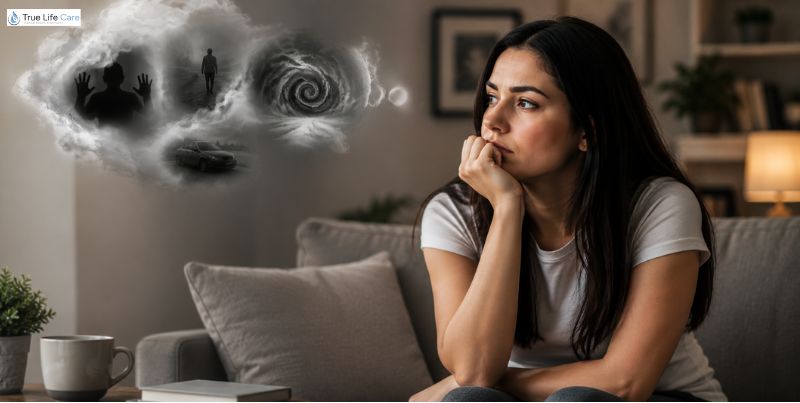
Almost everyone has strange or unwanted thoughts. The difference is in what happens next.
A person without OCD notices a disturbing thought and moves on.
A person with OCD attaches meaning to that thought. They treat it as a warning. So they check, repeat, or seek reassurance.
Attaching meaning to intrusive thoughts and acting on them is what drives OCD forward.
In general anxiety, unwanted thoughts center on real concerns, finances, relationships, health. They feel legitimate, not alien. That distinction guides a clinician toward the right treatment.
7. How Anxiety Therapy Differs Between the Two
CBT is effective for both conditions, but the specific methods differ.
For general anxiety, anxiety therapy focuses on reframing distorted thinking, facing feared situations gradually, and building tolerance for uncertainty.
For OCD, those tools still play a role, but the core method is exposure and response prevention. Without it, therapy addresses the worry but misses the compulsion cycle entirely.
A clinician who treats OCD like regular anxiety may inadvertently offer reassurance. It feels supportive, but reassurance is a compulsion. It feeds the cycle.
8. What Is ERP Therapy?
ERP therapy stands for Exposure and Response Prevention, the most evidence-based treatment for OCD available.
The idea is straightforward. The therapist helps the person face the thoughts or situations that trigger their obsessions, without performing the compulsive response. Over time, the brain learns that the feared outcome does not happen. The discomfort fades on its own. The need to perform the ritual weakens.
The process typically works like this:
- The therapist and patient build a list of feared situations, ranked from least to most distressing
- They start with the lower-anxiety triggers
- The patient stays with the discomfort instead of acting on the compulsion
- The anxiety decreases naturally, without the ritual
This approach is not easy. Deliberately sitting with discomfort takes real effort. But research shows many people who complete ERP see meaningful improvement, although results vary based on symptom severity, consistency, and the full treatment plan.
Living With OCD and Anxiety Can Feel Overwhelming
The combination of OCD and anxiety can create emotional strain and persistent worry. Daily routines may become difficult due to compulsive habits and intrusive thoughts. Professional support can help individuals manage symptoms and restore emotional balance.
Get Started Now9. When to Reach Out for Help
You do not need to wait until life feels unmanageable before asking for help. If worry, rituals, or unwanted thoughts are taking up time and energy every day, support can make things clearer.
Consider reaching out if:
- Rituals or worry are consuming more than an hour of your day
- You have stopped doing things you used to do because of fear
- Relationships or work are being affected
- You have tried to stop compulsive behavior, but cannot
Earlier treatment leads to better outcomes. Waiting does not make the symptoms settle down on their own, for most people, they intensify.
True Life Care Mental Health offers mental health treatment programs in New Jersey for people dealing with OCD, anxiety disorders, and related conditions. Our team includes clinicians who specialize in both.
If anxiety or obsessive thoughts are taking over your daily life, professional help is available. We are here to help you find the right path forward. Reach out today, the sooner you start, the sooner things improve.
Conclusion
OCD and anxiety can look similar, but they are not always treated the same way. The right diagnosis matters because it shapes the right care plan. When symptoms are understood clearly, people can receive support that matches what they are actually facing.
No one has to keep living with fear, rituals, or unwanted thoughts without help.
If OCD or anxiety is affecting your daily life, contact True Life Care Mental Health to explore professional support and find a treatment path that fits your needs.
FAQs
Q1. Can A Person Have OCD And An Anxiety Disorder At The Same Time?
Yes. A person can have both. OCD may occur with generalized anxiety, social anxiety, or panic symptoms. A clinician can decide which concern needs care first.
Q2. Is OCD still classified as an anxiety disorder?
No. The DSM-5 (2013) moved OCD into its own category, Obsessive-Compulsive and Related Disorders. Anxiety is still central to how OCD feels, but it is no longer classified as an anxiety disorder.
Q3. Does ERP therapy help with regular anxiety, too?
Exposure-based work is used in treating phobias, social anxiety, and panic disorder. But full ERP, with its structured focus on resisting compulsions, is designed specifically for OCD. The tools overlap, but the structure and goals differ.
Q4. Why do intrusive thoughts worsen when suppressed?
This is the rebound effect. Pushing a thought away makes it return stronger. For people with OCD, suppression increases both frequency and distress. ERP teaches people to sit with thoughts rather than act on them.
Q5. How long before ERP therapy shows results?
Most people notice improvement within 12 to 20 sessions. Progress depends on symptom severity and the consistency with which exposures are practiced between sessions.