
Top 10 Psychiatric Emergency Screening in New Jersey
When Every Minute Counts: Psychiatric Emergency Screening in New Jersey
Psychiatric emergency screening in New Jersey is a free, 24/7 service available in all 21 counties that helps people in mental health crisis get evaluated, stabilized, and connected to the right level of care.
Here’s what you need to know right away:
- Who it’s for: Adults, children, and elderly individuals experiencing a sudden mental health crisis
- How to access it: Walk into any designated hospital ER, call your county’s 24-hour hotline, or request a mobile crisis team to come to you
- What happens: A clinician assesses you, a doctor rules out medical causes, and a psychiatrist determines next steps
- How long: You can be held up to 24 hours for assessment and stabilization
- Cost: Services are state-designated and available regardless of ability to pay
- Quick national option: Call or text 988 (Suicide & Crisis Lifeline) at any time
Every county in New Jersey has at least one Psychiatric Emergency Screening Service (PESS) — many located directly inside hospital emergency rooms. These aren’t just walk-in clinics. They are state-designated centers with trained screeners, psychiatrists on call, and mobile teams that can come to you.
Whether you’re worried about yourself or someone you love, knowing where to turn — and what to expect — can make all the difference.
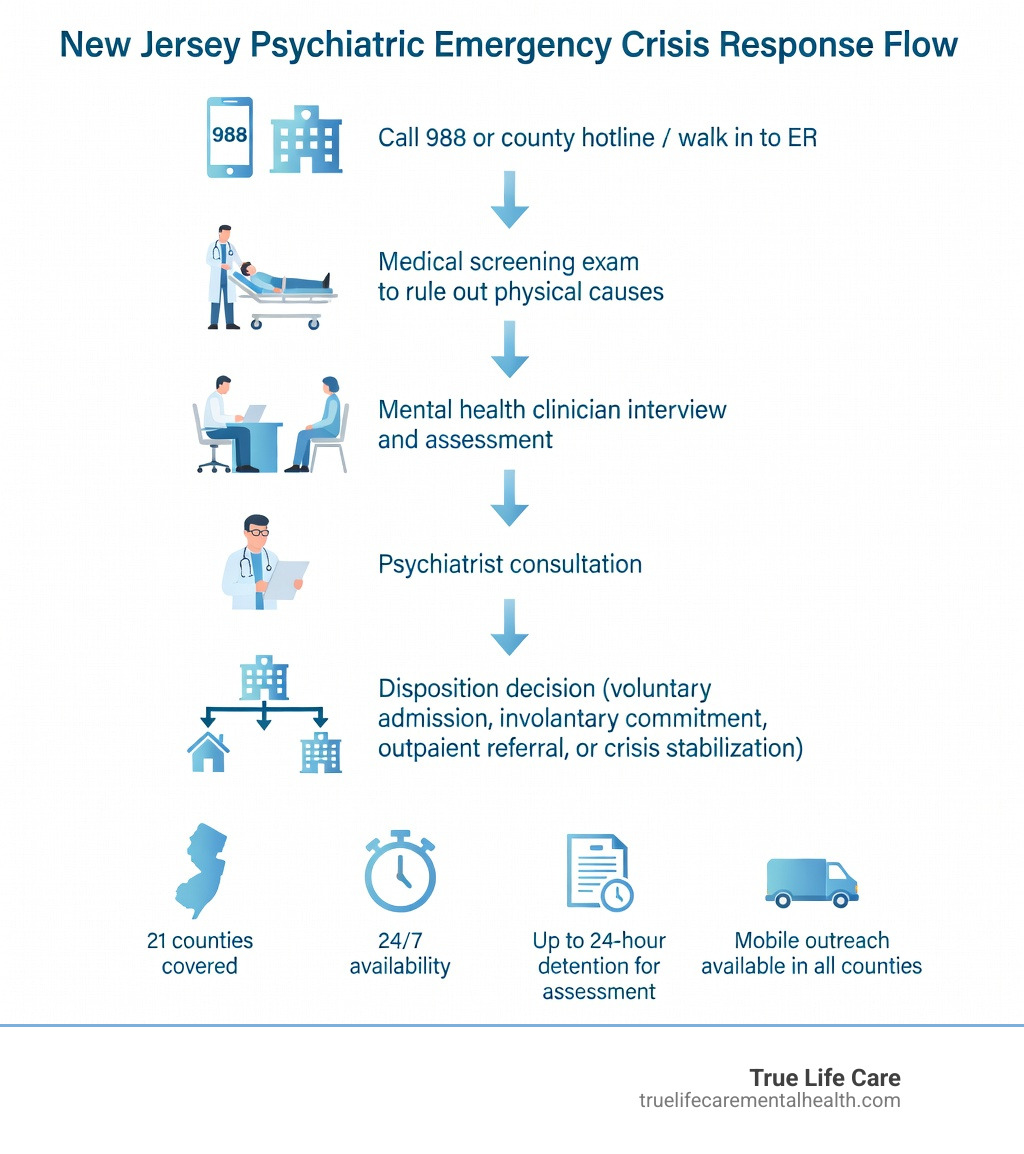
Glossary for Psychiatric emergency screening in New Jersey:
Understanding Psychiatric Emergency Screening in New Jersey
When we talk about Psychiatric emergency screening in New Jersey, we are referring to a highly regulated process designed to keep individuals safe during their most vulnerable moments. A Psychiatric Emergency Screening Service (PESS) is a state-designated facility—usually embedded within a hospital’s emergency department—that provides 24/7 crisis intervention, stabilization, and assessment.
The process is thorough and follows strict legal guidelines. Under N.J. Admin. Code § 10:31-2.3 – Screening process and procedures, the screening center can detain an individual for up to 24 hours. This time is used for:
- Medical Clearance: A doctor performs a medical screening exam to rule out physical or metabolic conditions (like a thyroid storm or drug toxicity) that might look like a psychiatric issue.
- Clinical Interview: A certified mental health screener conducts an in-depth assessment of the person’s history, current symptoms, and social supports.
- Psychiatrist Consultation: A psychiatrist reviews the findings to determine the “disposition”—the plan for what happens next.
The ultimate goal is to provide treatment in the “least restrictive environment” possible. This means if we can safely stabilize someone through crisis counseling or an outpatient program, we prioritize that over a hospital stay. However, if there are behavioral emergency examples you need to know, such as acute psychosis or immediate risk of harm, a more intensive intervention is required.

Legal Criteria for Psychiatric Emergency Screening in New Jersey
In New Jersey, the law sets a high bar for involuntary interventions. To be “screened” for involuntary commitment, an individual must meet specific legal criteria. They must be suffering from a mental illness and, because of that illness, be considered dangerous to themselves, others, or property.
“Dangerous to self” doesn’t just mean active suicidal thoughts; it can also include an inability to satisfy basic needs like food, clothing, or shelter, which could lead to serious injury or death in the near future. Understanding the legal options for helping loved ones is vital for families. If a person is unwilling to accept help voluntarily, the screening process becomes the legal bridge to getting them the care they need.
While the idea of forcing a loved one into a psych ward is incredibly painful, these laws exist to protect the individual’s civil rights while ensuring their physical safety. If a screening certificate is completed by a psychiatrist, the law (N.J.S.A. 30:4-27.9.c) requires that the individual be admitted to a facility and court proceedings begin within 72 hours.
Accessing Psychiatric Emergency Screening in New Jersey Hospitals
New Jersey uses a county-based system to ensure help is never too far away. Each of the 21 counties has a “Primary Screening Center.” Some larger counties also have “Affiliated Emergency Services” (AES) to provide additional coverage.
You can access emergency mental health services in New Jersey through several pathways:
- Walk-in: You can go directly to the designated hospital ER.
- 24-Hour Hotlines: Every county has a specific number staffed by professionals who can provide de-escalation over the phone.
- Mobile Outreach: If it is clinically appropriate and safe, a team can meet the person at their home or another community location.
For those specifically looking for emergency mental health services in Morris Plains NJ, services are coordinated through the Morris County designated center, ensuring local residents have rapid access to stabilization.
Top 10 Designated Screening Centers and Hotlines
Navigating the system during a crisis is stressful. To help, we have compiled a list of the primary designated screening services in the areas we serve. These locations provide 24/7 psychiatric emergency services.
| County | Designated Primary Screening Service | 24/7 Crisis Hotline |
|---|---|---|
| Bergen | Bergen County Designated Screening Center | 201-262-HELP (4357) |
| Essex | Essex County Designated Screening Center | 973-926-7444 |
| Hudson | Hudson County Designated Screening Center | 201-915-2210 |
| Mercer | Mercer County Designated Screening Center | 609-396-HELP (4357) |
| Middlesex | Middlesex County Designated Screening Center | 732-235-5700 |
| Monmouth | Monmouth County Designated Screening Center | 732-923-6999 |
| Morris | Morris County Designated Screening Center | 973-625-6160 |
| Passaic | Passaic County Designated Screening Center | 973-754-2230 |
| Union | Union County Designated Screening Center | 908-994-7131 |
| Warren | Warren County Designated Screening Center | 908-454-5141 |
Spotlight on Regional Services
- Bergen County: The designated screening center is a massive hub for behavioral health. Residents can call the “262-HELP” line for immediate guidance.
- Mercer County: The designated screening service provides not only on-site walk-in assessments but also robust mobile outreach services that can respond to any verifiable location in the county.
- Morris County: The designated lead facility for Morris County emphasizes a medical-first approach, ensuring patients are medically stable before moving to the psychiatric evaluation phase.
- Essex County: This county is unique in that it has multiple designated centers to handle its high volume, ensuring rapid access to stabilization for all residents.
The Role of Mobile Crisis Response and 988 Integration
One of the most significant shifts in Psychiatric emergency screening in New Jersey is the move toward community-based care. Mobile Crisis Response Teams (MCRTs) are designed to “bring the ER to the person” whenever possible. These teams usually include a licensed behavioral health professional and a certified peer specialist—someone who has “lived experience” with mental health challenges and can offer unique empathy and support.
Recent legislation, specifically P.L. 2022, c.035 (Chapter 35), has accelerated this integration. The goal is to create a “no wrong door” system. Whether you call your county hotline or the national 988 Suicide & Crisis Lifeline, you should be connected to the same high-quality care.
How 988 Works with NJ Screening
When you call 988 in New Jersey, the call is routed to a regional center. If the situation is acute, they can:
- Provide immediate phone de-escalation.
- Dispatch a mobile crisis team to your home.
- Coordinate with Law Enforcement (specifically Crisis Intervention Team or CIT officers) if there is an immediate safety threat.
Knowing when to seek a professional mental health intervention is the first step. The integration of 988 ensures that even if you don’t know your local county number, help is still just three digits away.
Frequently Asked Questions about NJ Psychiatric Screening
How long can someone be detained for psychiatric emergency screening in New Jersey?
By law, a screening service can detain a person for up to 24 hours. This period is specifically for “emergency treatment, medical clearance, and assessment.” It is not a long-term stay; it’s a window to determine if the person can be safely released with a referral or if they need inpatient care. If a psychiatrist completes a screening certificate, the facility has up to 72 hours to arrange admission to a psychiatric unit and begin the court notification process. If you are in the middle of a crisis and need help, you can also call the IMH emergency hotline now for immediate guidance.
What is the difference between voluntary and involuntary admission?
- Voluntary Admission: The individual agrees to treatment and has the “intact judgment” to make that decision. They sign themselves in and participate in their care plan.
- Consensual Admission: Similar to voluntary, but often used when a person might not meet the strict “dangerousness” criteria for involuntary care but still recognizes they need a hospital level of support.
- Involuntary Commitment: This is a legal process used when a person is a danger to themselves or others and refuses voluntary care. It requires a screening certificate signed by a psychiatrist and a subsequent court order. Having the IMH emergency number handy can help you navigate these complex legal waters.
What are the common suicide warning signs assessed during screening?
During a screening, professionals look for specific risk factors and “red flags.” These include:
- Expressing a wish to die or making specific plans.
- Giving away prized possessions or making final arrangements.
- Sudden withdrawal from friends, family, and society.
- Dramatic mood changes or out-of-character behavior.
- Significant changes in eating or sleeping patterns.
Screeners also look for “protective factors,” like a strong family support system or a connection to a therapist, which might allow for a less restrictive treatment plan. If you are concerned about the financial aspect of an emergency, it helps to understand IMH emergency charges and what to expect, though state law ensures crisis screening is accessible regardless of insurance status.
Conclusion
A psychiatric crisis is one of the most stressful experiences a person or family can face. Fortunately, Psychiatric emergency screening in New Jersey provides a robust safety net designed to catch people when they fall. From the 24-hour hotlines in Bergen and Morris counties to the mobile teams in Mercer and Passaic, help is always available.
At True Life Care Mental Health, we believe that the end of a crisis is the beginning of a new chapter. While screening centers focus on immediate safety and stabilization, we focus on what comes next. Our holistic, evidence-based approach offers flexible programs like Partial Hospitalization (PHP) and Intensive Outpatient Programs (IOP) that empower individuals for long-term recovery and well-being.
If you or a loved one is in a psychiatric emergency, we can help you understand your options and where to go next. If the immediate crisis has passed, we can also guide you toward a plan for lasting mental health and stability.
Ready to take the next step? Explore our Mental Health Programs in New Jersey and let us help you build a life worth living.