
When Depression Doesn’t Get Better: Is a Mental Health Retreat the Answer?
A mental health retreat for depression is a structured, residential program where people step away from daily life to receive intensive, around-the-clock care for depression — going far beyond what weekly therapy alone can offer. In the landscape of 2026, the need for these immersive environments has never been more critical. As we navigate a world of increasing digital isolation and economic pressure, the standard models of care are often stretched thin.
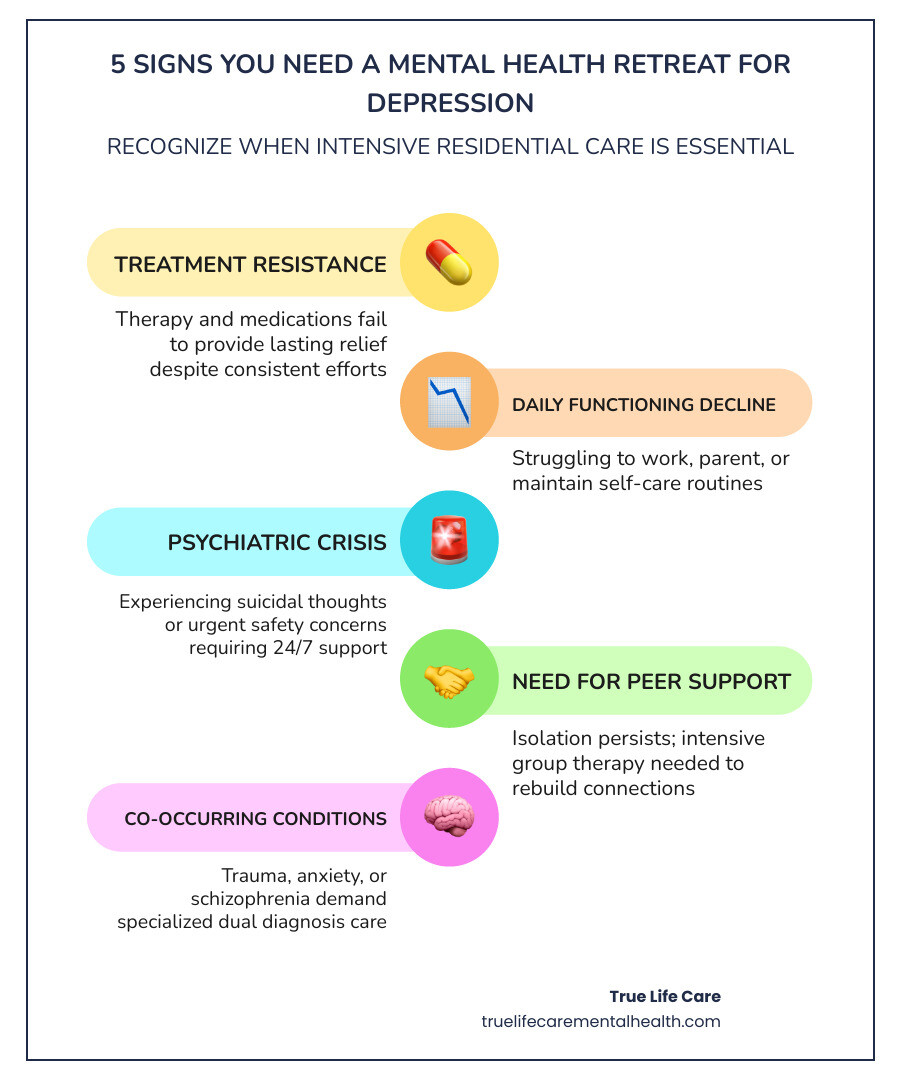
Here are 5 signs a depression retreat may be right for you:
- Therapy and antidepressants haven’t brought lasting relief
- Depression is affecting your ability to work, parent, or care for yourself
- You’re experiencing a psychiatric crisis or suicidal thoughts
- You need intensive group therapy and peer support to break isolation
- You have co-occurring conditions like trauma, anxiety, or schizophrenia that need specialized care
Depression is not a minor inconvenience. For millions of Americans, it is a condition that steals jobs, strains relationships, and makes getting out of bed feel impossible. According to the National Institute of Mental Health, depressive disorders are among the most common mental health conditions in the United States, affecting how you feel, think, and handle daily activities.
The numbers are striking. Over 17 million U.S. adults live with depression. In New Jersey and across the country, many people who need mental health support simply aren’t getting it — or aren’t getting enough of it. In areas like Monmouth County and Middlesex County, the demand for high-level psychiatric intervention has seen a significant uptick as residents seek more than just a temporary fix.
Standard outpatient therapy — a 50-minute session once a week — works for some people. But for others, especially those with major, chronic, or treatment-resistant depression, it’s like trying to bail out a flooding boat with a teaspoon. When you are in the middle of a psychiatric emergency, you cannot wait until next Tuesday at 4:00 PM for your appointment. You need immediate, comprehensive support.
That’s where a mental health retreat comes in. Think of it as a full reset: an immersive, clinically guided experience designed to address the root causes of depression, not just manage the symptoms. At True Life Care in Matawan, NJ, we work with Monmouth County residents and people across New Jersey who are ready to move from surviving to actually living. We are an out-of-network provider and accept PPO plans, making intensive care more accessible than many people expect. Our focus is on providing a sanctuary where healing is the only priority.
Not sure if a retreat is the right step for you? The 5 signs below can help you decide if it is time to transition from traditional outpatient care to a more robust, residential healing environment.
Terms related to mental health retreat for depression:
What is a Mental Health Retreat for Depression?

When we talk about a mental health retreat for depression, we aren’t just talking about a spa day or a vacation. While the environment is often serene and designed for comfort, these programs are clinically intensive. They represent a bridge between traditional psychiatric hospitals and outpatient therapy. At True Life Care, we focus on creating a “home-away-from-home” atmosphere where healing can happen without the sterile, cold feeling of a clinical ward. This is residential treatment reimagined as clinical immersion.
A retreat-style program typically involves staying at a facility for a set period—usually 21 to 30 days. During this time, you aren’t just “getting away”; you are engaging in a rigorous, 24/7 therapeutic environment. The goal is to provide enough time for the nervous system to reset, for medications to be properly adjusted, and for new habits to take root. In a residential setting, every interaction is an opportunity for growth, from the morning meditation to the evening reflection group.
True Life Care: Our Approach to Mental Health Retreats focuses on the individual. We know that depression isn’t just a “chemical imbalance.” It’s a complex tapestry woven from trauma history, thought patterns, biological factors, and environmental stressors. By removing you from the triggers of your daily life—work emails, family conflicts, and the physical spaces where you feel “stuck”—we create the room necessary for real transformation. This is especially vital for those managing complex conditions like schizophrenia, where a stable, predictable environment is necessary to manage symptoms and prevent relapse.
How Retreats Differ from Traditional Outpatient Therapy
The biggest difference is the volume of care. In traditional outpatient therapy, you might see a counselor for 50 minutes once a week. While valuable, that leaves 167 other hours in the week where you are left to fight depression on your own. For someone in the depths of a major depressive episode, that is a heavy burden. The isolation of those 167 hours can be where the most damage occurs.
In a mental health retreat for depression, the “therapy” doesn’t stop when the hour is up. You are looking at 6 to 8 hours of active therapeutic engagement every single day. This includes individual sessions, intensive group therapy, and holistic activities. This density of care allows for a level of breakthrough that is simply impossible in a weekly format. You are not just talking about your problems; you are living in a solution-oriented environment.
The Stress Free Guide To Mental Health Retreats Covered By Insurance highlights how this immersive structure breaks the cycle of daily stressors. Instead of managing your life while trying to heal, you pause your life to heal. This allows for breakthroughs that might otherwise take two years of weekly sessions to achieve. For residents in Matawan, NJ, and the surrounding Monmouth County area, this means access to a level of care that prioritizes rapid stabilization and long-term resilience.
Types of Depression Addressed in a Mental Health Retreat for Depression
Not all depression looks the same. A high-quality retreat program is equipped to handle various manifestations of mood disorders, including:
- Major Depressive Disorder (MDD): The classic, heavy weight of depression that makes functioning difficult.
- Treatment-Resistant Depression: Cases where at least two different antidepressant trials have failed to provide relief.
- Postpartum Depression: Specialized support for new parents struggling after childbirth, focusing on both the biological and emotional shifts.
- Seasonal Affective Disorder (SAD): Using light therapy and circadian realignment to help those affected by seasonal changes.
- Bipolar Depression: Managing the “lows” of bipolar disorder with expert psychiatric oversight to ensure mood stability.
- Schizophrenia and Psychotic Disorders: We provide a structured environment to manage symptoms, provide medication stabilization, and help individuals regain their footing in reality. Our team is trained to handle the nuances of disorganized thinking and the depression that often accompanies chronic psychotic disorders.
5 Signs You Need a Mental Health Retreat for Depression
Deciding to enter a residential program is a big step. It requires time, commitment, and vulnerability. To help you determine if this is the right path, we’ve put together a comparison of what you might be experiencing now versus what a retreat offers. Many of our clients from Bergen County to Monmouth County find that seeing the benefits laid out clearly helps them make the decision to seek higher-level care.
| Current Experience (Outpatient) | Retreat-Style Benefit |
|---|---|
| Weekly 50-minute sessions | 6-8 hours of daily clinical engagement |
| Managing triggers at home/work | Complete removal from environmental stressors |
| Medication changes every few months | Daily psychiatric oversight and real-time adjustments |
| Feeling isolated and misunderstood | Constant peer support and community healing |
| Focus on symptom management | Deep dive into root causes and trauma |
| Risk of psychiatric emergency at home | 24/7 safety and clinical support |
Identifying Treatment Resistance
If you’ve tried different medications and several therapists but still find yourself “laying in bed all day” or “losing motivation for parenting and work,” you may be dealing with treatment-resistant depression. Statistics show that about 10% or more of people with clinical depression switch medications at least once. If the needle isn’t moving, the intensity of a retreat can provide the “jolt” your system needs to start responding to treatment again.
Treatment resistance often stems from underlying issues that haven’t been addressed, such as unresolved trauma or metabolic imbalances. In a residential setting, we have the time to investigate these factors thoroughly. We don’t just look at the symptoms; we look at the whole person. For those in New Jersey struggling with persistent symptoms, our Matawan facility offers a specialized approach to breaking through the plateau of traditional care.
1. Traditional Outpatient Care and Medications Have Failed
We often see people who feel like they are “failing” at therapy. The truth is, sometimes the format of the therapy is what’s failing. When depression is severe, the brain is often in a state of high inflammation and the nervous system is dysregulated. A weekly chat isn’t enough to calm that storm. You need a consistent, supportive environment to allow your brain to begin the process of healing.
At True Life Care, we specialize in those “tough cases.” We look at medication optimization under daily supervision. In an outpatient setting, you might try a new pill and wait six weeks to see your doctor again. In a retreat setting, a psychiatrist can monitor your response daily. This allows for much safer and more effective adjustments, reducing the time you spend suffering through side effects or ineffective dosages. This is particularly important for patients with schizophrenia, where medication management is a delicate balance that requires constant observation.
Innovative Treatment Approaches for Depression at True Life Care include looking beyond the prescription pad. We explore why standard protocols aren’t working—whether it’s underlying trauma, metabolic issues, or lifestyle factors that need a complete overhaul. We utilize evidence-based practices to ensure that every resident has the best possible chance at a breakthrough. Our goal is to move you past the cycle of “trying and failing” and into a phase of consistent, measurable progress.
2. You Are Experiencing a Decline in Daily Functioning
Depression isn’t just about feeling sad; it’s about the loss of ability. We often hear from men who find themselves lashing out in anger or engaging in risky behaviors like drinking too much because they don’t know how to handle the “numbness” of depression. This decline in functioning can be gradual, or it can hit like a tidal wave, leaving you unable to meet the demands of your life.
If you find that you are:
- Missing work or facing job loss due to lack of focus and energy.
- Straining your marriage or relationship because you’ve withdrawn emotionally.
- Neglecting basic self-care, like showering, eating nutritiously, or keeping your home clean.
- Feeling like a “ghost” in your own home, unable to parent or connect with your children.
- Struggling with the cognitive fog that makes simple decisions feel impossible.
…then it is time for a higher level of care. A mental health retreat for depression provides the structure you can no longer provide for yourself. We take care of the “basics”—meals, schedule, and environment—so you can focus 100% of your energy on getting well. For professionals in Clifton or Montville, NJ, taking this time away is an investment in your future ability to lead and provide. For parents, it is the most responsible thing you can do to ensure you can be present for your children in the long run.
3. You Require a Safe Haven During Psychiatric Emergencies
Sometimes, depression moves from a “heavy mood” to a life-threatening crisis. If you are experiencing suicidal ideation or a complete inability to keep yourself safe, a retreat can serve as a vital intervention. We understand that a psychiatric emergency is a terrifying experience for both the individual and their family. You need a place that offers more than just a locked door; you need a place that offers active, compassionate healing.
Unlike a traditional hospital, which can feel cold and restrictive, our facility in Matawan, NJ, offers a “safe haven” environment. We provide 24/7 clinical support for residents in Monmouth County and surrounding areas. We are equipped to assist during psychiatric emergencies, providing immediate removal from the triggers that are fueling the crisis. Our staff is trained in crisis de-escalation and stabilization, ensuring that you are supported through the most difficult moments of your journey.
Our approach to safety isn’t just about monitoring; it’s about collaborative safety planning. We work with you to understand the “why” behind the crisis and build a toolkit that you can take home to ensure long-term security. This includes identifying early warning signs, developing coping strategies, and establishing a support network that extends beyond our walls. For those in New Jersey facing a mental health crisis, True Life Care provides the intensive, around-the-clock care necessary to navigate the storm and find a path back to safety.
4. You Crave the Healing Power of Intensive Group Therapy
Isolation is the fuel that keeps depression burning. Most people with depression feel like they are the only ones going through it. They feel like a “burden” to their friends and family, which leads to further withdrawal and a deepening of the depressive state. This cycle of isolation is one of the hardest parts of the disorder to break on your own.
In a retreat, you are surrounded by people who “get it.” Intensive group therapy is a cornerstone of our program. It’s not just about venting; it’s about:
- Breaking the Silence: Realizing your thoughts and feelings are shared by others, which immediately reduces the power of shame.
- Interpersonal Learning: Seeing how you relate to others in a safe, moderated space, and receiving honest, compassionate feedback.
- Social Skills: For those with social anxiety or schizophrenia, the group setting is a “lab” to practice connecting with people again in a low-stakes environment.
- Mutual Accountability: Encouraging each other to show up for the work every day, even when motivation is low.
- Shared Breakthroughs: Witnessing someone else’s progress can provide the hope you need to keep going with your own treatment.
Group dynamics are incredibly powerful for emotional regulation. When you see someone else make a breakthrough, it gives you the permission and hope to do the same. At our Matawan location, we facilitate groups that focus on everything from trauma processing to life skills, ensuring that every resident finds a community of support that resonates with their specific needs.
5. Co-occurring Conditions Like Schizophrenia or Trauma Require Specialized Focus
Depression rarely travels alone. Many of our clients are also dealing with deep-seated trauma (PTSD), severe anxiety, or conditions like schizophrenia. These “co-occurring” conditions make standard depression treatment much more difficult because they often feed into each other. For example, trauma can trigger depressive episodes, while the negative symptoms of schizophrenia can look very similar to clinical depression.
We utilize trauma-informed care protocols, including EMDR (Eye Movement Desensitization and Reprocessing) and somatic healing, to address the physical manifestations of past pain. For our clients managing schizophrenia, we provide the specialized psychiatric oversight needed to manage disorganized thinking and psychotic symptoms while simultaneously treating the underlying mood disorder. This integrated approach is essential for long-term stability. We don’t treat the depression in a vacuum; we treat the whole person and all the complexities they bring with them.
Managing complex psychiatric needs requires a multidisciplinary team. At True Life Care, you aren’t just seeing a therapist; you are supported by psychiatrists, nurses, and specialists who understand how these different conditions interact. Whether you are coming from Passaic County or Sussex County, our team is prepared to handle the nuances of your diagnosis with expertise and compassion. We believe that even the most complex conditions can be managed effectively with the right level of intensive, specialized care.
Evidence-Based Therapies and Holistic Healing Modalities

At True Life Care, we believe in a “whole-person” approach. This means we combine the best of modern science with time-tested holistic practices. We don’t believe in a one-size-fits-all solution; instead, we tailor our treatment plans to meet the unique biological and psychological needs of each resident.
- Cognitive Behavioral Therapy (CBT): Helping you identify and change the “loops” of negative thinking that keep you stuck in a depressive state.
- Dialectical Behavior Therapy (DBT): Teaching essential skills for distress tolerance, emotional regulation, and mindfulness.
- Exposure Therapy: Specifically for those whose depression is tied to trauma or phobias, helping them safely process and integrate difficult memories.
- Neuroplasticity Focus: Using intensive daily work to literally “re-wire” the brain’s response to stress. By engaging in consistent therapeutic work, you can create new neural pathways that support a healthier mood.
Detailed Reviews Of The Top Behavioral Health Retreat Features often highlight that the best programs don’t just pick one method—they integrate them all into a personalized plan. This integration is what allows for the deep, lasting change that residents are looking for.
The Role of Group Therapy in Long-Term Recovery
We cannot overstate the importance of the group. In a residential setting, you are living in a therapeutic community. This allows you to practice conflict resolution and communication skills in real-time. If a disagreement happens at lunch, it becomes a “therapeutic moment” to explore with your counselor later that day. This is how real-world application happens. You aren’t just learning theories; you are practicing them in a safe, supportive environment. This is particularly helpful for individuals with schizophrenia who may struggle with social cues and interpersonal connection.
Holistic Approaches: Yoga, Meditation, and Nutrition
The body and mind are not separate. If your body is inflamed and your sleep is trashed, your mood will follow. Our mental health retreat for depression incorporates:
- Yoga and Movement: To help “shake off” the physical lethargy of depression and reconnect with the body. Movement is a powerful tool for releasing stored tension and improving mood.
- Meditation and Breathwork: Tools to calm the nervous system instantly, providing a sense of peace even in the midst of emotional turmoil.
- Nutrition: We focus on an anti-inflammatory diet. Research shows that what you eat directly impacts brain health and mood stabilization. Our meals are designed to nourish both the body and the mind.
- Nature Therapy: Utilizing the beautiful surroundings of New Jersey to ground the soul. Whether it’s a walk in a local park or simply sitting in our garden, connection with nature is a vital part of the healing process.
Navigating the Mental Health Retreat for Depression in New Jersey
Location matters. While some people want to fly across the country, many find that staying local is more effective for long-term recovery. Why? Because the transition back to “real life” is easier when you are still in your home community. You can begin to build your support network while you are still in treatment, making the step down to outpatient care much smoother.
Our facility in Matawan, NJ, is perfectly situated to serve residents of:
- Monmouth County
- Mercer County
- Morris County
- Passaic County
- Bergen County
- Middlesex County
- Hunterdon County
- Sussex County
- Warren County
By staying in New Jersey, you can involve your family in the healing process more easily through family therapy sessions, and your aftercare plan can be seamlessly integrated with local resources in towns like Boonton, Clifton, or Ringwood.
Specialized Programs for Men, Women, and Professionals
We recognize that a 25-year-old woman struggling with postpartum depression has different needs than a 50-year-old male executive facing burnout. We offer gender-specific tracks and tailored protocols for different life stages. For men, we focus on breaking down the stigma of vulnerability and addressing the unique ways depression manifests in males, such as irritability and social withdrawal.
For professionals, we offer a “Luxury Mental Health Retreat” feel that prioritizes privacy and discretion. We know that the fear of “people finding out” often keeps high-functioning individuals from getting help. We ensure your stay is confidential and focused on getting you back to your peak performance. Our facility provides a quiet, professional environment where you can focus entirely on your recovery.
The Best Mental Health Retreats For Men explores why men specifically benefit from these programs, often finding a sense of camaraderie that they’ve lacked in traditional therapy.
Understanding Insurance: PPO Plans and Out-of-Network Coverage
One of the biggest hurdles to getting care is the cost. At True Life Care, we want to make this as “stress-free” as possible. We believe that financial concerns should not be a barrier to receiving life-saving treatment.
We are an out-of-network provider and accept PPO plans.
Under the Affordable Care Act, insurance providers are required to cover mental health as an “essential benefit.” This includes residential treatment for depression. Our admissions team handles the insurance verification process for you, communicating directly with your provider to determine your benefits. We work to establish “medical necessity”—showing your insurance company that outpatient care hasn’t worked and that this intensive level of care is required for your safety and recovery. This process ensures that you can focus on your health while we handle the logistics.
What to Expect: From Assessment to Aftercare
Walking through our doors for the first time might feel scary, but we make the process gentle. We understand that the decision to enter a residential program is often made during a time of great distress, and our goal is to provide a warm, welcoming environment from the very first moment.
- Initial Clinical Evaluation: A warm conversation to understand your history, your current struggles, and your goals for treatment.
- Comprehensive Psychiatric Assessment: Meeting with our medical team to review medications, symptoms, and any co-occurring conditions like schizophrenia or anxiety.
- Collaborative Goal Setting: You are a partner in your recovery. We decide together what success looks like for your 30-day stay, ensuring that your treatment plan is aligned with your personal values.
A typical day involves a mix of individual therapy, group sessions, movement, and “white space” for reflection. It is structured, but it is not a “prison.” It is a cocoon for transformation. You will have the opportunity to engage in deep clinical work while also having time to rest and recharge.
Life After the Retreat: Sustaining Progress
The most important part of a mental health retreat for depression is what happens after you leave. We don’t just send you home with a handshake. We create a comprehensive aftercare plan that is designed to help you maintain the progress you’ve made. This plan might include:
- Relapse prevention strategies: Identifying your triggers and developing a plan to manage them.
- Transitioning to our Partial Hospitalization (PHP) or Intensive Outpatient (IOP) programs: Continuing your care at our Matawan, NJ location while you begin to reintegrate into your daily life.
- Joining our alumni network: Staying connected with a community of peers who have shared similar experiences.
- Referrals to local therapists: Ensuring you have ongoing support in your specific New Jersey county, whether you are in Hunterdon, Sussex, or Warren.
Our commitment to your well-being doesn’t end when you check out. We are here to support you as you navigate the challenges of long-term recovery, providing the resources and community you need to thrive.
Frequently Asked Questions about Depression Retreats
How long do these programs typically last?
Most residents stay for 30 days, though some programs are 21 or 45 days. The first week is usually about stabilization—getting your sleep and appetite back and adjusting to the routine. The middle weeks are for “deep work” on trauma, thought patterns, and interpersonal dynamics. The final week is focused on integration—preparing you to go home with new skills and a solid aftercare plan. The length of stay is ultimately determined by your individual needs and progress.
Will my insurance cover the cost of a retreat?
If you have a PPO plan, there is a very high likelihood that a significant portion of your stay will be covered. We are an out-of-network provider, and our team is expert at navigating the verification process to ensure you get the benefits you are entitled to. We will work with your insurance company to demonstrate the medical necessity of residential care, especially if you have a history of treatment resistance or psychiatric emergencies.
Can retreats help with severe conditions like schizophrenia?
Yes. While a retreat is not a substitute for a long-term psychiatric hospital in cases of active psychosis, it is an excellent environment for medication stabilization and learning “life skills” for those living with schizophrenia. The structured environment and expert oversight help individuals gain better control over their symptoms and improve their daily functioning. We focus on helping residents manage the depression and social isolation that often accompany schizophrenia, providing a path toward a more fulfilling life.
What should I bring to a mental health retreat?
We recommend bringing comfortable clothing, personal hygiene items, and any current medications. We also encourage residents to bring items that provide comfort, such as books, journals, or photos of loved ones. Our admissions team will provide a detailed packing list to ensure you have everything you need for a comfortable and productive stay. The goal is to create an environment where you feel at home so you can focus entirely on your healing.
Conclusion
If you are reading this in April 2026, you know that the world hasn’t gotten any quieter. The pressure to “perform” and “keep it together” is higher than ever, and for many, the weight of depression has become too much to bear alone. But you don’t have to fight this battle in isolation. There is a higher level of care available that can provide the breakthrough you’ve been searching for.
A mental health retreat for depression is more than just a break—it’s a transformation. It’s a chance to reclaim the joy and purpose that depression has stolen from you. Whether you are in Boonton, Clifton, or Ringwood, help is closer than you think. By choosing a residential program, you are giving yourself the time and space necessary to address the root causes of your suffering and build a foundation for a healthier future.
At True Life Care, we are dedicated to helping Monmouth County residents and all New Jerseyans find their way back to the light. We offer a holistic, evidence-based approach that treats the whole person, not just the diagnosis. You deserve to live a life that feels worth living, free from the heavy burden of chronic depression. Reach out to us today to learn more about how our Matawan facility can support your journey to recovery.