Why Creative Expression Can Open up Trauma Healing
Trauma-informed art therapy activities offer a powerful pathway to healing for those who struggle to verbalize their pain. When traumatic experiences affect the brain’s language centers, traditional talk therapy can feel impossible. Art therapy provides an alternative route—one that bypasses words entirely and taps into the body’s innate wisdom.
Quick Answer: Top Trauma-Informed Art Therapy Activities
- Safe Place Drawing – Visualize and create images of safety and calm
- Body Mapping – Trace your body outline and fill it with colors representing emotions
- Mandala Creation – Use repetitive, circular patterns for grounding
- Expressive Collage – Cut and arrange images that express complex feelings
- Clay Sculpture – Shape emotions through tactile, three-dimensional work
- Narrative Art Therapy – Tell your story visually to reframe experiences
These activities focus on the process of creation, not artistic skill. They help trauma survivors reconnect with themselves, regulate their nervous systems, and develop healthier coping strategies.
Trauma changes the brain—specifically Broca’s area, which controls language. This is why survivors often say “I can’t find the words” or “I don’t know how to explain it.” Art therapy can mitigate the need to speak about trauma directly. Instead, it uses somatically-based methods that work with the body’s stored sensations and images.
Research shows that art therapy significantly reduces PTSD symptoms in veterans and helps women recovering from domestic violence manage depression. The creative process itself becomes therapeutic, offering a sense of control and agency that trauma often strips away.
Whether you’re exploring these activities on your own or with a trained therapist, the goal remains the same: to create a safe container for your healing journey. Art therapy isn’t about creating masterpieces—it’s about creating peace.
The “Why” Behind the Art: Understanding Trauma-Informed Expressive Therapy
Trauma is an emotional wound that can deeply impact our minds and bodies. While talk therapy is a common approach, it can be difficult for survivors to verbalize their experiences. This is where trauma-informed expressive arts therapy offers a powerful path to healing.
Unlike talk therapy, which relies on verbal communication, expressive arts therapy uses creative processes like drawing, painting, music, and movement to promote well-being. The key difference lies in its approach to expression. Trauma can affect the brain’s language center (Broca’s area), making it hard to articulate feelings. Forcing verbalization can even be re-traumatizing.
Trauma-informed art therapy activities bypass this by using non-verbal, sensory-based methods. Since trauma is often stored in the body as sensations and images, creative arts help process these somatic experiences, release pent-up emotions, and improve a sense of safety. It provides an alternative language for expression and understanding, making it especially helpful for those who find it difficult to speak about their trauma directly.
The Science of Healing: How Art Therapy Impacts the Brain and Body
The effectiveness of trauma-informed art therapy activities is rooted in how our brains and bodies respond to trauma. It engages both the mind and body, activating different parts of the brain than talk therapy, which is crucial for processing difficult-to-articulate memories. This approach often uses a neurosequential framework to stabilize the body’s trauma responses through sensory-based activities, promoting self-regulation and resilience. Healing from trauma involves both top-down (cognitive) and bottom-up (somatic) approaches. Art therapy excels at the latter, directly addressing the physiological effects of trauma. Research confirms its effectiveness, showing significant reductions in PTSD and depression symptoms.
Addressing the Somatic (Body-Based) Storage of Trauma
Trauma is often stored in the body as physical sensations and non-verbal memories, a result of the “fight, flight, or freeze” response. Art therapy directly addresses this by bypassing the need for words. Through sensory-based methods like finger painting or body mapping, individuals can express and process these stored feelings. This helps release physical tension, reconnect the mind and body, and build resilience.
Pioneers in Trauma and Expressive Arts
The field of trauma-informed expressive arts therapy is built on the work of pioneers like Cathy Malchiodi, PhD, who emphasizes the brain-body connection, and Judith Herman, whose three-stage model of recovery (Safety and Stabilization, Remembrance and Mourning, and Reconnection) provides a framework for treatment. These concepts guide our practice, ensuring a structured and effective path to healing.
A Practical Toolkit of Trauma-Informed Art Therapy Activities
When engaging in trauma-informed art therapy activities, remember the focus is on the process of creation, not the final product. No artistic skill is required, only a willingness to explore and express yourself.
Here’s a list of recommended art supplies for beginners:
- Paper: Various types and sizes (sketch paper, construction paper, watercolor paper)
- Drawing Tools: Pencils (graphite, colored), crayons, oil pastels, markers
- Paints: Watercolor sets or tempera paints (washable and easy to use)
- Sculpting Material: Air-dry clay or modeling clay
- Collage Materials: Old magazines, newspapers, fabric scraps, glue sticks, scissors
- Optional: Glitter, beads, yarn, found objects from nature
Phase 1: Grounding and Stabilization Activities
This phase focuses on establishing safety and stability. These activities help regulate the nervous system and reduce anxiety.
- Safe Place Drawing: Visualize and draw a place where you feel safe and calm. This serves as a mental refuge to return to when feeling overwhelmed.
- Body Mapping: Trace your body’s outline and use colors or symbols to represent emotions and physical sensations, helping to reconnect mind and body.
- Mandala Creation: The repetitive, symmetrical nature of creating mandalas is calming and helps center the mind.
- Sensory Art: Activities like finger painting or working with clay can be very grounding. The tactile sensation helps you focus on the present moment, redirecting attention from distressing thoughts.
Phase 2: Processing and Narrative-Based Activities
Once a sense of safety is established, these activities help process traumatic experiences and reframe personal stories.
- Expressive Collage: Use images and words from magazines to create a visual representation of complex emotions or experiences.
- Narrative Art Therapy: Visually tell your story using symbols and metaphors to gain perspective and control over the narrative.
- Timeline Drawing: Create a visual timeline of your life, using colors or symbols to represent emotions at different stages.
- Expressive Mask-Making: Create a mask to explore different aspects of your identity, such as the face you show the world versus your inner self.
Phase 3: Integration and Reconnection Activities
This final phase focuses on integrating new insights, building coping skills, and fostering reconnection.
- Collaborative Art Projects: Working on a group art piece, like a mural, fosters unity and reduces feelings of isolation.
- Spirit Warrior Sticks: Decorate a stick with items that symbolize your inner strength and resilience, creating a tangible reminder of your power.
- Future-Self Portraits: Create a visual representation of your future self, focusing on hopes and aspirations to cultivate a positive outlook.
- Group Art Therapy: Group sessions offer a safe space to connect with peers who have similar experiences, reducing isolation and building interpersonal skills through shared creative activities.
Creating the Canvas for Healing: Integrating Art Therapy Effectively
Integrating trauma-informed art therapy activities into a comprehensive treatment plan is where its true power blossoms. It’s not a standalone solution but a vital component of a holistic approach, often combined with traditional talk therapy to provide a non-verbal avenue for expression. The resulting artwork can serve as a powerful tool for further dialogue and insight.
Personalizing Your Approach to Trauma-Informed Art Therapy
A one-size-fits-all approach doesn’t work for trauma recovery. A successful art therapy plan is personalized by:
- Assessing Individual Needs: Understanding each person’s unique history, sensitivities, and preferences.
- Setting Collaborative Goals: Working together to define clear objectives, such as reducing anxiety or building self-esteem.
- Selecting Appropriate Techniques: Choosing activities that align with the individual’s comfort level and therapeutic stage.
- Adapting for Limitations: Modifying techniques to accommodate any physical or emotional needs.
- Incorporating Feedback: Continuously seeking input to refine the approach and ensure it remains effective.
A flexible approach, guided by the individual’s evolving needs, is paramount. More on personalizing art therapy.
The Role of Group Therapy and Workshops
Group art therapy sessions offer unique benefits for trauma survivors, complementing individual therapy by:
- Reducing Isolation: Creating a safe space to connect with others who have similar experiences.
- Fostering a Sense of Shared Experience: Validating and normalizing feelings through shared creative expression.
- Strengthening Interpersonal Skills: Encouraging communication, empathy, and mutual support in a safe environment.
- Fostering Unity: Building a sense of community and shared accomplishment through collaborative projects.
Expressive arts workshops provide similar benefits, often focusing on specific themes or modalities like painting, dance, or music to provide a rich, multi-sensory experience for healing.
Frequently Asked Questions about Art Therapy for Trauma
Here are answers to some common questions about trauma-informed art therapy activities.
Do I need to be good at art to benefit from art therapy?
No, artistic skill is not required. Art therapy focuses on the process of creation and self-expression, not the final product. It’s about using art as a tool for communication and healing, regardless of your artistic ability.
How does art therapy help when talking about trauma is too hard?
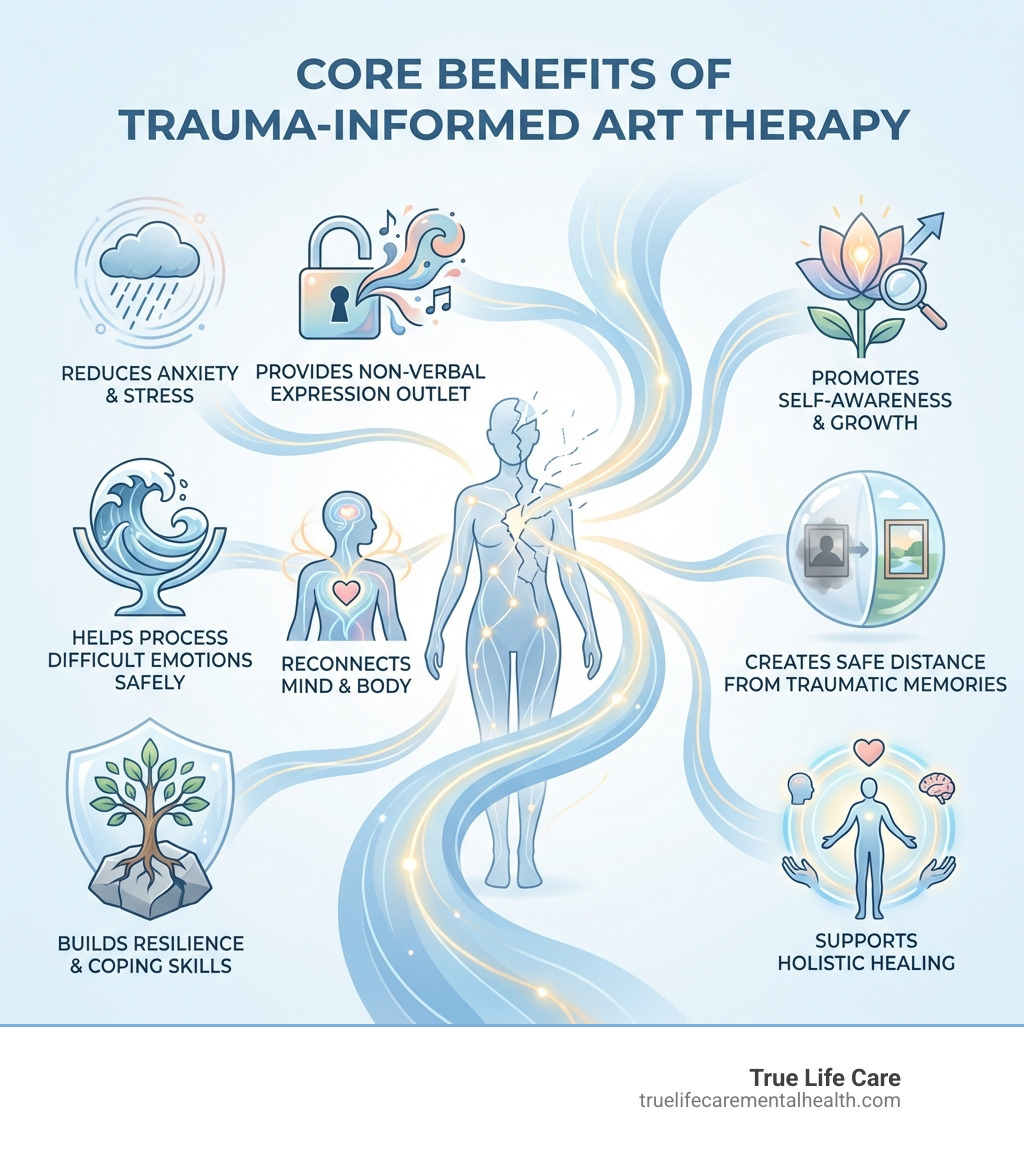
Trauma can impact the brain’s language centers, making it difficult to talk about. Art therapy offers a non-verbal way to process these experiences. It allows you to:
- Express complex emotions and memories without words.
- Access pre-verbal or deeply buried memories.
- Work with trauma stored as images and physical sensations.
- Create a safe distance from painful events by externalizing them into art.
This process helps you understand and manage feelings that are hard to articulate.
Is art therapy just for children?
No, art therapy is effective for all ages, from children to adults and veterans. The techniques are adapted to suit the individual’s needs, making it a valuable tool for anyone seeking healing and recovery. We use specific art therapy activities for anxiety and PTSD that are highly beneficial for adults and teens.
Begin Your Creative Path to Recovery
Trauma-informed art therapy activities offer a profound and accessible pathway to healing. By providing a non-verbal outlet for expression, reconnecting the mind and body, and fostering resilience, art therapy is a powerful tool for personal growth and emotional well-being.
At True Life Care Mental Health, we believe in a holistic approach to healing. Our dedicated team in New Jersey and New York offers personalized, evidence-based mental health and addiction treatment programs. We integrate innovative therapies like art therapy into comprehensive treatment plans, empowering individuals for long-term recovery. If you or a loved one are seeking a path to mend minds with masterpieces, we invite you to explore our art therapy and trauma programs to learn more about how we can support your journey towards a more fulfilling life.
Frequently Asked Questions about Art Therapy for Trauma
We often hear common questions about trauma-informed art therapy activities. Let’s address some of them:
Do I need to be good at art to benefit from art therapy?
Absolutely not! This is one of the most common misconceptions about art therapy. We want to emphasize that no artistic skill is required to benefit from art therapy. The focus is entirely on the process of creation and self-expression, not on producing a masterpiece. Our therapists guide individuals through the creative process in a supportive and non-judgmental manner. Whether you draw stick figures or intricate designs, the act of putting your feelings onto paper or shaping clay is what facilitates healing. It’s about communicating what’s inside, not about artistic talent.
How does art therapy help when talking about trauma is too hard?
Art therapy is uniquely suited for individuals who struggle with verbalizing their traumatic experiences. Trauma can affect the brain’s language centers (Broca’s area), making it incredibly difficult to find words for what happened or how it feels. In these situations, art therapy provides a non-verbal pathway for expression:
- Bypasses Verbal Processing: Art allows individuals to express complex emotions, memories, and sensations without needing to articulate them verbally.
- Accesses Pre-Verbal Memories: Some traumatic memories are stored in a pre-verbal state, meaning they existed before language developed. Art can access and process these deeper, often implicit, memories.
- Uses Images and Sensations: Since trauma is often stored in the body as images and sensations, art provides a direct way to work with these experiences.
- Creates a Safe Distance: The artwork itself can create a “distancing effect,” allowing individuals to process painful memories with a degree of separation, making it feel less overwhelming.
- Externalizes Feelings: By externalizing emotions onto a canvas or into a sculpture, individuals can observe and understand their feelings from a new perspective, which can be less intimidating than confronting them head-on.
Art therapy can mitigate the trauma survivor’s need to speak about the trauma, using arts therapies that are also somatically based, which can help. It allows individuals to express feelings they may not be able to articulate.
Is art therapy just for children?
Definitely not! While art therapy is incredibly effective for children, its benefits extend to individuals of all ages, including adolescents, adults, and veterans. The techniques are adaptable and can be custom to meet the unique developmental and emotional needs of different age groups. For example, we use specific art therapy activities for anxiety and PTSD that are highly beneficial for adults and teens struggling with these conditions. The power of creative expression for healing is universal, offering a valuable tool for anyone on a journey of recovery, regardless of their age.
Begin Your Creative Path to Recovery
We’ve explored how trauma-informed art therapy activities offer a profound and accessible pathway to healing, especially for those navigating the complex landscape of trauma. From providing a non-verbal outlet for expression to reconnecting the mind and body, and fostering resilience, art therapy is a powerful tool for personal growth and emotional well-being. The powerful alliance of imagination in healing, creative interventions, and the use of art and play can transform trauma into growth.
At True Life Care Mental Health, we believe in a holistic approach to healing. Our dedicated team in New Jersey offers personalized, evidence-based mental health and addiction treatment programs. We integrate innovative therapies like art therapy into comprehensive treatment plans, empowering individuals for long-term recovery and well-being. If you or a loved one in New Jersey, including Bergen County NJ, Hunterdon County NJ, Mercer County NJ, Middlesex County NJ, Morris County NJ, Passaic County NJ, Sussex County NJ, Warren County NJ, Boonton NJ, Chester NJ, Clifton NJ, Clinton NJ, Fair Lawn NJ, Lake Hopatcong NJ, Montville NJ, Morris Plains NJ, Ringwood NJ, or in New York, NYC, are seeking a path to mend minds with masterpieces, we invite you to reach out.
We offer hope for recovery and the empowerment that comes from finding your inner strength through creative expression. Explore our art therapy and trauma programs to learn more about how we can support your journey towards healing and a more fulfilling life.