
Objective
This blog is meant for people who feel like they are holding everything together on the outside, but quietly struggling inside. It explains what depression without sadness can look like, how hidden anxiety and depression symptoms show up in daily life, and why it is important to take these signs seriously even when nothing seems “wrong” from the outside.
Key Takeaways
- You can be productive, social, and still deal with a real depression disorder.
- Not all depression looks like sadness. Sometimes it feels like emptiness or constant mental tiredness.
- Many anxiety and depression symptoms are easy to hide from others.
- People often ignore early signs because life still “works.”
- Support, including depression recovery programs, can help before things get worse.
Table Of Contents
- What Smiling Depression Actually Feels Like
- Why People Don’t Notice It
- Anxiety And Depression Symptoms That Stay Hidden
- The Small Changes That Add Up
- Why People Keep Pretending They’re Fine
- What Happens If It Keeps Going
- When You Should Stop Ignoring It
- How Depression Recovery Programs Can Help
- FAQs
- Conclusion
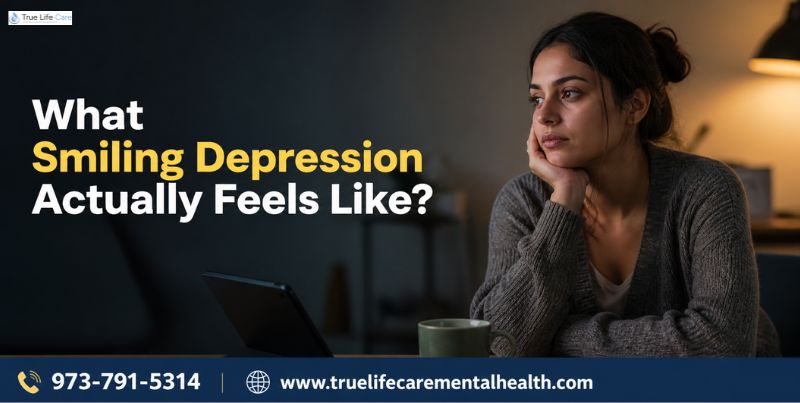
What Smiling Depression Actually Feels Like?
On paper, everything looks okay.
You get up. You go to work or school. You reply to messages. You show up when people expect you to. You laugh when it fits the moment.
Nothing is falling apart.
But something doesn’t feel right either.
There is a quiet heaviness that stays in the background. Not strong enough to stop you, but always there. You feel tired, even when you’ve slept. You don’t feel excited about things anymore, even the ones you used to enjoy.
You don’t always feel sad. That’s the confusing part.
This is why people call it depression without sadness.
It’s not dramatic. It’s not loud. It’s just… constant.
At True Life Care Mental Health, this kind of hidden struggle is often the one that gets overlooked the longest, because it blends so easily into daily life.
Why People Don’t Notice It?
Most people think depression looks obvious.
They expect someone to withdraw completely, cry often, or openly say they’re struggling.
But many people do the opposite.
They keep everything running.
They don’t cancel plans. They don’t stop working. They don’t talk about what’s going on.
From the outside, they look stable.
Because of that, people around them may not ask deeper questions. And even if they do, the answer is usually the same:
“I’m fine.”
That’s how depression disorder can stay hidden. Not because it isn’t serious, but because it doesn’t interrupt life in obvious ways at first.
Anxiety And Depression Symptoms That Stay Hidden
The early anxiety and depression symptoms are not always intense. They show up in ways that are easy to dismiss.
You might notice:
- Your mind doesn’t slow down, even when you want it to
- You feel tired most of the time, but not in a clear way
- You have trouble focusing on things that used to feel easy
- You feel disconnected during conversations
- You lose interest slowly, not suddenly
Nothing here feels urgent. That’s why it’s easy to ignore.
But when these things stick around, they start to shape how you experience your day.
The Small Changes That Add Up
Smiling depression is not one big moment. It’s a series of small changes that slowly become your norm.
You may start saying “I’m just tired” more often.
You may stop looking forward to things.
You may notice that even rest doesn’t fully recharge you.
You may feel like you’re going through the motions instead of actually being present.
These changes don’t stop you from functioning. But they make everything feel heavier.
Over time, that weight builds.
Why People Keep Pretending They’re Fine?
There isn’t always a clear reason.
Sometimes it’s a habit. Sometimes it’s fear. Sometimes it’s just easier.
People tell themselves:
- “It’s not that bad.”
- “I can handle it.”
- “Everyone feels like this sometimes.”
- “I don’t want to make it a big deal.”
And since life is still moving forward, it feels like there’s no reason to stop and question it.
But ignoring it doesn’t make it disappear. It just makes it easier for it to stay.

What Happens If It Keeps Going
At first, it’s manageable.
Then it becomes tiring.
Then it becomes normal.
That’s the part people don’t notice.
You stop comparing how you feel now to how you used to feel. You adjust to the lower energy, the lack of interest, the constant mental noise.
This is how depression settles in quietly.
You don’t break down. You just keep going, with less energy each time.
When You Should Stop Ignoring It?
There isn’t a perfect moment to decide that something is serious.
But there are signs that it’s time to pay attention.
If you feel like:
- You’re always tired, no matter what
- You don’t enjoy things the way you used to
- Your thoughts feel heavier than usual
- You’re just “getting through” each day
- You don’t feel like yourself anymore
That’s enough.
You don’t need a crisis to take your feelings seriously.
Those are real anxiety and depression symptoms, even if they don’t look extreme.
How Depression Recovery Programs Can Help?
Many people wait until things get worse before asking for help.
But support doesn’t have to come that late.
Depression recovery programs are not only for severe cases. They are also for people who feel stuck, tired, or disconnected and don’t know why.
They help by giving you space to talk honestly without needing to pretend.
They help you understand patterns in your thinking.
They help you rebuild simple routines that bring back a sense of stability.
Most importantly, they remind you that what you’re feeling is not something you have to carry alone.
At True Life Care Mental Health, this kind of early support is seen as important, especially for people who are used to handling everything on their own.
Smiling Depression: Suffering in Silence Every Day
Hiding pain behind a smile can make daily life exhausting and isolating. Many silently struggle while appearing fine to others. Recognizing these hidden emotions is the first step toward healing. Support, understanding, and the right help can make a real difference.
Get Started NowFAQs
What Is Smiling Depression In Simple Terms?
It’s when you appear okay on the outside, but inside you feel low, tired, or disconnected. It’s a type of depression disorder that doesn’t always show obvious signs.
Can You Have Depression Without Feeling Sad?
Yes. Depression without sadness is very real. Many people feel empty or emotionally flat instead of clearly sad.
What Are Early Anxiety And Depression Symptoms?
Early anxiety and depression symptoms often include constant tiredness, overthinking, lack of focus, and loss of interest in daily life.
Why Do People Ignore These Signs?
Because life still works. They can still show up, complete tasks, and meet expectations, so it doesn’t feel serious enough to act on.
Do Depression Recovery Programs Really Help?
They can help you understand what you’re feeling, reduce mental pressure, and build routines that make daily life easier.
When Should Someone Reach Out For Help?
When things feel off for weeks, or when you no longer feel like yourself. You don’t need to wait until it gets worse.
Conclusion
Smiling depression is difficult to recognize because nothing clearly breaks. Life continues. Responsibilities are handled. Conversations happen. From the outside, everything looks steady. But inside, there can be a quiet struggle that doesn’t go away. It shows up as constant tiredness, lack of interest, and a feeling that something isn’t right, even if you can’t explain it. This is what makes depression without sadness so easy to ignore and so important to notice. The fact that you are still functioning does not mean you are okay. It just means you have learned how to keep going while carrying more than you should. Recognizing these anxiety and depression symptoms early can help prevent them from becoming heavier over time. Support, including depression recovery programs, can help you understand what you’re feeling and slowly bring back a sense of balance. True Life Care Mental Health emphasizes that even when struggles are not visible, they are still real and deserve attention.
Just because nothing looks broken doesn’t mean everything is okay, sometimes the struggle is simply hidden.